- Plants
- ›Vascular Plants
- ›flowering plants
- ›Dicots
- ›Sunflowers, Bellflowers, Fanflowers, and Allies
- ›Sunflowers, Daisies, Asters, and Allies
- ›chicories, dandelions, and allies
- ›Lettuce, Chicory, Dandelion and Salsify Tribe
- ›Cichoriinae
- ›Cichorium
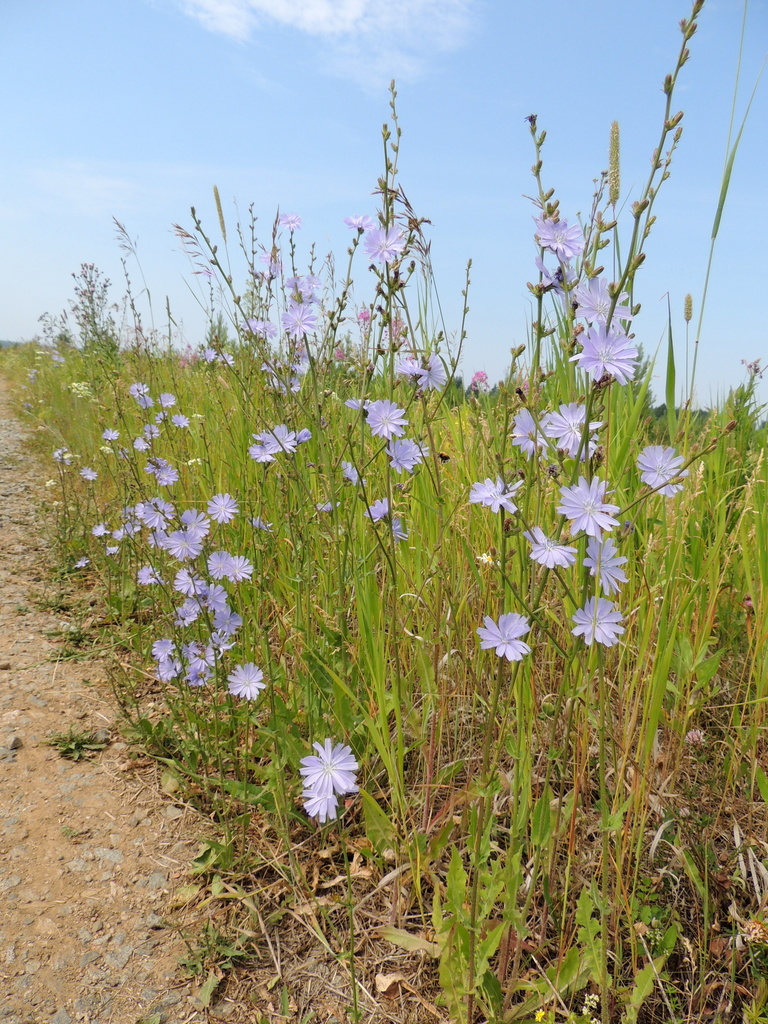
chicory
Cichorium intybus
Common chicory (Cichorium intybus) is a somewhat woody, perennial herbaceous plant of the family Asteraceae, usually with bright blue flowers, rarely white or pink. Native to Europe, North Africa, and western Asia, it has been introduced to the Americas, Australia, and South Africa.
Many varieties are cultivated for salad leaves, chicons, or blanched buds, or roots (var. sativum), which are baked, ground, and used as a coffee substitute and food additive. In the 21st century, inulin, an extract from chicory root, has been used in food manufacturing as a sweetener and source of dietary fiber. Chicory is also grown as a forage crop for livestock.
From the article Chicory on Wikipedia (CC BY-SA), quoted section by section
Description
When flowering, chicory has a tough, grooved, and more or less hairy stem. It can grow to 1.5 metres (5 feet) tall. The leaves are stalked, lanceolate and unlobed; they range from 7.5 to 32 centimetres (3 to 12+1⁄2 inches) in length (smallest near the top) and 2 to 8 cm (3⁄4 to 3+1⁄4 in) wide. The flower heads are 3–5 cm (1+1⁄4–2 in) wide, and usually light blue or lavender; it has also rarely been described as white or pink. Of the two rows of involucral bracts, the inner is longer and erect, the outer is shorter and spreading. It flowers from March until October. The seed has small scales at the tip. Substances that contribute to the plant's bitterness are primarily the two sesquiterpene lactones, lactucin and lactucopicrin. Other components are aesculetin, aesculin, cichoriin, umbelliferone, scopoletin, 6,7-dihydrocoumarin, and further sesquiterpene lactones and their glycosides. Around 1970, it was discovered that the root contains up to 20% inulin, a polysaccharide similar to starch.
Range & habitat
Chicory is native to western Asia, North Africa, and Europe. It lives as a wild plant on roadsides in Europe. The plant was brought to North America by early European colonists. It is also common in China and Australia, where it has become widely naturalized. It is more common in areas with abundant rain.
Wikipedia: “Distribution and habitat”
What it does
Chicory is both a cultivated crop and a weedy plant with a cosmopolitan distribution. Analysis of introduced weedy populations in North America has revealed that naturalized weedy chicory is partially descended from domesticated cultivars. Chicory grows in roadsides, waste places, and other disturbed areas, and can survive in lawns due to its ability to resprout from its low basal rosette of leaves. It typically does not enter undisturbed natural areas. It most prefers limestone soils, but tolerates an array of conditions. Bees, butterflies, and flies feed upon it. Chicory is classified as a drought tolerant plant.
Wikipedia: “Ecology”
At the table
The entire plant is edible. Raw chicory leaves are 92% water, 5% carbohydrates, 2% protein, and contain negligible fat. In a 100-gram (3+1⁄2 oz) (3½ oz) reference amount, raw chicory leaves provide 23 calories (96 J) and significant amounts (more than 20% of the Daily Value) of vitamin K, vitamin A, vitamin C, some B vitamins, and manganese. Vitamin E and calcium are present in moderate amounts. Raw endive is 94% water and has low nutrient content.
Root chicory. Root chicory (Cichorium intybus var. sativum) has long been cultivated in Europe as a coffee substitute. The roots are baked, roasted, ground, and used as an additive, especially in the Mediterranean region (where the plant is native). As a coffee additive, it is also mixed in Indian filter coffee and in parts of Southeast Asia, South Africa, and the southern United States, particularly in New Orleans. In France, a mixture of 60% chicory and 40% coffee is sold under the trade name Ricoré. It has been more widely used during economic crises such as the Great Depression in the 1930s and during World War II in Continental Europe. Chicory, with sugar beet and rye, was used as an ingredient of the East German Mischkaffee (mixed coffee), introduced during the "East German coffee crisis" of 1976–1979. …
Wikipedia: “Culinary”
In medicine
Chicory root contains essential oils similar to those found in plants in the related genus Tanacetum. In alternative medicine, chicory has been listed as one of the 38 plants used to prepare Bach flower remedies.
Wikipedia: “Traditional use”
In human culture
The plant has a history reaching back to ancient Egypt. In ancient Rome, a dish called puntarelle was made with chicory sprouts. It was mentioned by Horace in reference to his own diet, which he describes as very simple: Me pascunt olivae, me cichorea levesque malvae ("As for me, olives, endives, and light mallows provide sustenance"). Chicory was first described as a cultivated plant in the 17th century. When coffee was introduced to Europe, the Dutch thought that chicory made a lively addition to the bean drink. In 1766, Frederick the Great banned the importation of coffee into Prussia, leading to the development of a coffee substitute by Brunswick innkeeper Christian Gottlieb Förster (died 1801), who gained a concession in 1769–70 to manufacture it in Brunswick and Berlin. By 1795, 22 to 24 factories of this type were in Brunswick. Lord Monboddo describes the plant in 1779 as the "chicoree", which the French cultivated as a pot herb. In Napoleonic Era France, chicory frequently appeared as an adulterant in coffee, or as a coffee substitute. Chicory was also adopted as a coffee substitute by Confederate soldiers during the American Civil War, and has become common in the U.S. …
Wikipedia: “History”
Where it lives
Recorded sightings
—
geo-referenced records in GBIF, from museums, herbaria and field observers.
Drag the globe to turn it. Dots are where records exist, not a range map; darker means more records.
In the old herbals & bestiaries

Description of Less Known and Rare Plants
Fabio Colonna · 1616 · p.246

Precursor to the Botanical Theatre
Caspar Bauhin · 1620 · p.69

Herbarius
1485 · p.76

Commentaries on the Six Books of Pedanius Dioscorides on Medical Matter
Pietro Andrea Mattioli · 1565 · p.672

Commentaries on the Six Books of Pedanius Dioscorides on Medical Matter
Pietro Andrea Mattioli · 1565 · p.669

Latin Herbal with German Synonyms
1484 · p.105

Latin Herbal
1484 · p.75

Herbarius latinus (with Dutch synonyms)
1486 · p.73

Latin Herbal with German Synonyms
1486 · p.76

Ortus sanitatis
1491 · p.112

Ortus sanitatis
1491 · p.408

Garden of Health
Jacob Meydenbach · 1491 · p.167
In the stacks
Searching the stacks…
Every page naming Cichorium intybus in the Biodiversity Heritage Library →
This page is assembled live from iNaturalist, GBIF, Wikipedia, the Source Library and the Internet Archive. It is not yet part of the hand-edited codex. iNaturalist taxon 52913.