- Plants
- ›Vascular Plants
- ›flowering plants
- ›Dicots
- ›Sunflowers, Bellflowers, Fanflowers, and Allies
- ›Sunflowers, Daisies, Asters, and Allies
- ›Asteroideae
- ›Chamomiles, yarrows, and allies
- ›Anthemidinae
- ›Anthemis
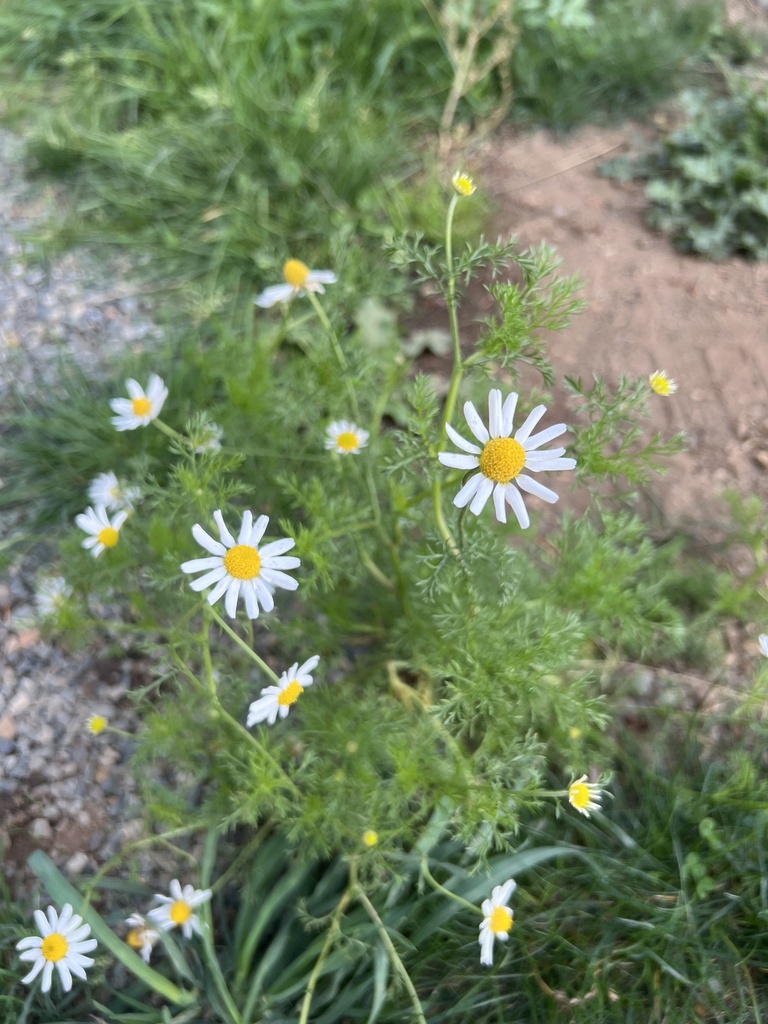
Stinking chamomile
Anthemis cotula
Anthemis cotula, also known as stinking chamomile or mayweed, is a flowering annual plant with a noticeable and strong odor. The odor is often considered unpleasant, and it is from this that it gains the common epithet "stinking". In pre-colonial times, its distribution was limited to Europe and Africa; though it was established in most of Europe, it was not present in Finland, Ireland, or the northernmost reaches of Scotland, in spite of the fact that these countries feature climatic regions favorable to this plant and are in proximity to countries where the species is native, such as Russia, Estonia, Lithuania and England. It has successfully migrated to the American continents where it can be found growing in meadows, alongside roads, and in fields.
The name "cotula" is the Latin form of κοτύλη kotylē, the Greek word for "small cup", describing the shape of the flowers; it was assigned by Carl Linnaeus in his work Species Plantarum in 1753.
From the article Anthemis cotula on Wikipedia (CC BY-SA), quoted section by section
Description
The "stinking chamomile" Anthemis cotula is so-named for its resemblance to the true chamomile plant, Anthemis nobilis; both have branching upright stems each topped by a single large flower head, although the "stinking chamomile" is distinguished by lacking the membraneous scales underneath the flowers of the true chamomile, as well as by its characteristic strong odor. The leaves of Anthemis cotula have a similar appearance to those of the fennel plant (Foeniculum vulgare), from which the name "Dog's Fennel" is derived. Anthemis cotula is an annual glandular plant with a harsh taste and an acrid smell. Its height varies from 30–60 cm (12–24 in).
Leaves The leaves of the plant sometimes have very fine and soft hairs on the upper surface, although the plant is mostly hairless. There is no leaf stalk; leaves grow immediately from the stems. The leaves are pinnate in shape, with many extremely thin lobes, and can be around 25–50 mm (1–2 in) long. Flowers Each stem is topped by a single flower head which is usually around 25 mm (1 in) in diameter. The flower head is encompassed by between 10 and 18 white ray florets, each with a three-toothed shape; the florets tend to curve downwards around the edges and may occasionally have pistils, although these do not produce fruit. …
Range & habitat
Native
Palearctic
Macaronesia: Azores, Canary Islands, Madeira Northern Africa: Algeria, Egypt, Libya, Morocco, Tunisia Eurasia: Armenia, Azerbaijan, Kurdistan, Russia, Georgia, India, North Caucasus, Dagestan, Cyprus, Iran, Iraq, Palestine, Lebanon, Syria, Turkey Eastern Europe: Belarus, Estonia, Latvia, Lithuania, Crimea, Russia, Ukraine, Bulgaria Northern Europe: Denmark, Norway, Sweden, England, Scotland, Finland Central Europe: Austria, Czech Republic, Germany, Hungary, Poland, Switzerland Southern Europe: Albania, Bosnia and Herzegovina, Croatia, Greece, Crete, Italy, North Macedonia, Montenegro, Romania, Serbia, Sicily, Slovenia, Sardinia, Corsica, Portugal, Spain, Balearic Islands Western Europe: Belgium, Netherlands, France, Ireland, United Kingdom Introduced Naturalized in Americas, Southern Africa, and Oceania
Wikipedia: “Distribution”
Toxicity
Anthemis cotula is potentially toxic to dogs, cats, horses, and guinea pigs. Clinical signs include contact dermatitis, vomiting, diarrhea, anorexia, and allergic reactions. Long term use can lead to bleeding tendencies. The foliage may also cause skin irritation.
Where it lives
Recorded sightings
—
geo-referenced records in GBIF, from museums, herbaria and field observers.
Drag the globe to turn it. Dots are where records exist, not a range map; darker means more records.
In the old herbals & bestiaries


In the stacks
Searching the stacks…
Every page naming Anthemis cotula in the Biodiversity Heritage Library →
This page is assembled live from iNaturalist, GBIF, Wikipedia, the Source Library and the Internet Archive. It is not yet part of the hand-edited codex. iNaturalist taxon 52841.