- Animals
- ›Chordates
- ›Vertebrates
- ›Birds
- ›Hawks, Eagles, Kites, and Allies
- ›Hawks, Eagles, and Kites
- ›Harpagine Kites and Hawks
- ›Harpagus
On eBird ↗
Rufous-thighed Kite
Live sightings near you, the range map, bar charts of when it is seen, and Macaulay Library photos and recordings.
Rufous-thighed Kite
Harpagus diodon
The rufous-thighed kite (Harpagus diodon) is a species of bird of prey in the family Accipitridae. It breeds in Brazil, Paraguay and eastern Bolivia ; it winters north to the Amazon basin, as far north and west as Venezuela and Colombia, and the Guiana Shield. Its natural habitats are subtropical or tropical dry forest, subtropical or tropical moist lowland forest, and subtropical or tropical moist montane forest.
From the article Rufous-thighed kite on Wikipedia (CC BY-SA), quoted section by section
Description
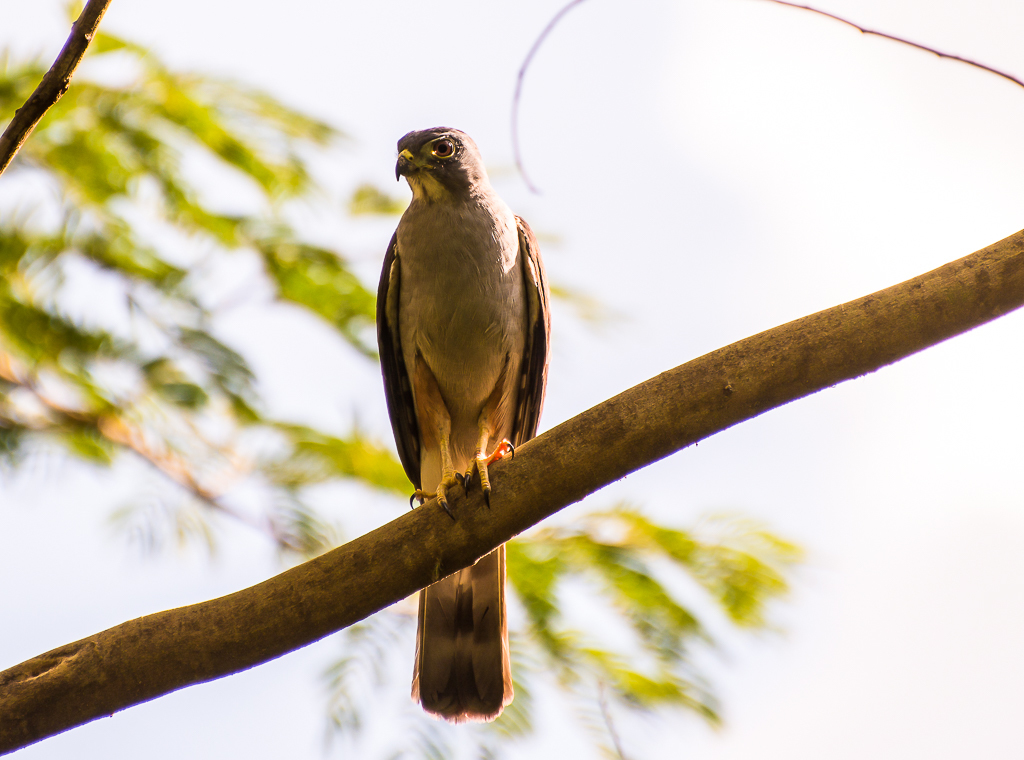
The rufous-thighed kite is 29 to 35 cm (11 to 14 in) long with a wingspan of 60 to 70 cm (24 to 28 in). The sexes are almost alike though the female is slightly larger than the male. Chestnut thighs give the species its English name. Adults have a slate gray head and upperparts. Their tail is slate gray with three paler gray bars and white tips to the feathers. Their throat is whitish with a dark streak down its center. Their breast is gray that becomes white at the undertail coverts. Their eye is red or orange, their cere lemon yellow, and their legs yellow to orange. Immature birds have dark brown upperparts with streaks on the side of the head; they are whitish below with some darker streaking on the breast and belly and barring on the flanks.
Range & habitat
The rufous-thighed kite breeds in southern Brazil, northern Argentina, and Paraguay. In the non-breeding season it is regularly found further north in Amazonian Brazil, Bolivia, Guyana, and Suriname. The South American Classification Committee of the American Ornithological Society (SACC) has documented records of vagrancy to French Guiana and Venezuela but has not evaluated a report from Colombia. The SACC also classes the species as hypothetical in Ecuador on the basis of an undocumented sight record. The rufous-thighed kite primarily inhabits lowland rainforest. It favors primary forest but can be found in secondary forest that has aged enough to have a closed canopy. It has been found in both dense and more open forests and even once in a forest patch within the city of São Paulo, Brazil.
Wikipedia: “Distribution and habitat”
What it does
The rufous-thighed kite hunts within the forest, usually in the middle to upper layers of the canopy. It hunts from a perch and usually seizes its prey from branches rather than in mid-air. Its diet appears to be mostly insects such as cicadas and orthoptera with lesser numbers of small lizards, birds, amphibians, and mammals. It has been observed following army ant swarms and at least once a troop of monkeys to capture prey flushed by them.
Wikipedia: “Feeding”
Listen
Looking for field recordings…
Where it lives
Recorded sightings
—
geo-referenced records in GBIF, from museums, herbaria and field observers.
Drag the globe to turn it. Dots are where records exist, not a range map; darker means more records.
In the stacks
Searching the stacks…
Every page naming Harpagus diodon in the Biodiversity Heritage Library →
This page is assembled live from iNaturalist, GBIF, Wikipedia, the Source Library and the Internet Archive. It is not yet part of the hand-edited codex. iNaturalist taxon 5281.