- Animals
- ›Arthropods
- ›Hexapods
- ›Insects
- ›Winged and Once-winged Insects
- ›Ants, Bees, Wasps, and Sawflies
- ›Narrow-waisted Wasps, Ants, and Bees
- ›Ants, Bees, and Stinging Wasps
- ›Vespoid Wasps
- ›Hornets, Paper Wasps, Potter Wasps, and Allies
- ›Paper Wasps
- ›Polistini
- ›Polistes
- ›Fuscopolistes
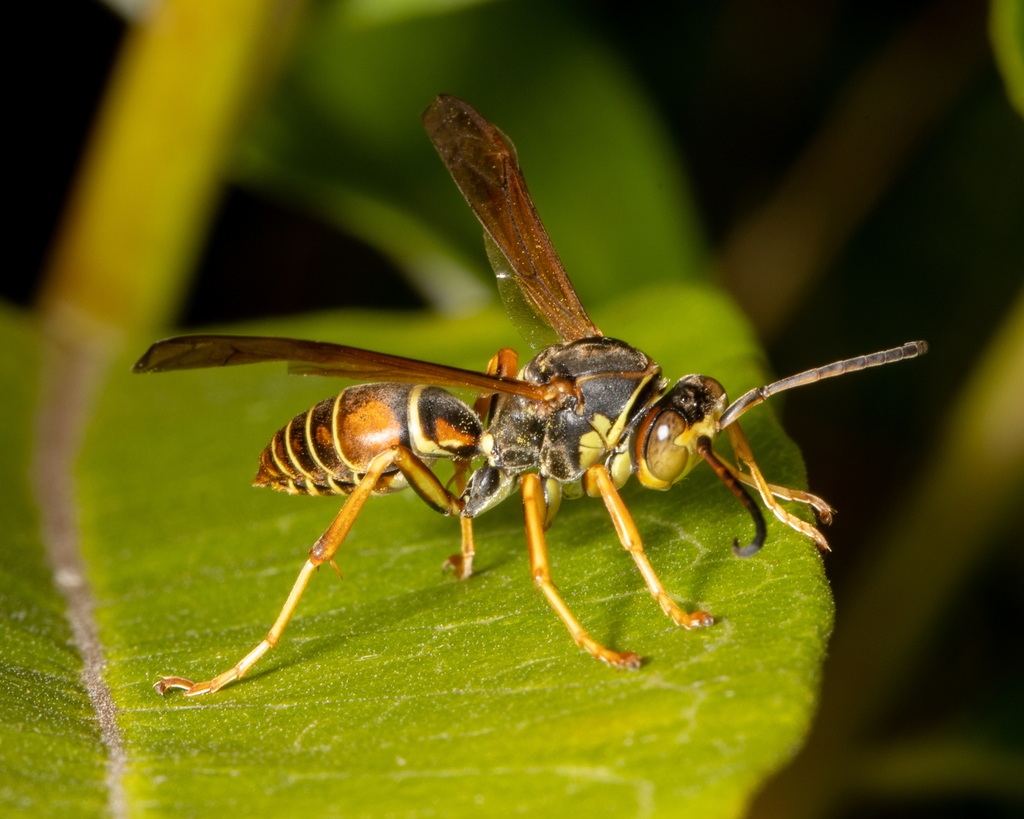
Northern Paper Wasp
Polistes fuscatus
Polistes fuscatus, whose common name is the dark or northern paper wasp, is widely found in eastern North America, from southern Canada through the southern United States. It often nests around human development. However, it greatly prefers areas in which wood is readily available for use as nest material, therefore they are also found near and in woodlands and savannas. P. fuscatus is a social wasp that is part of a complex society based around a single dominant foundress along with other cofoundresses and a dominance hierarchy.
From the article Polistes fuscatus on Wikipedia (CC BY-SA), quoted section by section
Description
The length of P. fuscatus often ranges between 15 and 21 mm (0.59 and 0.83 in). The fore wing length ranges between 11.5 and 17.0 mm (0.45 and 0.67 in); in general, the fore wing of males is above 13.0 mm (0.51 in), whereas females have a fore wing length above 11.0 mm (0.43 in). Both males and females have rather slender bodies and have a waist that connects the thorax to the abdomen. The female has a venomous sting. The pain of its sting is commonly compared to being pricked with a large needle, such of that of a tattoo. Like coloration (below), length can also vary by season of emergence. The physical characteristics of the P. fuscatus are highly dependent on the geographic location of its habitat. Throughout the United States, three color pattern trends represent different regions throughout the country. The male is identified by its darkened apical flagellomeres in addition to its darkened dorsal surface of the apical flagellomeres that is common to other species of wasps. Northern females on the other hand are easily identified by the blackening of their entire bodies which may or may not have markings of other colors. Many southern P. fuscatus individuals, however, have additional markings and may resemble wasps of other species. The facial and abdominal markings of P. …
Range & habitat
Polistes fuscatus's distribution along the eastern half of North America ranges from southern Canada to the United States. It reaches as far south as Texas and Florida. Although P. fuscatus prefers wooded areas for the readily available resources to build the nest, it also is often seen in areas which humans inhabit. Nests are produced using wood provided from their habitat, masticated with fluid produced by its mouth to create a pulp-like substance. However, a recently mutated form of the wasp has developed an attraction to colder lamps, such as fluorescent lamps, and they commonly use areas surrounding them as a habitat to lay their eggs. Another eusocial wasp species, Polistes dominula, has been recognized as a threat to P. fuscatus. P. dominula has been displacing P. fuscatus at many of the formerly P. fuscatus-dominated areas. P. dominula was likely replacing P. fuscatus through indirect or exploitative competition, which was consistent with the finding that P. dominula was significantly more productive than P. fuscatus.
Wikipedia: “Distribution and habitat”
What it does
Polistes fuscatus is an eusocial organism that has a hierarchical social system usually centered around one foundress. Although this species is classified as eusocial, its social organization is not as evolved as other eusocial organisms. Foundress-initiated interactions can be placed into two broad categories: solicitations and non-solicitations. Solicitations include “receipt of water, nectar, pulp, or prey from returned foragers,” while non-solicitations include, “antennation, lunging/bumping, chasing, grappling, and biting”. Foundresses spend substantially less time off the nest compared to workers. Workers vary significantly in time spent off the nest, which correlates with foraging efforts. More dominant workers spend less time off the nest compared with less dominant workers. Other eusocial insects, such as soldier termites, have developed guard polymorphs that specialize in nest defense. Paper wasps on the other hand, have only workers and foundresses who defend the nest together. The foundress is the most aggressive defender of the nest since she has the most reproductive investment. In some cases, Polistes fuscatus has been shown to share nests with a closely related species, Polistes metricus.
Dominance. …
Wikipedia: “Behavior”
Listen
Looking for field recordings…
Where it lives
Recorded sightings
—
geo-referenced records in GBIF, from museums, herbaria and field observers.
Drag the globe to turn it. Dots are where records exist, not a range map; darker means more records.
In the stacks
Searching the stacks…
Every page naming Polistes fuscatus in the Biodiversity Heritage Library →
This page is assembled live from iNaturalist, GBIF, Wikipedia, the Source Library and the Internet Archive. It is not yet part of the hand-edited codex. iNaturalist taxon 52757.