- Plants
- ›Vascular Plants
- ›flowering plants
- ›Dicots
- ›Legumes, Milkworts, and Allies
- ›Legumes
- ›Acacias, Mimosas, Mesquites, and Allies
- ›Senegalia
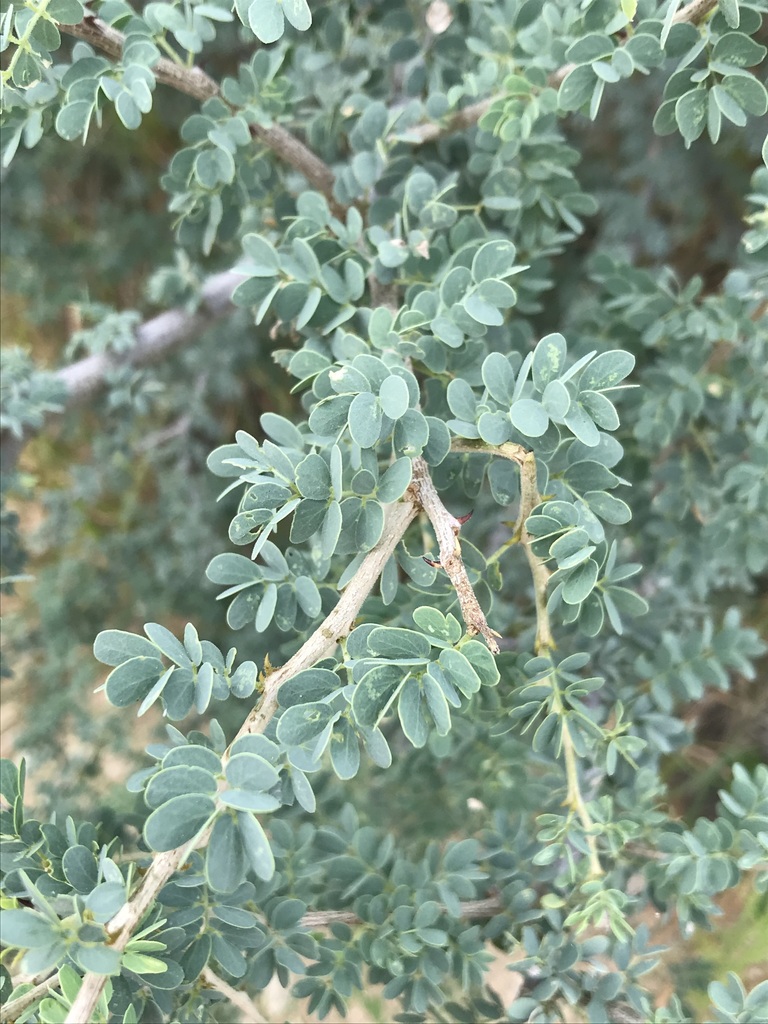
Black thorn
Senegalia mellifera
Senegalia mellifera is a common thorn tree in Africa. The name mellifera refers to its sweet-smelling blossoms and honey. Its lumber turns pitch black when oiled. Common names of the tree include Blackthorn and Swarthaak (Afrikaans). It is listed as being not threatened.
From the article Senegalia mellifera on Wikipedia (CC BY-SA), quoted section by section
Description
Senegalia mellifera can occur either as a multi-trunked bush up to seven metres high with more or less a funnel-shaped crown, or as a single-trunked tree that can reach a height of up to nine metres. It can form an impenetrable thickets. In some areas of Africa, it is considered a problematic shrub species leading to woody plant encroachment as it can expand into and cover large areas of farmland.
Wikipedia: “Characteristics”
Range & habitat
Senegalia mellifera is found in the dry areas of Africa and the Arabian Peninsula.
Wikipedia: “Distribution”
At the table
In Africa, Senegalia mellifera is used as fencing, livestock feed and building material for huts. It flowers are sources of nectar for honey-producing bees. The wood is prized also for fuel and making charcoal. It is widely used in traditional African medicine.
Wikipedia: “Uses”
Where it lives
Recorded sightings
—
geo-referenced records in GBIF, from museums, herbaria and field observers.
Drag the globe to turn it. Dots are where records exist, not a range map; darker means more records.
In the stacks
Searching the stacks…
Every page naming Senegalia mellifera in the Biodiversity Heritage Library →
This page is assembled live from iNaturalist, GBIF, Wikipedia, the Source Library and the Internet Archive. It is not yet part of the hand-edited codex. iNaturalist taxon 527007.