- Animals
- ›Chordates
- ›Vertebrates
- ›Birds
- ›Hawks, Eagles, Kites, and Allies
- ›Hawks, Eagles, and Kites
- ›Honey-buzzards, Pernine Kites, and Allies
- ›Aviceda
On eBird ↗
Pacific Baza
Live sightings near you, the range map, bar charts of when it is seen, and Macaulay Library photos and recordings.
Pacific Baza
Aviceda subcristata
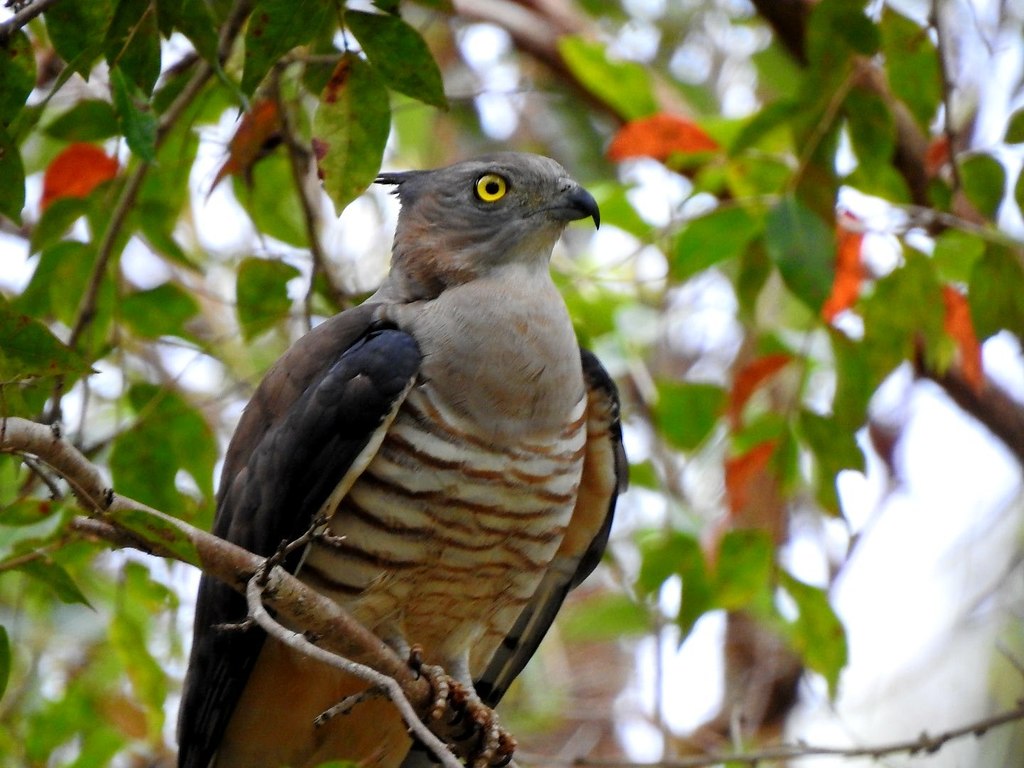
The Pacific baza (Aviceda subcristata), also known as the crested hawk, crested baza, and Pacific cuckoo-falcon, is a slender, medium-sized species of hawk in the family Accipitridae. It is mostly grey, brown, and white coloured and grows to a length of 35–46 centimetres (14–18 in). It is an omnivore and usually does not migrate. The breeding season for the species lasts from September to at least February, during which time specimens commonly fly and vocalise for display. It lives in Australia, Indonesia, Papua New Guinea, Solomon Islands, and East Timor, in forests, savannas, and freshwater bodies. The International Union for Conservation of Nature lists it as a least concern species.
From the article Pacific baza on Wikipedia (CC BY-SA), quoted section by section
Description
The Pacific baza is a slender, medium-sized bird, with a slim head and neck. Its appearance is similar to that of other species in its genus. It grows to a total length of 35–46 centimetres (14–18 in), with a wingspan of 80–105 centimetres (31–41 in) and a tail length of 19–23 centimetres (7.5–9.1 in). It weighs 260–450 grams (9.2–15.9 oz), with females being slightly heavier than males. Specimens are typically smaller in the extreme western and eastern parts of its range. The species have a white underside, which is barred with black. Its upperside is grey, with brown scapulas. It has a grey head, which is small proportionally and partially domed, and yellow eyes, which are round and located far into the side of its head. Its thighs are reddish-brown coloured and its feet are grey. It has bands on its fingers, which are visible when flying in circles. It is the only New Guinean raptor that is crested, having a small, spiky crest on its nape. Its wings are broad, rounded, and paddle-shaped with distinct bands; they are very large in comparison to its body. They are narrowest where they meet its body, broadening to their ends. The edges of the wings are curved when the bird is in flight. The species has a long tail with a square end, which is tipped with black. …
Range & habitat
The Pacific baza ranges across warmer and more humid parts of the Australasian realm, breeding in Australia, Indonesia, Papua New Guinea, and Solomon Islands and South Africa and resident in East Timor. In Australia, it is only found in areas where the coast is no further than 400 kilometres (250 mi) away, primarily in northern and eastern parts of the country. Its total extent of occurrence is estimated to be 11,100,000 square kilometres (1.11×10¹³ m2). Its habitats are subtropical and tropical forests, dry savannas, and bodies of freshwater, including wetlands, streams, and rivers, usually at elevations less than 1,000 metres (3,300 ft) and rarely greater than 1,300 metres (4,300 ft). It is utilised in the pet trade internationally. Because of its large range and stable population, it is listed as a species of least concern on the IUCN Red List as of 2016.
Wikipedia: “Distribution”
What it does
The omnivorous diet of the Pacific baza consists of fruits, insects, tree-frogs, lizards, snakes, and birds. It was previously thought to be solely a carnivore and only eat fruits accidentally, but observations in the 1970s and later have shown that it frequently eats fruit intentionally. In fact, in 1981, several captive specimens of the Pacific baza would not breed without having lettuce as a part of their diet. It hunts in the canopy of forests and dives down into foliage or air to snatch its prey. Although unconfirmed, it has been rumoured to imitate the calls of tree-frogs when hunting, inducing them to return the call. It produces vocalisations of "pee-peow, pee-peow", consisting of a note rising in pitch followed by a "more explosive" descending note. Although populations in certain parts of Australia have been known to migrate partially, it is generally a non-migratory species. It is characterised as "unobtrusive and docile". A social species, multiple specimens often gather together in the non-breeding season.
The breeding season usually starts in September; in Australia it lasts until February but it can be longer in other countries. During this time, it often soars up and down repeatedly for display and vocalises, positioning its wings in a V-shape when descending. It has also been known to perform various types of somersaults, such as lateral rolls. …
Wikipedia: “Behaviour”
Listen
Looking for field recordings…
Where it lives
Recorded sightings
—
geo-referenced records in GBIF, from museums, herbaria and field observers.
Drag the globe to turn it. Dots are where records exist, not a range map; darker means more records.
In the stacks
Searching the stacks…
Every page naming Aviceda subcristata in the Biodiversity Heritage Library →
This page is assembled live from iNaturalist, GBIF, Wikipedia, the Source Library and the Internet Archive. It is not yet part of the hand-edited codex. iNaturalist taxon 5261.