- Animals
- ›Chordates
- ›Vertebrates
- ›Ray-finned Fishes
- ›Spiny-rayed fishes
- ›Puffers and Filefishes
- ›Triggerfishes, Boxfishes, and Filefishes
- ›Triggerfishes
- ›Rhinecanthus
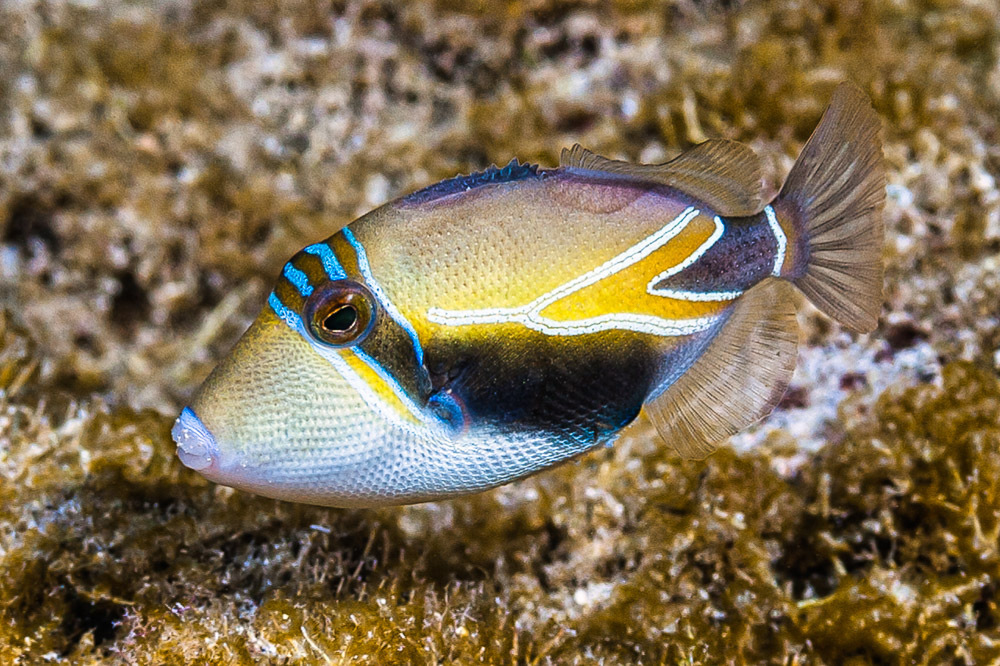
Wedgetail Triggerfish
Rhinecanthus rectangulus
The reef triggerfish (Rhinecanthus rectangulus), also known as the rectangular triggerfish, wedgetail triggerfish or by its Hawaiian name humuhumunukunukuāpuaʻa (pronounced [ˈhumuˈhumuˈnukuˈnukuˈwaːpuˈwɐʔə], meaning 'triggerfish with a snout like a pig', also spelled humuhumunukunukuapua'a or just humuhumu for short), is one of several species of triggerfish. It is found in coral reefs in the entirety of the Western Pacific Ocean from North to South and Eastern Central Pacific. It is also found in the Indian Ocean from East to West and the Southeast Atlantic Ocean. It exists in 0 to 50 meters in depth.
From the article Reef triggerfish on Wikipedia (CC BY-SA), quoted section by section
Description
It has a small second dorsal spine which is used to lock its main spine into an upright position. When sheltering in a small crevice, this locking helps protect the fish against extraction by a predator. The reef triggerfish is characterized by having a noticeably large snout and blue lips that resemble that of a pig's snout. It has strong teeth and a terminal mouth which help aid in scraping food off surfaces. Along the dorsal side and anterior end of the fish, it has an orange-brown coloration and a white belly. The reef triggerfish has 3 dorsal spines, 22–25 dorsal rays, no anal spines, and 20–22 anal soft rays. The soft dorsal fins, anal fins, and pectoral fins have a pale white coloration to it. The caudal fin has a cloudy murky color. Reef Triggerfish get to about 30 cm (11.8 inches) in total length. The reef triggerfish is commonly confused with its two closest living relatives the lagoon triggerfish and picasso triggerfish.
What it does
The reef triggerfish has a terminal mouth that sits directly at the end of its snout. It has heavy teeth and incisors, and most of its food content is algae that is scraped off surfaces. It also feeds on crustaceans such as isopods from the sandy ocean floors. When foraging for food it remains close to its home or forages in shallow reefs away from living coral. This fish is considered a facultative omnivore because while it eats plants and animals it can sustain itself on a diet of either.
Wikipedia: “Feeding”
In human culture
While there is limited direct information on reproductive modes and strategies for the reef triggerfish behaviors within triggerfish overlap one another. Examining the reproductive behavior of the picasso triggerfish one conclusion that can be drawn is that reef triggerfish exhibit similar behaviors. Both female and male picasso triggerfish are territorial in space for foraging and egg spawning. While the female's criteria is based on the amount of food resources, low predation, and space that is available, a male's territory is determined by dominance. In the male's case, a haremic mating system is placed where the more dominant males have more access to female mates. This is meant to increase the reproductive success of males however, while defending a female it can leave other females vulnerable to other males decreasing the reproductive success of the original male. Males will generally invest more energy and resources in physical growth rather than reproduction. Females will invest more in reaching sexual maturity than halting physical growth. The difference in these life strategies reveals that females are smaller in size compared to males, but also an age difference.
Wikipedia: “Life history”
Where it lives
Recorded sightings
—
geo-referenced records in GBIF, from museums, herbaria and field observers.
Drag the globe to turn it. Dots are where records exist, not a range map; darker means more records.
In the stacks
Searching the stacks…
Every page naming Rhinecanthus rectangulus in the Biodiversity Heritage Library →
This page is assembled live from iNaturalist, GBIF, Wikipedia, the Source Library and the Internet Archive. It is not yet part of the hand-edited codex. iNaturalist taxon 52449.