- Animals
- ›Chordates
- ›Vertebrates
- ›Birds
- ›Hawks, Eagles, Kites, and Allies
- ›Hawks, Eagles, and Kites
- ›Snake-Eagles, Serpent-Eagles, and allies
- ›Circaetus
On eBird ↗
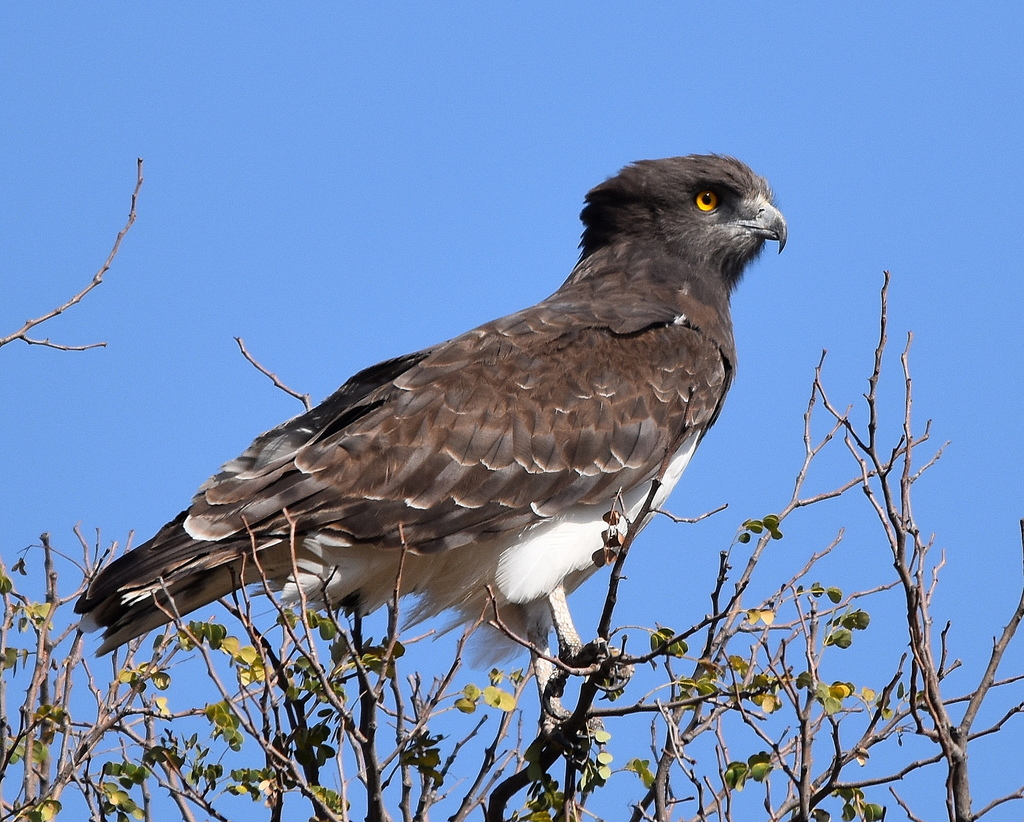
Black-chested Snake-Eagle
Live sightings near you, the range map, bar charts of when it is seen, and Macaulay Library photos and recordings.
Black-chested Snake-Eagle
Circaetus pectoralis
The black-chested snake eagle or black-breasted snake eagle (Circaetus pectoralis) is a large African bird of prey of the family Accipitridae. It resembles other snake eagles and was formerly considered conspecific with the short-toed and Beaudouin's snake eagles, to which it is closely related.
From the article Black-chested snake eagle on Wikipedia (CC BY-SA), quoted section by section
Range & habitat
This species has an Afrotropical distribution and can be found throughout southern and East Africa, from Ethiopia and Sudan in the north to South Africa (north of 26S) in the south, ranging as far west as the southern Democratic Republic of the Congo and southeastern Gabon. It is a partial migrant, with many populations in southern Africa and East Africa appearing to be resident year-round, while the species has only ever been recorded as a breeding visitor in Sudan and as a largely non-breeding visitor in Ethiopia and the former Transvaal, where it is considered locally nomadic. However, seasonal movements have been recorded even in areas in which the species is considered resident, for example in Zimbabwe, where there is an influx of birds in the dry winter months.
Wikipedia: “Distribution”
What it does
As its name indicates, this bird feeds mostly on snakes (particularly venomous snakes up to 80 cm. in length), but will also prey on lizards, insects, small mammals and frogs. It mainly hunts from a perch or by hovering or searching the ground, stalking prey on the wing and then parachuting slowly to the ground to capture its prey. The species has also been found to be highly dependent on seasonal fluctuations in small mammal prey availability, with its numbers increasing in accordance with booms in small mammal abundance in the Serengeti National Park. A specimen collected from Morogoro in 1922 was found to have a pellet of rodent fur and a hissing sand snake in its stomach contents.
Wikipedia: “Feeding Ecology”
Listen
Looking for field recordings…
Where it lives
Recorded sightings
—
geo-referenced records in GBIF, from museums, herbaria and field observers.
Drag the globe to turn it. Dots are where records exist, not a range map; darker means more records.
In the stacks
Searching the stacks…
Every page naming Circaetus pectoralis in the Biodiversity Heritage Library →
This page is assembled live from iNaturalist, GBIF, Wikipedia, the Source Library and the Internet Archive. It is not yet part of the hand-edited codex. iNaturalist taxon 5240.