- Animals
- ›Arthropods
- ›Hexapods
- ›Insects
- ›Winged and Once-winged Insects
- ›Grasshoppers, Crickets, and Katydids
- ›Katydids, Crickets, and Allies
- ›Crickets
- ›Mole and Ant Crickets
- ›Mole Crickets

Scapteriscinae
Mole crickets are members of the insect family Gryllotalpidae, in the order Orthoptera (grasshoppers, locusts, and crickets). Mole crickets are cylindrical-bodied, fossorial insects about 3–5 cm (1.2–2.0 in) long as adults, with small eyes and shovel-like fore limbs highly developed for burrowing. They are present in many parts of the world and where they have arrived in new regions, they may become agricultural pests.
Mole crickets have three life stages: eggs, nymphs, and adults. Most of their lives in these stages are spent underground, but adults have wings and disperse in the breeding season. They vary in their diet: some species are herbivores, mainly feeding on roots; others are omnivores, including worms and grubs in their diet; and a few are largely predatory. Male mole crickets have an exceptionally loud song; they sing from a burrow that opens out into the air in the shape of an exponential horn. The song is an almost pure tone, modulated into chirps. It is used to attract females, either for mating, or for indicating favourable habitats for them to lay their eggs.
2 branches of this subfamily, most-observed first
See this branch on the Wheel of Life →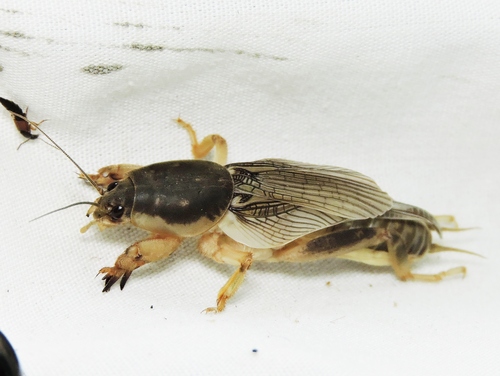
Where it lives
Recorded sightings
—
geo-referenced records in GBIF, from museums, herbaria and field observers.
Drag the globe to turn it. Dots are where records exist, not a range map; darker means more records.
In the stacks
Searching the stacks…
Every page naming Scapteriscinae in the Biodiversity Heritage Library →
This page is assembled live from iNaturalist, GBIF, Wikipedia, the Source Library and the Internet Archive. It is not yet part of the hand-edited codex. iNaturalist taxon 523960.