- Animals
- ›Chordates
- ›Vertebrates
- ›Birds
- ›Hawks, Eagles, Kites, and Allies
- ›Hawks, Eagles, and Kites
- ›Buteonine Hawks, Kites, and allies
- ›Buteo
On eBird ↗
Upland Buzzard
Live sightings near you, the range map, bar charts of when it is seen, and Macaulay Library photos and recordings.
Upland Buzzard
Buteo hemilasius
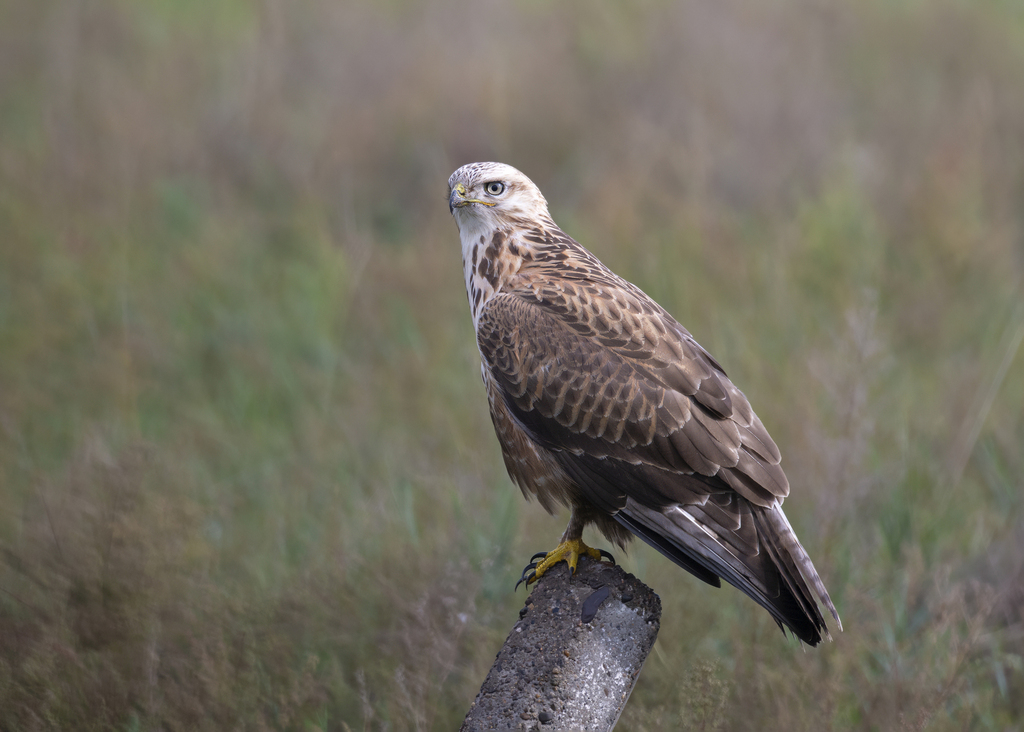
The upland buzzard (Buteo hemilasius) is a species of bird of prey in the family Accipitridae. The largest species of the Buteo genus, this buzzard lives in mountainous grassy and rocky areas in areas of Central Asia, northern South Asia and East Asia from Kazakhstan to Korea. The upland buzzard is migratory but typically covers a short distance apparently to avoid snow cover that may hamper prey capture. This species primarily subsists on small mammals but does not shun alternate prey from small to large birds and insects. This little-known raptor has a large range, and though generally uncommon, it is not thought to be rare or declining as a species. As a result, it is classified as least concern by the IUCN.
From the article Upland buzzard on Wikipedia (CC BY-SA), quoted section by section
Description
This is the largest buzzard and the largest member of the genus Buteo in the world based on total length and wingspan. However, it is roughly equaled in bulk by the North American ferruginous hawk (Buteo regalis), which is also only marginally smaller going on mean standard measurements. The total length of the upland buzzard is 57 to 72 cm (22 to 28 in) and wingspan is 143 to 161 cm (4 ft 8 in to 5 ft 3 in). Body mass is known to range from 950 to 1,400 g (2.09 to 3.09 lb) in males, with three averaging 1,168 g (2.575 lb), and from 970 to 2,050 g (2.14 to 4.52 lb) in females, with seven averaging 1,581 g (3.486 lb). The average size of 14 upland buzzards in the Tibetan Plateau was 639 mm (25.2 in) in length, including a tail of 289 mm (11.4 in), a smallish culmen of 30 mm (1.2 in), a tarsus length of 86 mm (3.4 in) and a body mass of 1,557 g (3.433 lb). The Upland buzzard is conspicuously large for a Buteo, with long wings and a relatively long tail, and fairly eagle-like compared to related species. There are both pale and dark morphs. The pale morph is generally beige and earthen dark brown in colour. This morph bears a lightly marked whitish colour with a variable ochre wash to the head and nape with the chest generally appearing purest whitish. …
Range & habitat
The central portion of the breeding range, comprising a great majority, of the upland buzzard is in Mongolia and China, in the latter nation especially in the western, northern and northeastern areas. To the north of Mongolia, where they occur throughout, upland buzzards also breed in several adjacent areas of southern Siberia. In the west, their breeding range may edge very slightly into far eastern Tajikistan, southeastern Kyrgyzstan and fairly recently in the East Kazakhstan Region, where they were documented to nest for the first time only in 1990. In the south, the upland buzzard may breed in the quite northern reaches of Bhutan, Nepal and now for the first recorded time in 1998 to nest in the Indian subcontinent within Changtang, Tibet. During times of passage, northern birds radiate through non-breeding areas of western China and in eastern Kyrgyzstan as well in North Korea and South Korea far to the east. Wintering areas of upland buzzards can include much of eastern Kazakhstan, northern India, much of Nepal and Bhutan and central and eastern China. Generally speaking, upland buzzards are not long-distance migrants and many travel minimal distances to winter. In seldom cases, upland buzzards have appeared in Japan as well, most likely vagrating from Korea. An unusual old claim exists of the upland buzzard turning up in Iran during winter. …
Wikipedia: “Distribution and status”
What it does
The upland buzzard is normally found in open, high elevation regions. While recorded at over 5,000 m (16,000 ft) in elevation, the species normally nests at elevations between 1,000 and 4,500 m (3,300 and 14,800 ft) and may at times be recorded down to sea-level during the winter. In the montane areas it nests in habitats such as alpine meadow, upland steppe and plateaus, often foraging in these assorted grasslands and rocky areas. They also visit cultivation such as arable lands in both summer and winter. The upland buzzard is fairly typical Buteo often given to extensively soaring flights, with their wings held in quite a strong dihedral. The upland buzzard frequently hovers, often during hunting spells. Unlike many Buteos, they do not have perches usually available to them while hunting so must swoop down from active flight, but may sometimes be able to make use of rocks as hunting perches. They will also sometimes capture insects on the ground. The upland buzzard is a partial migrant, often traveling minimal distances in an apparent search of appropriate hunting areas. Migration appears to be undertaken in September to October in autumn and returns in spring in March to May. The species is frequently recorded migrating over the Gobi Desert in late October. …
Wikipedia: “Behaviour and ecology”
Listen
Looking for field recordings…
Where it lives
Recorded sightings
—
geo-referenced records in GBIF, from museums, herbaria and field observers.
Drag the globe to turn it. Dots are where records exist, not a range map; darker means more records.
In the stacks
Searching the stacks…
Every page naming Buteo hemilasius in the Biodiversity Heritage Library →
This page is assembled live from iNaturalist, GBIF, Wikipedia, the Source Library and the Internet Archive. It is not yet part of the hand-edited codex. iNaturalist taxon 5225.