 NL·0666
Herbarium of the Nature Library
- Name
- Rhincodon typus
- Family
- Rhincodontidae
- Native to
- Tropical and warm-temperate seas worldwide; aggregations at Ningaloo (Australia), Yucatán (Mexico), Donsol and Oslob (Philippines), the Maldives and the Gulf of Oman
- Habitat
- Open ocean, Coral reef, Coastal waters
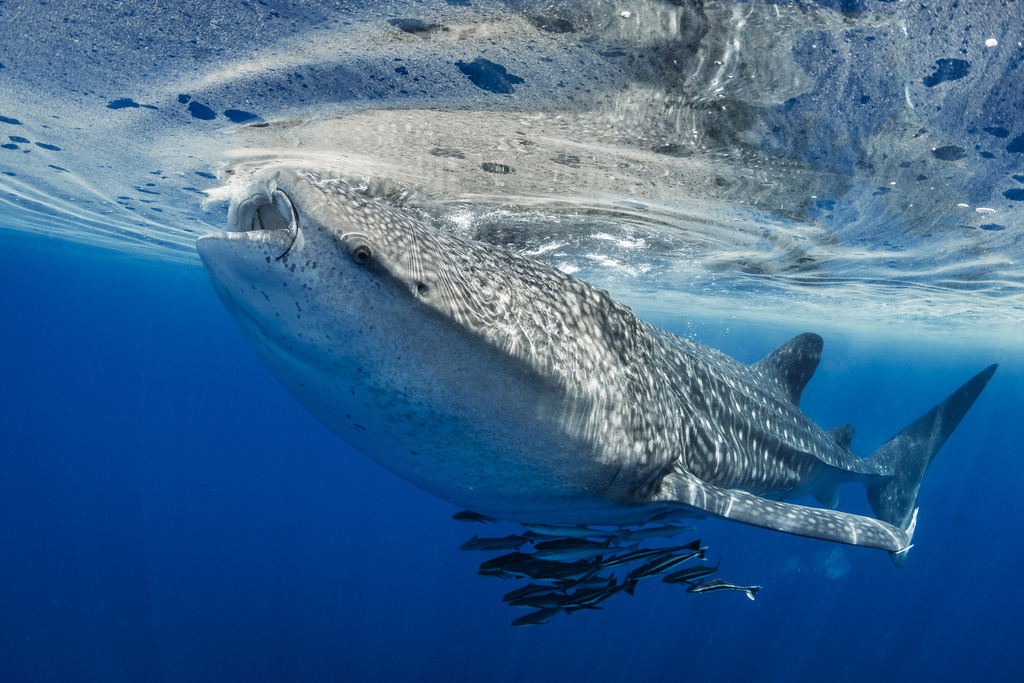
Whale shark
Rhincodon typus
Also calledButanding (Filipino) · Hiu paus (Indonesian) · Jinbē-zame / Ebisu-zame (Japanese) · Jīngshā 鲸鲨 (Chinese) · Tiburón ballena (Spanish)
The largest living fish, a slow-moving filter feeder that can grow longer than a bus. Despite its size it eats plankton, fish eggs and small fish, and it is harmless to divers.
The whale shark is a slow-moving, filter-feeding carpet shark and the largest known extant fish species. An individual with a length of 18.8 m (61.7 ft) has been considered the largest reliably recorded. The whale shark holds many records for size in the animal kingdom, most notably being by far the largest living non-cetacean animal. It is the only living species of the genus Rhincodon and the only extant member of the family Rhincodontidae, which belongs to the subclass Elasmobranchii in the class Chondrichthyes. Before 1984, it was classified as Rhiniodon into Rhinodontidae. An extinct species, Rhincodon ferriolensis, was described in Europe, in the Late Burdigalian stage. Wikipedia
What it can do
- iFilters plankton through spongy pads across its gills, swallowing by suction as well as by swimming forward
- iiDives to nearly 2,000 m
- iiiMigrates thousands of kilometres to seasonal feeding sites, such as spawning coral and fish
- ivEach shark's spot pattern is unique and is matched using an algorithm built for mapping stars
In the field
Field marks
- aLargest fish; flattened head and wide mouth at the front
- bDark grey with pale spots and stripes
- cRidges along the back
- dSwims slowly near the surface
- Not to be confused with
- Basking shark lacks spots and has huge gill slits.
- Where to see it
- Ningaloo Reef (Australia), Isla Holbox and Isla Mujeres (Mexico) and Donsol (Philippines)
- When
- Ningaloo Mar–Jul; Mexico Jun–Sep; Donsol about Dec–May
Life & habits
- Diet
- Filter feeder: plankton, krill, fish and coral eggs, small fish and squid
- Habitat
- Warm open ocean and plankton-rich coasts
- Size
- Usually 5–12 m; largest reliably measured about 18–19 m; up to ~20 t
- Lifespan
- Estimated 80–130 years
A female caught off Taiwan in 1995 carried about 300 embryos at different stages, showing that the species hatches eggs inside the mother and gives birth to live young.
Where it lives
Recorded sightings
—
geo-referenced records in GBIF, from museums, herbaria and field observers.
Native range
Tropical and warm-temperate seas worldwide; aggregations at Ningaloo (Australia), Yucatán (Mexico), Donsol and Oslob (Philippines), the Maldives and the Gulf of Oman
Drag the globe to turn it. Dots are where records exist, not a range map; darker means more records.
In the stacks
Searching the stacks…
Every page naming Rhincodon typus in the Biodiversity Heritage Library →
Marginalia
Japanese fishermen called it Ebisu-zame after the god of fishing and good fortune, because schools of fish gathered around it.
Curiosity
Its skin can be up to about 10 cm thick, among the thickest of any animal.
Kinship




Photographs: iNaturalist contributors under the licences shown. Records: GBIF.org. Historical plates: Source Library (CC BY-SA 4.0; originals public domain). Summary text: Nature Library editors and Wikipedia (CC BY-SA). Medicinal and edibility notes are historical and educational, not advice. iNaturalist taxon 52188.