- Animals
- ›Arthropods
- ›Hexapods
- ›Insects
- ›Winged and Once-winged Insects
- ›Butterflies and Moths
- ›Butterflies
- ›Gossamer-winged Butterflies
- ›Blues
- ›Typical Blues
- ›Jamidina
- ›Jamides
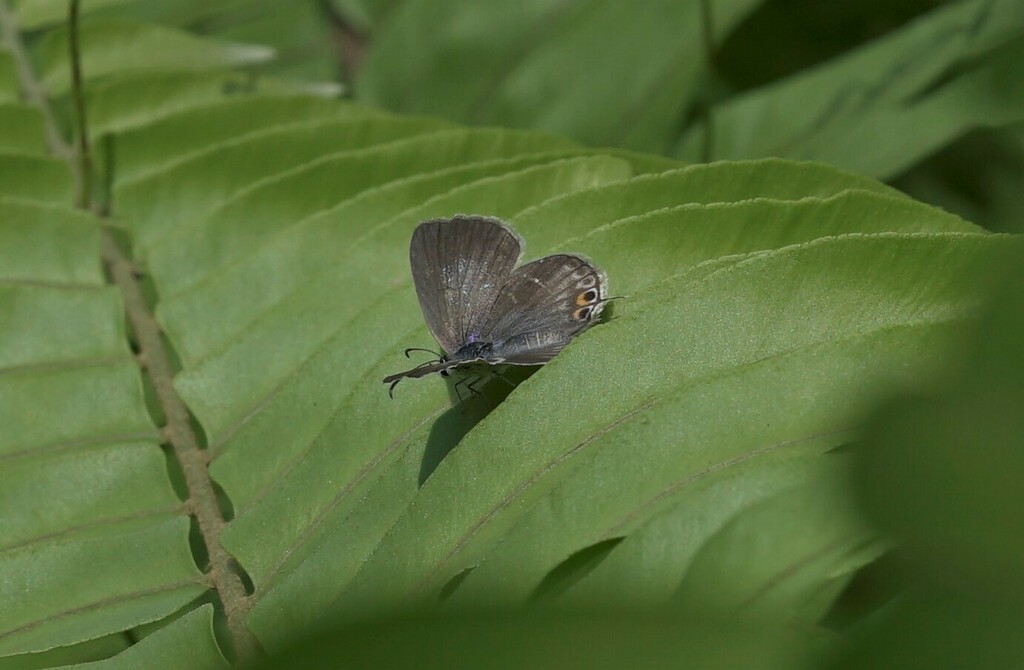
Common Cerulean
Jamides celeno
Jamides celeno, the common cerulean, is a small butterfly found in Indomalayan realm belonging to the lycaenids or blues family. The species was first described by Pieter Cramer in 1775.
From the article Jamides celeno on Wikipedia (CC BY-SA), quoted section by section
Description
Like many tropical butterflies, this species shows seasonal polyphenism, with the appearance differing between adults according to the season.
Dry-season brood. Male upperside has the ground colour pale bluish white. The forewing has the terminal margin narrowly edged with black that broadens very slightly towards the apex of the wing; the cilia are brownish black. The hindwing is uniformly coloured, except for an anteciliary black line faintly edged on the inner side by a white line within which and touching it is a row of black spots, the anterior spots very faint, the spot in interspace 2 large and well-defined, two geminate (paired) spots in interspace 1 and a very small black lunular dot in interspace 1a; cilia brown, white at the base in the interspaces. In specimens obtained in the height of the dry season the black edging to the termen of the forewing is much reduced and the subterminal series of black spots in the hindwing is altogether missing. The underside is greyish brown. …
Listen
Looking for field recordings…
Where it lives
Recorded sightings
—
geo-referenced records in GBIF, from museums, herbaria and field observers.
Drag the globe to turn it. Dots are where records exist, not a range map; darker means more records.
In the stacks
Searching the stacks…
Every page naming Jamides celeno in the Biodiversity Heritage Library →
This page is assembled live from iNaturalist, GBIF, Wikipedia, the Source Library and the Internet Archive. It is not yet part of the hand-edited codex. iNaturalist taxon 52069.