- Animals
- ›Arthropods
- ›Hexapods
- ›Insects
- ›Winged and Once-winged Insects
- ›Butterflies and Moths
- ›Owlet Moths and Allies
- ›Underwing, Tiger, Tussock, and Allied Moths
- ›Erebinae
- ›Euclidiini
- ›Mocis
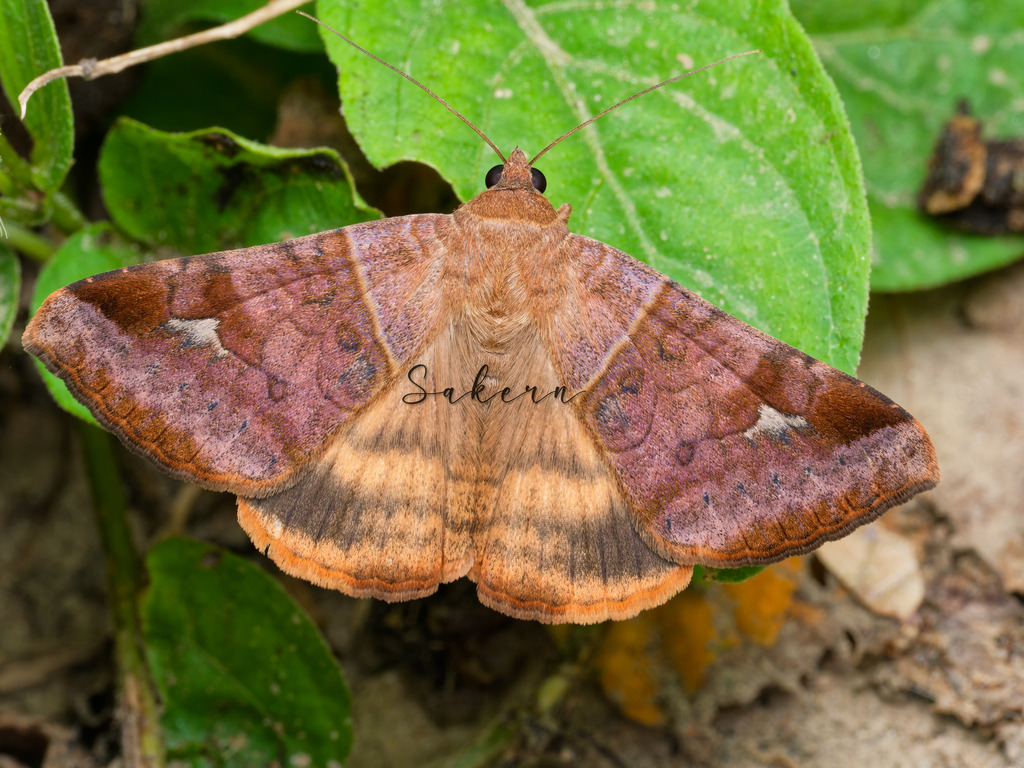
Brown-striped Semilooper
Mocis undata
Mocis undata, the brown-striped semilooper, is a moth of the family Erebidae. The species was first described by Johan Christian Fabricius in 1775. It is found in the Afrotropical and Oriental regions, including India and Sri Lanka.
From the article Mocis undata on Wikipedia (CC BY-SA), quoted section by section
Description
The male has a mid and hind tibia and is clothed with long hair. Body pale red-brown. Abdomen pale fuscous, the anal tuft ochreous. Forewing with a short sub-basal red-brown line. An oblique antemedial pale of ochreous line present, with diffused red-brown band on its outer edge. A sinuous medial line angled on median nervure. Reniform large and indistinct. A red-brown diffused postmedial band, on which is a dark line slightly curved outwards beyond the cell, and at vein 2, it is very irregularly curved inwards to lower angle of cell, then descending to inner margin. An indistinct pale waved sub-marginal line present with a black specks series on it. There is a dark waved marginal line. Hindwings ochreous fuscous, with narrow fuscous medial band and diffused sub-marginal band. Legs rufous. Larva purplish brown speckled with black. The lateral area yellowish with red lines. A sub-lateral row of small black dots present. Head brownish with red lateral streak. Pupa efflorescent. The larvae feed on Cytisus, Desmodium, Wisteria, Arachis, Butea, Cajanus, Calopogonium, Crotalaria, Derris, Glycine, Indigofera, Mucuna, Phaseolus, Pueraria, Rhynchosia, Tephrosia, Vigna, Shorea, Hevea, Gossypium, Nephelium and Solanum species.
Listen
Looking for field recordings…
Where it lives
Recorded sightings
—
geo-referenced records in GBIF, from museums, herbaria and field observers.
Drag the globe to turn it. Dots are where records exist, not a range map; darker means more records.
In the stacks
Searching the stacks…
Every page naming Mocis undata in the Biodiversity Heritage Library →
This page is assembled live from iNaturalist, GBIF, Wikipedia, the Source Library and the Internet Archive. It is not yet part of the hand-edited codex. iNaturalist taxon 52034.