- Animals
- ›Chordates
- ›Vertebrates
- ›Birds
- ›Hawks, Eagles, Kites, and Allies
- ›Hawks, Eagles, and Kites
- ›Buteonine Hawks, Kites, and allies
- ›Buteo
On eBird ↗
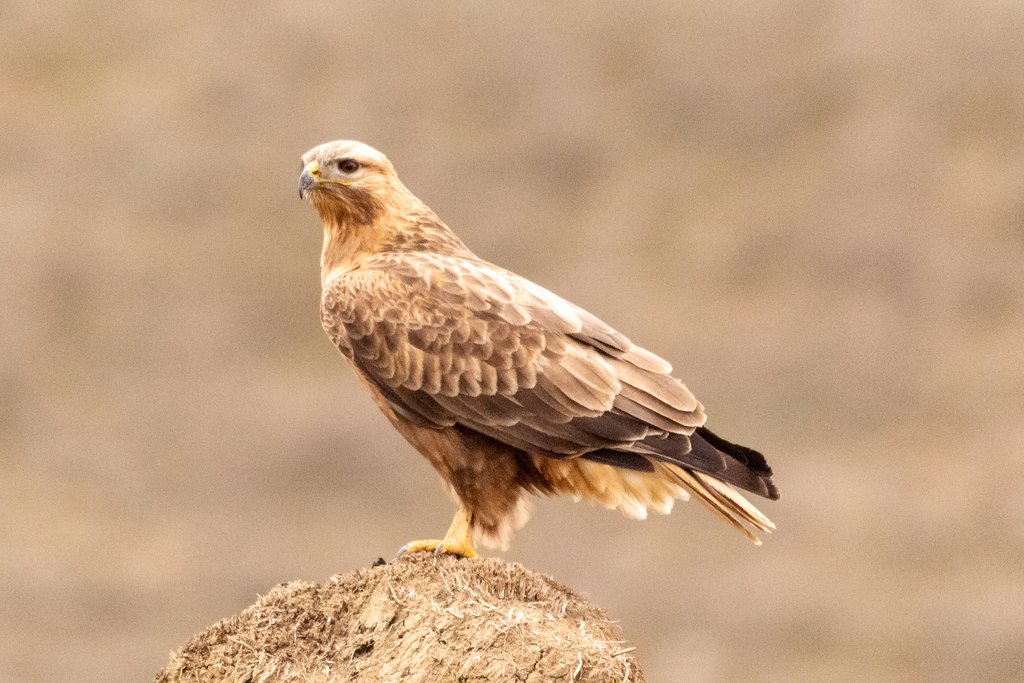
Long-legged Buzzard
Live sightings near you, the range map, bar charts of when it is seen, and Macaulay Library photos and recordings.
Long-legged Buzzard
Buteo rufinus
The long-legged buzzard (Buteo rufinus) is a bird of prey found widely in several parts of Eurasia and in North Africa. This species ranges from Southeastern Europe down to East Africa to the northern part of the Indian subcontinent. The long-legged buzzard is a member of the genus Buteo, being one of the larger species therein. This species is simultaneously considered relatively powerful and aggressive for its taxonomic group as well as a relatively sluggish raptor overall. Like most buzzards, it prefers small mammals such as rodents, including gerbils, ground squirrels, voles and rats, also taking reptiles, birds and insects as well as carrion. Adaptable to a variety of habitats, long-legged buzzards may nest on a variety of surfaces, including rocks, cliffs and trees. It is a typical buzzard in its reproductive biology. The long-legged buzzard is widely distributed and appears to be quite stable in population. Therefore, it is considered as Least Concern by the IUCN.
From the article Long-legged buzzard on Wikipedia (CC BY-SA), quoted section by section
Range & habitat
The long-legged buzzard inhabits arid areas of northern Africa, southeastern Europe, west and central Asia east to China, and down to as far as central India. The farthermost western part of their breeding range is in west Africa, in Western Sahara, extreme northern Mauritania, much of Morocco west to northern Algeria (spottily elsewhere in the nation), Tunisia and northern Libya (mainly northwestern parts). Long-legged buzzards occur accidentally in several other parts of Africa. In mainland Europe, they mainly nest in the southeastern region. Nesting long-legged buzzards have been known in eastern Hungary, central and eastern Ukraine, southern Moldova, southern and far eastern Romania, southern Serbia and more broadly in Bulgaria and somewhat so in northern Greece. Recent sightings indicate that there is a small population in the Apulian region of south-eastern Italy. Similarly, increasing records of long-legged buzzards are known in far southern Spain with the first nesting occurring in Gibraltar in 2009. The recent colonisation Europe due to the climate in southern Europe becoming more suitable for this species. Vagrant long-legged buzzards have been documented in many parts of Europe, including Finland, Denmark, the Netherlands, France, Poland, Czech Republic, Slovakia, and one record in Shetland in Great Britain on 1 September 2019. …
Wikipedia: “Distribution and habitat”
What it does
Although frequently described as sluggish, the long-legged buzzard appears by most accounts to be a fairly active and powerful predator. This species often hunts by pounces on unwary prey from a variety of lookout perches. Long-legged buzzards, like many Buteo, regularly still-hunt, using tallish or high perch sites or mounds, spending long periods of time scanning the ground. Regular perch sites while hunting may include power poles, pylons, powerlines, boulders, rocky outcrops and dead and sometimes live trees. They also will watch for prey whilst standing on the ground, sometimes right by the entrance of a prey's burrow. No less often, they may hunt on the wing from hovering or active flight. During hunting on the wing they often hang in the air, at up to about 30 m (100 ft) above the ground, for sometimes several minutes, before dropping steepwise and making a short stoop. It is likely that the habitat being used and dictating availability of perches or sloping land from which to watch the ground dictate the variations in hunting modes seen in this species. Often the preferred hunting habitat is fairly open including upland steppe, arid semi-desert and cultivated fields. …
Wikipedia: “Dietary biology”
Listen
Looking for field recordings…
Where it lives
Recorded sightings
—
geo-referenced records in GBIF, from museums, herbaria and field observers.
Drag the globe to turn it. Dots are where records exist, not a range map; darker means more records.
In the stacks
Searching the stacks…
Every page naming Buteo rufinus in the Biodiversity Heritage Library →
This page is assembled live from iNaturalist, GBIF, Wikipedia, the Source Library and the Internet Archive. It is not yet part of the hand-edited codex. iNaturalist taxon 5192.