- Animals
- ›Arthropods
- ›Hexapods
- ›Insects
- ›Winged and Once-winged Insects
- ›Beetles
- ›Water, Rove, Scarab, Long-horned, Leaf, and Snout Beetles
- ›Scarabaeiform Beetles
- ›Scarabs, Stag Beetles, and Allies
- ›Scarabs
- ›Dung Beetles
- ›Phanaeini
- ›Coprophanaeus
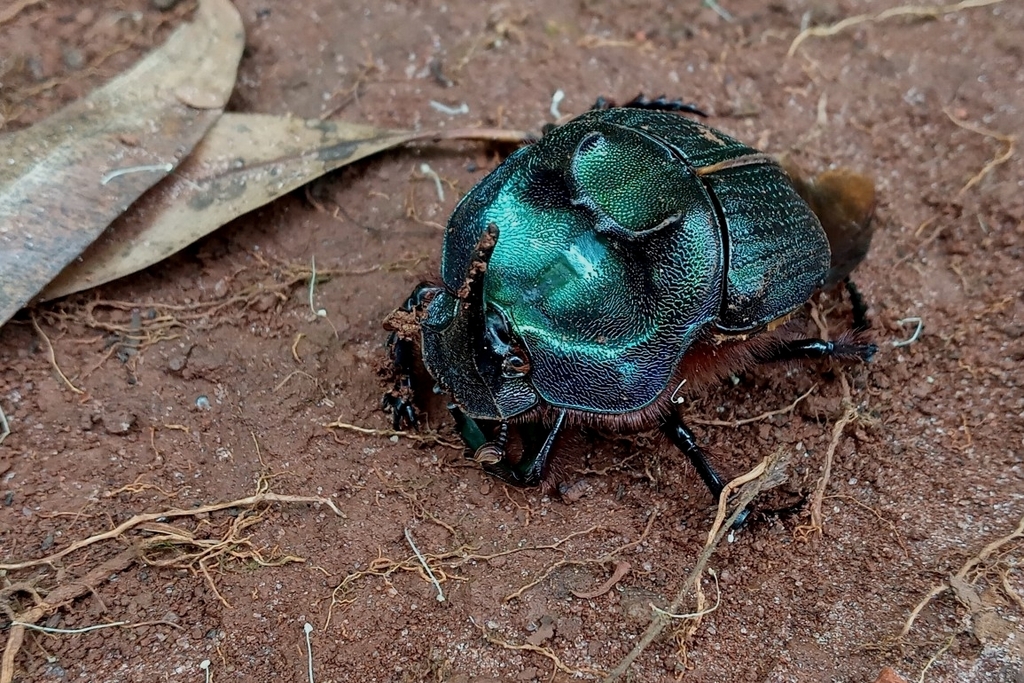
Coprophanaeus ensifer
Coprophanaeus ensifer is a large South American species of beetle belonging to the family Scarabaeidae. This species is necrophagous and builds burrows near or on animal carcasses to dismember the flesh of decaying bodies and bring it to its burrow to feed. Both females and males help build the burrow and feed. It is characterized by its iridescent colors and a horn that is similar in shape and size in females and males. It uses its horn to tear apart carcasses and to fight with other individuals, with male-male fighting occurring more often. However, females also fight to determine a variety of characteristics of the opposing male. This species may be of importance in forensic science due to its destructive behavior on decaying bodies, especially in areas of Brazil where homicide rates are high.
From the article Coprophanaeus ensifer on Wikipedia (CC BY-SA), quoted section by section
Description
Adults typically are 30–56 mm (1.2–2.2 in) long, occasionally even reaching 65 mm (2.6 in). This makes C. ensifer and the closely related Amazonian C. lancifer some of the largest dung beetles in the world (together with certain Catharsius and Heliocopris) and the largest in the Americas. This beetle has a horn on the head that is of similar size in males and females. It is usually dark metallic green, often with some blue reflections, but it can occasionally be all metallic blue.
Sexual dimorphism. Female and male C. ensifer do not exhibit pronounced sexual dimorphism. The main differences are that females do not have a spiniform process in the pronotal concavity compared to males, but they have a protarsi that males do not have.
Horn. C. ensifer has a long horn with a pair of processes projecting up and two other pairs of processes projecting forward. Although the body size of females and males is similar, the male horns are relatively larger than female horns. This could be because males have to compete for females. The horn has been suggested to play roles in sexual selection, defense, as a tool for building burrows, or during conflict between individuals. Specifically, females may have evolved the horn to defend their burrow since they can only have a limited number of offspring due to their small reproductive system.
Chromatic variations. C. …
Range & habitat
This species is found widely in eastern, central and southern Brazil, far northeastern Argentina, eastern Bolivia and Paraguay, occurring up to about 780 m (2,560 ft) above sea level. Most of its range is in the Caatinga, Cerrado and similar habitats, but in some regions its range also extends into the Atlantic forest and the Amazon rainforest. A relates species, C. lancifer occupies northern Brazil, limiting the distribution of C. ensifer in those regions. C. lancifer was also thought to occupy the Juína region, but upon genetic investigation, it was found that individuals in that region are more closely related to C. ensifer, suggesting that the distribution of C. ensifer is wider than previously thought. A study found that in Northeast Brazil, C. ensifer is more active during the rainy season, when temperatures drop. This preference can be explained by their large body. At high temperatures during dry seasons, it could be difficult to maintain a proper water balance because a large amount of water can be evaporated from their bodies. This could also explain why these beetles are crepuscular, or most active at dawn and dusk.
Wikipedia: “Distribution and habitat”
What it does
Compared to other Scarabaeidae species who are coprophagous, this species is necrophagous, which means it feeds on carrion, or the decaying body of dead animals. It has even been reported to bury a dead snake to feed on it. A carcass goes through various stages of decomposition and C. ensifer is most attracted to the body when it is actively decomposing in the initial stages of decomposition. By breaking down carrion and moving it or burying it, nutrient cycling may occur where nutrients that were part of the decaying carcass reenter the soil, affecting plant growth. It has been suggested that the difference in diet in C. ensifer compared to other species in the Scarabaeidae family evolved in the Pleistocene because of the extinction of large mammals, so the beetles were forced to change their diet to decrease competition and ensure survival. These beetles find decomposing carcasses through the detection of volatiles released during the decomposition process. A study found that females always arrived first to a pig carcass after the sun set, while males arrived later. Once the beetles arrive at the carcass, males bury themselves while females feed from it using their horn. The difference in arrival time suggest that females first find a suitable resource to feed and for oviposition while males arrive later to mate with females. …
Wikipedia: “Diet”
Listen
Looking for field recordings…
Where it lives
Recorded sightings
—
geo-referenced records in GBIF, from museums, herbaria and field observers.
Drag the globe to turn it. Dots are where records exist, not a range map; darker means more records.
In the stacks
Searching the stacks…
Every page naming Coprophanaeus ensifer in the Biodiversity Heritage Library →
This page is assembled live from iNaturalist, GBIF, Wikipedia, the Source Library and the Internet Archive. It is not yet part of the hand-edited codex. iNaturalist taxon 519079.