- Animals
- ›Chordates
- ›Vertebrates
- ›Birds
- ›Hawks, Eagles, Kites, and Allies
- ›Hawks, Eagles, and Kites
- ›Typical Hawks and Harriers
- ›Circus
On eBird ↗
Long-winged Harrier
Live sightings near you, the range map, bar charts of when it is seen, and Macaulay Library photos and recordings.
Long-winged Harrier
Circus buffoni
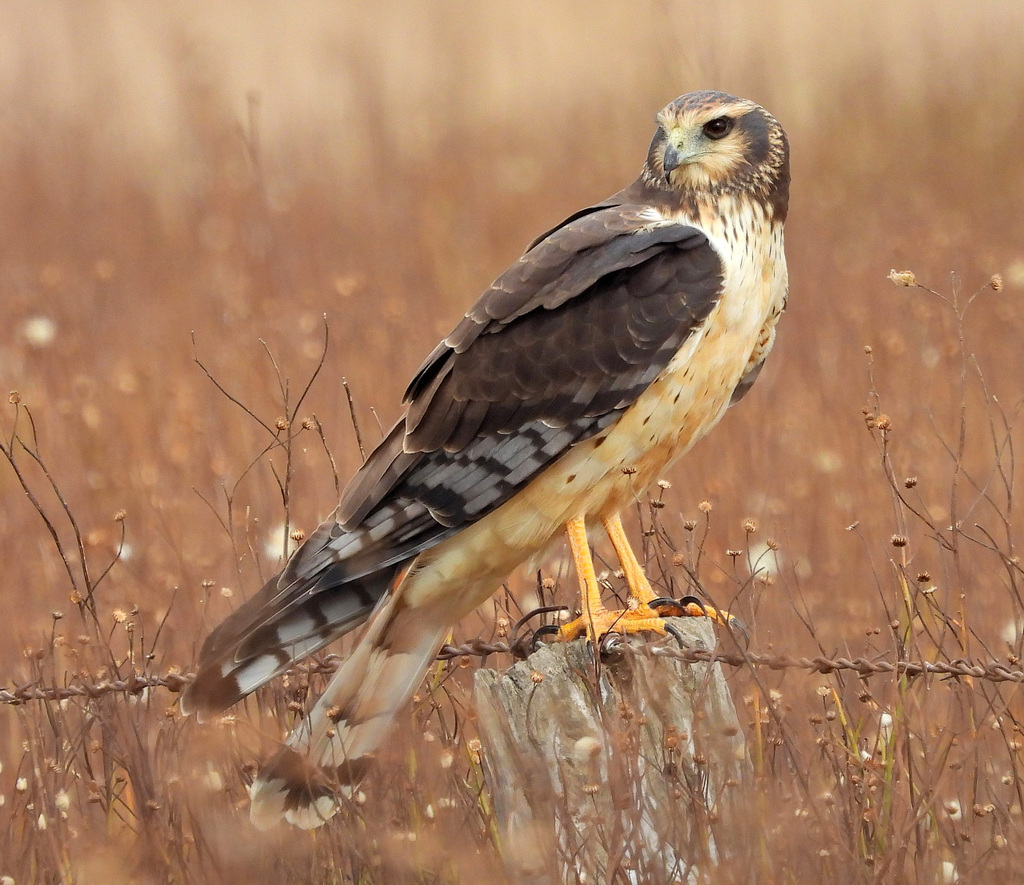
The long-winged harrier (Circus buffoni) is a common bird of prey species endemic to South America. They are members of the family Accipitridae, under the genus Circus which encompasses other harrier species. Its range encompasses most of South America, in grassland and wetland all across the continent. The long-winged harrier is a carnivorous bird, and will feed on many different animals found in its habitat.
Like owls and other harrier species, the long-winged harrier has a distinctive facial disc, which is used to triangulate the bird's hearing while it is hunting.
From the article Long-winged harrier on Wikipedia (CC BY-SA), quoted section by section
Description
The long-winged is mid-sized bird of prey, and like most birds of prey species, the females are larger than the males. Males will weigh from 390 to 464 g (13.8 to 16.4 oz) and females will be slightly heavier, ranging from 400 to 645 g (14.1 to 22.8 oz). Their length can range between 46 and 60 cm (18 and 23.5 in) and their wingspan ranges between 120 and 155 cm (47 and 61 in). As other harrier species, the long-winged harrier can be identified by its long and narrow tail and its especially long wings. Their wings and their back are mostly grey, with the primary feathers on the wings being much darker than the rest of the wing feathers, which are streaked with variants of white, grey and brown.
The long-winged harrier can harbor 2 different morphs, a dark morph and a light morph. In dark morph individuals, the belly is all black with females having more of a brown undertone. The light morph individuals can be identified by their white underparts, which contrasts heavily with their dark morph counterpart. Juvenile long-winged harriers usually have the same colour patterns as females, but they have a more speckled chest. …
Range & habitat
The long-winged harrier's year-round range encompasses most of eastern South America, including eastern Argentina, Uruguay, Brazil and Paraguay, and extends up to Colombia, Venezuela, and the northern tips of Guyana, Suriname and French Guiana. The species has also been observed occasionally in extant areas such as Bolivia, Peru, Chile, Trinidad and Tobago, and all the way down to Tierra del Fuego in southern Argentina. It is vagrant to Panama and the Falkland Islands. This species occupies large grasslands and agricultural fields, where their wide-range active hunting technique is very effective. Their habitat also includes savanna, marshes and wetlands of South America.
Wikipedia: “Distribution and habitat”
What it does
As all of the extended members of the family Accipitridae, the long-winged harrier is carnivorous, feeding on a large variety of animals due to its widespread distribution. Their diet includes small mammals (such as cavies), amphibians (such as frogs), reptiles (such as lizards) and birds (such as crakes and young coots), with birds consisting the majority of their food intake. It will also feed on bird eggs, varying from taking the whole ball-nests of water-tyrants to raiding heronries. Its hunting strategy differs vastly from other hawks sharing the same habitat such as the roadside hawk (Rupornis magnirostris). Instead of opting for a passive hunting strategy consisting of the use of high perches to locate their prey, the long-winged harrier will fly slowly in large circles above its range in order to find its prey, using its keen vision and hearing.
Wikipedia: “Food and feeding”
Listen
Looking for field recordings…
Where it lives
Recorded sightings
—
geo-referenced records in GBIF, from museums, herbaria and field observers.
Drag the globe to turn it. Dots are where records exist, not a range map; darker means more records.
In the stacks
Searching the stacks…
Every page naming Circus buffoni in the Biodiversity Heritage Library →
This page is assembled live from iNaturalist, GBIF, Wikipedia, the Source Library and the Internet Archive. It is not yet part of the hand-edited codex. iNaturalist taxon 5177.