- Animals
- ›Arthropods
- ›Hexapods
- ›Insects
- ›Winged and Once-winged Insects
- ›Scorpionflies, Hangingflies, and Allies
- ›Scorpionflies
- ›Panorpinae
- ›Panorpa
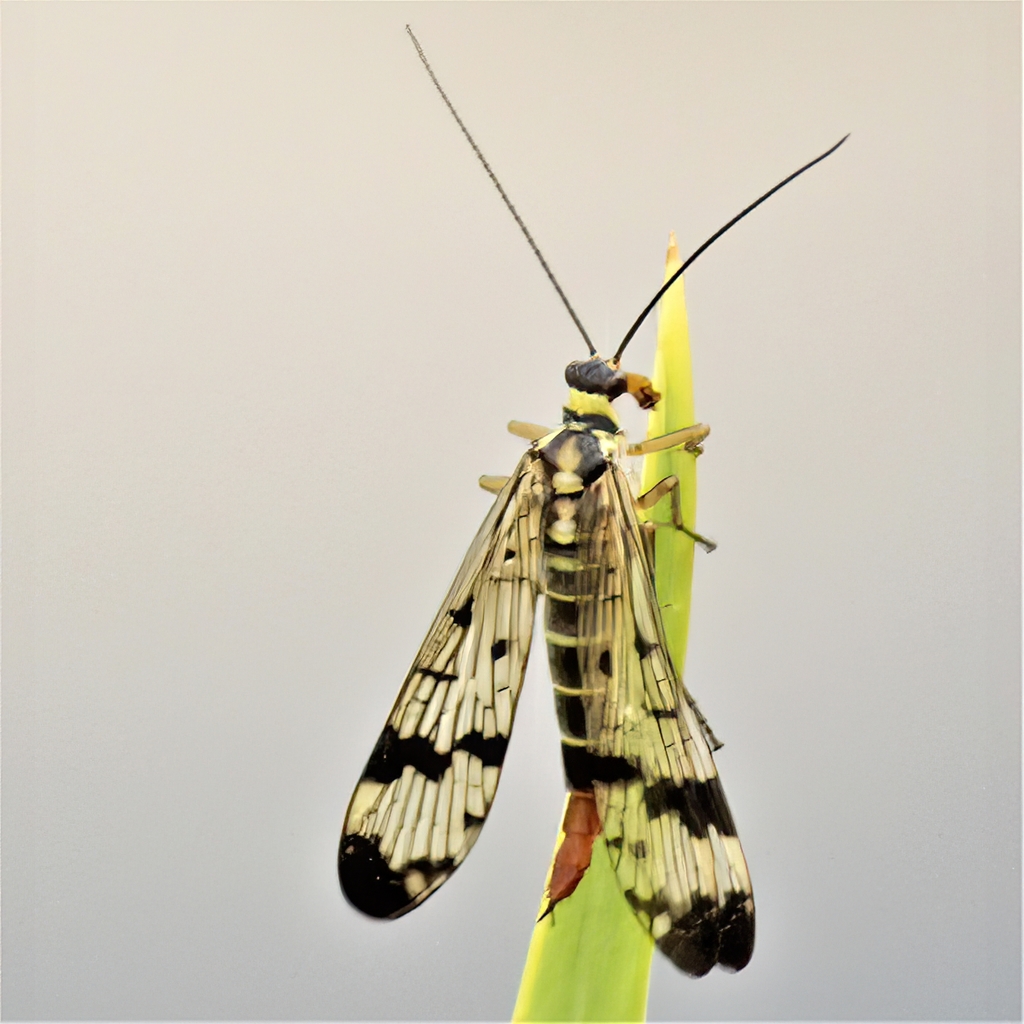
Common European Scorpionfly
Panorpa communis
Panorpa communis, the common scorpionfly, is a species of scorpionfly native to Western Europe.
From the article Panorpa communis on Wikipedia (CC BY-SA), quoted section by section
Description
Panorpa communis can reach a body length of about 30 millimetres (1.2 in). The common scorpionfly has a black and yellow body, with a reddish head and tail. The male has a pair of claspers at the end of its tail (for holding the female during mating), giving it a scorpion-like appearance, although it is not a stinger. The adult insect has a wingspan of about 35 millimetres (1.4 in), with wings that are mostly clear, but have many dark spots or patches. Its head, mounted with large eyes, is drawn into a prominent, downward pointing beak, which opens at the tip of its head. Females are longer, heavier, and have longer legs than males. In the female, the eighth abdominal segment is the shortest, almost twice shorter than the seventh; the sixth is narrowed towards the back. The larva resembles a caterpillar and grows up to 20 millimetres (0.79 in) long. It has three pairs of thoracic legs and eight pairs of prolegs.
Range & habitat
This species is native to Europe (except Iceland and Ireland) and Northern Asia (except China).
Wikipedia: “Distribution”
What it does
Males release pheromones and offer nuptial gifts to females in the form of saliva secretions and nuptial prey (usually dead arthropods). Before offering the nuptial gifts, the male and female, perform ritualized premating behavior, which includes slow wing movements, accompanied by brief sequences of rapid vibrations from their abdomen. The mating success of females increases with the size of nuptial gifts offered by the male.
Wikipedia: “Mating behavior”
Listen
Looking for field recordings…
Where it lives
Recorded sightings
—
geo-referenced records in GBIF, from museums, herbaria and field observers.
Drag the globe to turn it. Dots are where records exist, not a range map; darker means more records.
In the stacks
Searching the stacks…
Every page naming Panorpa communis in the Biodiversity Heritage Library →
This page is assembled live from iNaturalist, GBIF, Wikipedia, the Source Library and the Internet Archive. It is not yet part of the hand-edited codex. iNaturalist taxon 51699.