- Animals
- ›Arthropods
- ›Hexapods
- ›Insects
- ›Winged and Once-winged Insects
- ›Beetles
- ›Water, Rove, Scarab, Long-horned, Leaf, and Snout Beetles
- ›Scarabaeiform Beetles
- ›Scarabs, Stag Beetles, and Allies
- ›Scarabs
- ›Shining Leaf Chafers
- ›Anomalini
- ›Anomalina
- ›Phyllopertha
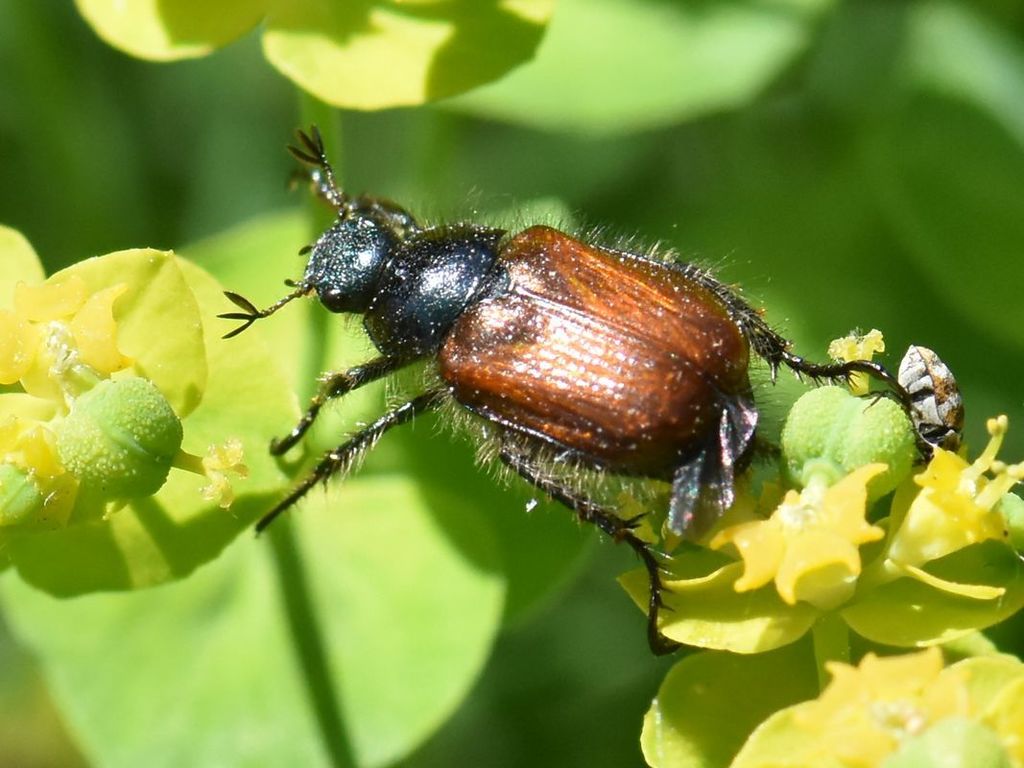
Garden Chafer
Phyllopertha horticola
Phyllopertha horticola, or the Garden Chafer, is a beetle from the Scarabaeidae family. It is approximately 10mm in size with chestnut brown wing casings which are covered in tiny hairs. The head legs and thorax are dark green in colour. Like other chafers there are fan-like flaps at the ends of their antennae.
From the article Phyllopertha horticola on Wikipedia (CC BY-SA), quoted section by section
Description
Phyllopertha horticola is approximately 8.5–11 millimetres (0.33–0.43 in) in size. Unlike Mimela of the same family, these beetles have a non-ovoid body. They have chestnut-brown wing casings which are covered with a long upright pubescence. On each elytron run six longitudinal bands of small dots. Head and thorax are finely granulated. Head, thorax and legs are shiny dark green or bluish. The underside of the body is also green. The antennas are very short and end in a fan-like group of three lamellae, with which the beetle perceives fragrances.
Range & habitat
This rather common species is widely widespread in Europe and in Asia, east to Siberia and Mongolia. In the north of Europe their distribution reaches the middle Fennoscandia and includes the British Isles, in southern Europe it mainly occurs in the mountains. It is the only European representative of the genus Phyllopertha.
Wikipedia: “Distribution”
Listen
Looking for field recordings…
Where it lives
Recorded sightings
—
geo-referenced records in GBIF, from museums, herbaria and field observers.
Drag the globe to turn it. Dots are where records exist, not a range map; darker means more records.
In the stacks
Searching the stacks…
Every page naming Phyllopertha horticola in the Biodiversity Heritage Library →
This page is assembled live from iNaturalist, GBIF, Wikipedia, the Source Library and the Internet Archive. It is not yet part of the hand-edited codex. iNaturalist taxon 51662.