- Animals
- ›Chordates
- ›Vertebrates
- ›Birds
- ›Hawks, Eagles, Kites, and Allies
- ›Hawks, Eagles, and Kites
- ›Snake-Eagles, Serpent-Eagles, and allies
- ›Spilornis
On eBird ↗
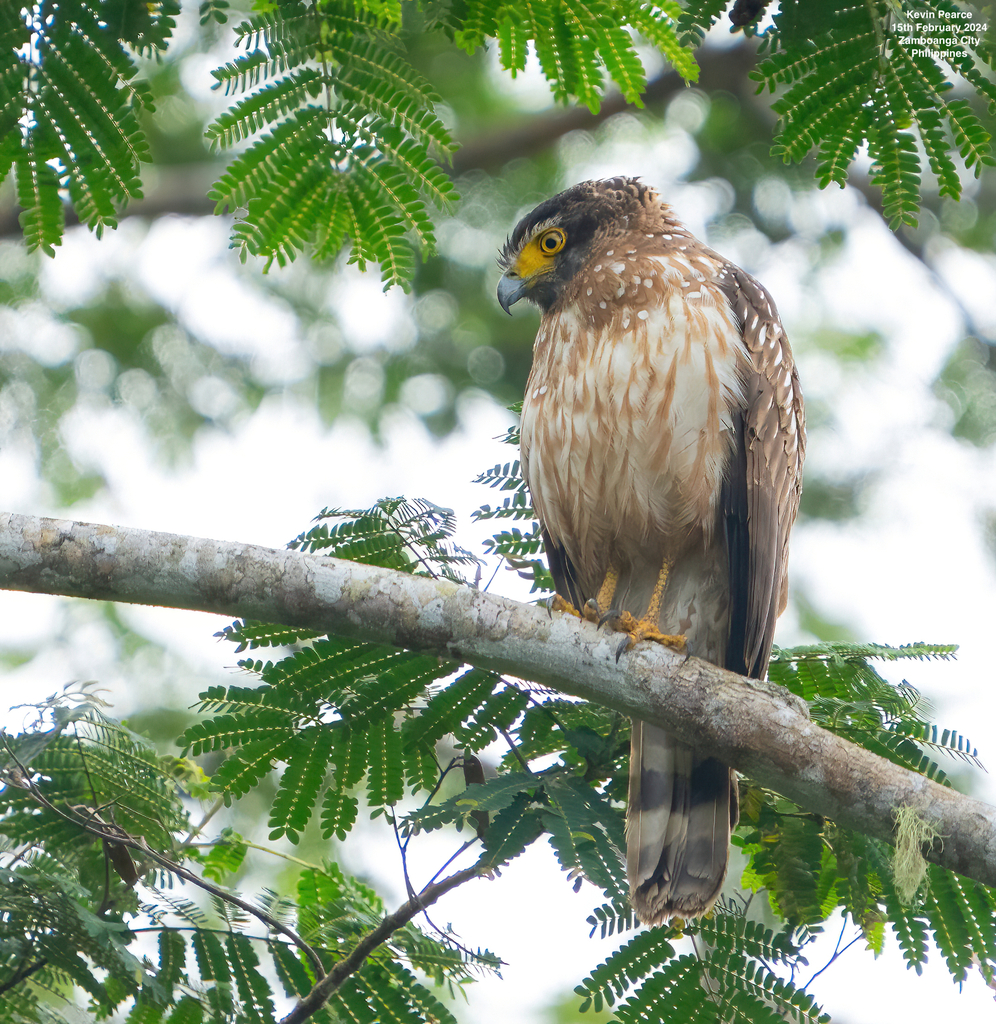
Philippine Serpent-Eagle
Live sightings near you, the range map, bar charts of when it is seen, and Macaulay Library photos and recordings.
Philippine Serpent-Eagle
Spilornis holospilus
The Philippine serpent eagle (Spilornis holospilus) is an eagle found in the major islands of the Philippines. It is sometimes treated as a race of the crested serpent eagle (Spilornis cheela). This species is usually found in forest clearings, open woodlands, and sometimes in cultivated lands with scattered trees. It is endemic to the Philippines. The species is found on most part of the major islands, except for Palawan.
It is illegal to hunt, capture or possess Philippine serpent eagles under Philippine Law RA 9147.
From the article Philippine serpent eagle on Wikipedia (CC BY-SA), quoted section by section
Description
It has a length of 47 to 53 cm and a wingspan of 105 to 120 cm. This species is monotypic.
Wikipedia: “Description and taxonomy”
Range & habitat
Its natural habitats are tropical moist lowland forest, montane forest, second growth and cultivated areas up to 2,500 meters above sea level. The IUCN has classified the species as being of Least Concern as it has a large range and it is common throughout its range and appears to adapt to second growth. Populations are still declining due to habitat loss due to slash and burn farming, mining, illegal logging and habitat conversion, hunting and poaching for the illegal wildlife trade. It is found in multiple protected areas such as Pasonanca Natural Park, Bataan National Park, Mount Banahaw, Mount Kitanglad. Mount Apo, Pasonanca Natural Park and Northern Sierra Madre Natural Park but like all areas in the Philippines, protection is lax and deforestation continues despite this protection on paper.
Wikipedia: “Habitat and conservation status”
What it does
The bird feeds on amphibians, reptiles and other live prey. Not much is known about its breeding habits. A female was collected with a single egg in its oviducts in April of 2020.
Wikipedia: “Ecology and behavior”
Listen
Looking for field recordings…
Where it lives
Recorded sightings
—
geo-referenced records in GBIF, from museums, herbaria and field observers.
Drag the globe to turn it. Dots are where records exist, not a range map; darker means more records.
In the stacks
Searching the stacks…
Every page naming Spilornis holospilus in the Biodiversity Heritage Library →
This page is assembled live from iNaturalist, GBIF, Wikipedia, the Source Library and the Internet Archive. It is not yet part of the hand-edited codex. iNaturalist taxon 5160.