- Animals
- ›Arthropods
- ›Hexapods
- ›Insects
- ›Winged and Once-winged Insects
- ›Butterflies and Moths
- ›Butterflies
- ›Swallowtails and Parnassians
- ›Swallowtails
- ›Kite Swallowtails, Swordtails, and Jays
- ›Graphium
- ›Graphium
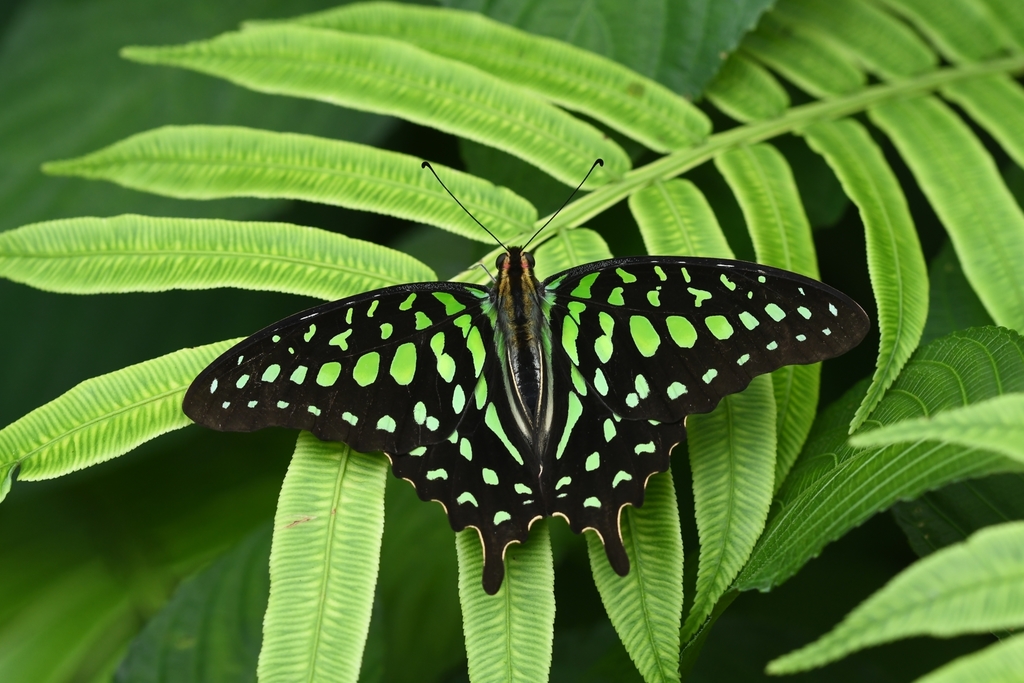
Tailed Jay
Graphium agamemnon
Graphium agamemnon, the tailed jay, is a predominantly green and black tropical butterfly that belongs to the swallowtail family. The butterfly is also called the green-spotted triangle, tailed green jay, or green triangle. It is a common, non-threatened species native to Nepal, India and Sri Lanka, through Southeast Asia to Australia. Several geographic races are recognized. The species was first described by Carl Linnaeus in his 1758 10th edition of Systema Naturae.
From the article Graphium agamemnon on Wikipedia (CC BY-SA), quoted section by section
Description
Male upperside black. Forewing with the following green markings: a spot at the extreme base of the costal margin, a transverse short bar near base of cell and seven spots beyond, two and two except the apical spot which is single; two spots beyond apex of cell; a spot at base of interspaces 1a and 1, followed by two oblique short macular bands; a discal series of spots decreasing in size towards the costa, and a postdiscal series of smaller spots that begins with two in interspace 1; the spots in interspace 7 in both series are out of line, placed outwards. Hindwing: three series of similarly-coloured markings that ran transversely across the wing more or less parallel to the dorsal margin, the upper markings (those in interspace 7) white; a short greenish stripe at the extreme base of the wing.
Underside: fuliginous (sooty) brown or brownish black, more or less suffused with pink along the costal margin, on apical area and along the outer margin of the discal markings on the forewing, broadly along the dorsal and terminal margins and at base on interspaces 6 and 7 on the hindwing; markings similar to those on the upperside but less clearly defined and somewhat more grey in tint. Hindwing black, inwardly red-margined spots superposed on the pink area in interspaces 6 and 7. Cilia very narrow, pale pink. …
Range & habitat
Southern India to Saurashtra, northern India (Kumaon to Assam), Nepal, Sri Lanka, Andamans, Nicobars, Bangladesh, Brunei, Myanmar, Thailand, Malaysia, Laos, Cambodia, Indonesia, Vietnam, Singapore, southern China (including Hainan), Taiwan, Japan (Ryukyu Islands), South East Asia to New Guinea, Bougainville, Solomon Islands, and Australia (northern Queensland).
Wikipedia: “Range”
What it does
Strong and restless fliers, they are very active butterflies and flutter their wings constantly even when at flowers. They are seldom seen drinking from damp patches. The males are particularly fond of nectaring from flowers such as Lantana, Ixora, Mussaenda, and Poinsettia. The females are more likely caught when looking for food plants or laying eggs. Tailed jays are active throughout the year but their abundance depends upon the local monsoon and availability of the larval host plants. The butterflies generally fly among the tree-tops but descend to ground level in search of flowers or host plants. Because of their relatively fast life cycle (just over one month from egg to adult), tailed jays are multivoltine and may produce up to seven or eight broods per year. It has been noted in one instance to be attracted to lights at night.
Wikipedia: “Behaviour”
At the table
Polyalthia longifolia, Polyalthia cerasoides, Annona squamosa, Annona reticulata, Annona discolor, Annona muricata, Goniothalamus cardiopetalus, Mitrephora heyneana and Uvaria narum of the family Annonaceae, Michelia doltospa, Michelia champaca, Milliusa tomentosum, Cinnamomum spp., and Artabotrys hexapetalus.
Wikipedia: “Food plants”
Listen
Looking for field recordings…
Where it lives
Recorded sightings
—
geo-referenced records in GBIF, from museums, herbaria and field observers.
Drag the globe to turn it. Dots are where records exist, not a range map; darker means more records.
In the stacks
Searching the stacks…
Every page naming Graphium agamemnon in the Biodiversity Heritage Library →
This page is assembled live from iNaturalist, GBIF, Wikipedia, the Source Library and the Internet Archive. It is not yet part of the hand-edited codex. iNaturalist taxon 51581.