- Animals
- ›Arthropods
- ›Hexapods
- ›Insects
- ›Winged and Once-winged Insects
- ›Butterflies and Moths
- ›Butterflies
- ›Gossamer-winged Butterflies
- ›Blues
- ›Typical Blues
- ›Everina
- ›Talicada
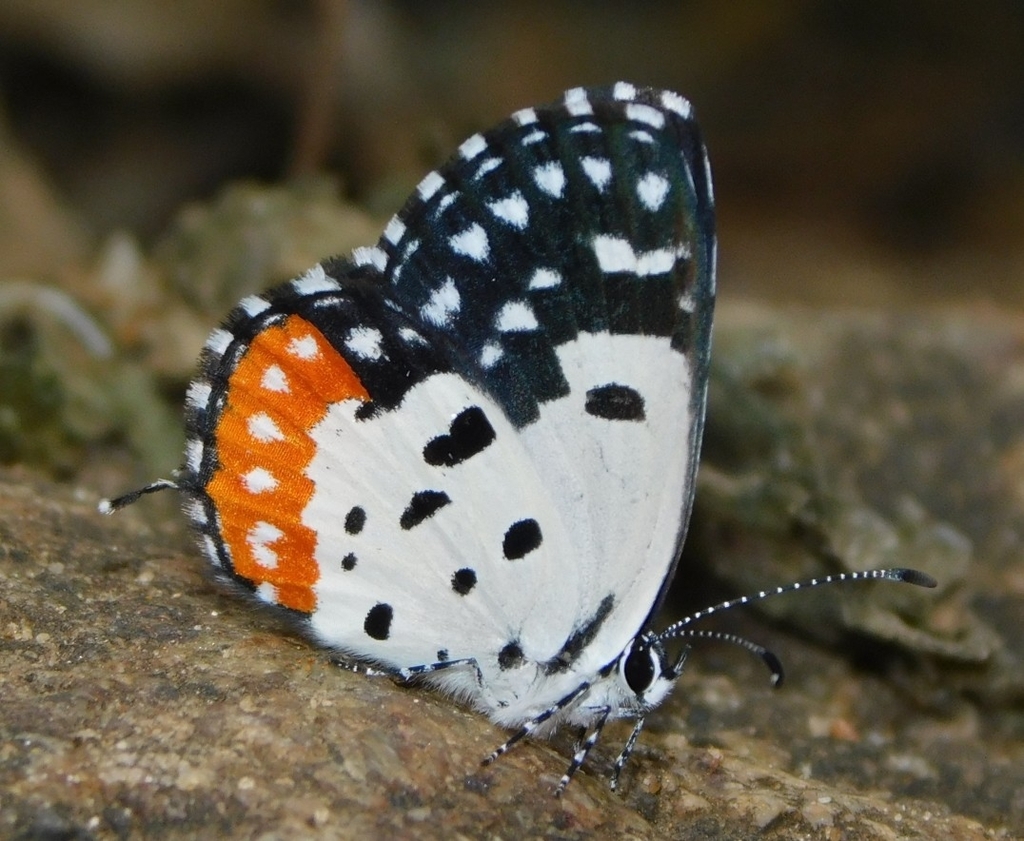
Red Pierrot
Talicada nyseus
Talicada nyseus, the red Pierrot, is a small but striking butterfly found in the Indian subcontinent and South-East Asia belonging to the lycaenids, or blues family. The red Pierrots, often found perching on its larva host plant, Kalanchoe, are usually noticed due to their striking patterns and colors.
From the article Talicada nyseus on Wikipedia (CC BY-SA), quoted section by section
Description
The butterfly has a wingspan of 3 to 3.5 cm. The upperside of its wings are black except for a large orange portion of the lower edge of the hindwing. On the underside, the forewing is white with black spots more toward the margin. The hindwing is very striking, it is white with black spots toward the base and the margin has a wide band of orange with white spots. There is a lot of variation found in the blacks spots on the hindwings.
Technical description. Males and females. Upperside: black or brownish black, in fresh specimens in certain lights with a dull purplish flush. Fore wing: uniform, with a very slender thread-like edging of white to the costa. Hindwing: a large conspicuous orange-red patch on the posterior terminal half of the wing between the dorsum and vein 7; this patch does not extend quite to the termen but leaves a narrow edging of the black ground-colour which is produced inwards in short conical projections in interspaces 2 to 5. Cilia of both fore and hind wings chequered with black and white alternately. Underside: silvery white. …
Range & habitat
Himalayan foothills, North India, South India, Meghalaya, Assam, Sri Lanka and North Myanmar.
Wikipedia: “Range”
At the table
The larval host plants are Kalanchoe laciniata and K. pinnata of the family Crassulaceae (stonecrop family); the latter host being a common garden plant. Adult butterflies have sometimes been seen to visit lichens. Studies suggest that they collect phenolic substances by scraping lichens.
Wikipedia: “Food plants”
In human culture
It is not a common butterfly, but near its food plant, Kalanchoe, it is found in abundance and is gregarious in all its stages.
Egg. The female lays eggs on the underside of a leaf. They are light green ellipsoid-shaped small egg. Young and old leaves are selected without discrimination as the leaves of Kalanchoe are thick and succulent during all stages.
Caterpillar. The caterpillar is pale yellow to a dirty white, and flattened with large, jet black spiracles. The entire body is covered with tiny white setae or bristle-like hair. This caterpillar is a leaf miner by habit and this serves as its defense. As soon as it hatches it bores into the leaf and will spend the rest of its life between the epidermal layers of the leaf. Occasionally it will change leaves.
The caterpillar tunnels through the entire leaf in a neat winding manner so as to make sure to consume the entire leaf. It leaves a black trail within that is filled with droppings. The caterpillar can only be seen when it is changing leaves or when it comes to the surface to pupate.
Onisciform, but much rounded, and with the segments at the divisions very clearly defined; head small, almost concealed; last segment flattened. …
Wikipedia: “Life history”
Listen
Looking for field recordings…
Where it lives
Recorded sightings
—
geo-referenced records in GBIF, from museums, herbaria and field observers.
Drag the globe to turn it. Dots are where records exist, not a range map; darker means more records.
In the stacks
Searching the stacks…
Every page naming Talicada nyseus in the Biodiversity Heritage Library →
This page is assembled live from iNaturalist, GBIF, Wikipedia, the Source Library and the Internet Archive. It is not yet part of the hand-edited codex. iNaturalist taxon 51569.