On eBird ↗
Gray-cowled Wood-Rail
Live sightings near you, the range map, bar charts of when it is seen, and Macaulay Library photos and recordings.
Gray-cowled Wood-Rail
Aramides cajaneus
The grey-cowled wood rail or grey-necked wood rail (Aramides cajaneus; also gray-) is a species of bird in the family Rallidae, the rails. It lives primarily in the forests, mangroves, and swamps of Central and South America. Of the two subspecies, A. c. avicenniae is found in southeastern Brazil, while the nominate is found throughout the portion of the range not occupied by the other subspecies. The species as a whole is usually found at elevations from sea level to 2,000 metres (6,600 ft), although some have been found above that. This bird's large range, along with its significant population, is why it is considered to be least-concern by the International Union for Conservation of Nature (IUCN). In some places, it is occasionally hunted and kept for food.
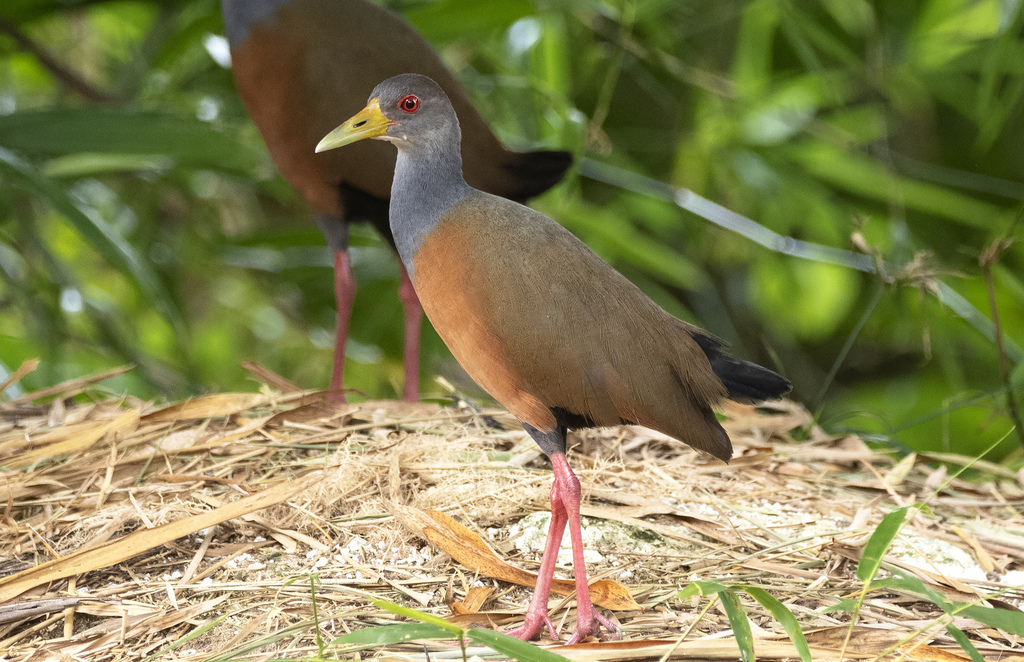
This bird, large for a wood rail, has both a grey head and neck. In the nominate, the back of the head has a brown patch. The upperparts are olive-green to dark brown. The chest and flanks are a rufous colour, with the belly, rump, and tail being black. The legs are coral-red, the bill is a bright greenish-yellow, and the eyes are red. The sexes are similar. The juveniles can be differentiated by their duller look, and the chicks have a black, downy appearance, brown head, and black beak. The subspecies A. c. avicenniae can be differentiated by its smaller size, lack of a brown patch at the back of the neck, and its lower back being toned slightly olive. The underparts are also pale.
From the article Grey-cowled wood rail on Wikipedia (CC BY-SA), quoted section by section
Description
The grey-cowled wood rail usually measures 33–40 centimetres (13–16 in) long and weighs 320–465 grams (11.3–16.4 oz), particularly large for a wood rail. The upperparts are olive-green to dark brown. The head and neck are medium-grey, blending into a brown patch at the back of the head. The eyes are red. The chest and flanks are rufous. The belly, rump, and tail are black. The legs are coral-red, while the bill is a bright greenish-yellow. The males and females are similar. Juvenile birds are similar to the adult but are duller in colour, with their belly sooty-black and flecked with buff. The juveniles also differ in that their bill and legs are dusky, and have brownish eyes. The chicks are black and downy, with a brownish head. Their dark eyes are lined with dull, reddish bare skin. The black bill has a flesh-coloured base, and a small, white egg tooth behind the tip of the upper mandible, as well as a very small one at the tip of the lower mandible. The subspecies A. c. avicenniae differs from the nominate by its smaller size. It also varies as its nape to back is a dull grey colour. The brown spot present at the back of the head of the nominate is also reduced or gone. The lower back is toned a slight olive, and the underparts are also slightly paler than the nominate, but without white feathers. The upper wing coverts of A. c. avicenniae are also more greenish-grey. …
Range & habitat
The grey-cowled wood rail is found in Argentina, Bolivia, Brazil, Colombia, Costa Rica, Ecuador, French Guiana, Guyana, Panama, Paraguay, Peru, Suriname, Trinidad and Tobago, Uruguay, and Venezuela. The nominate subspecies is cut off by the Andes Mountains and lives east of the range in Ecuador, Peru, and Bolivia; it is not found in the southeastern interior of Brazil. The subspecies A. c. avicenniae is found in coastal southeastern Brazil, around São Paulo. The grey-cowled wood rail's natural habitats are subtropical or tropical moist lowland forests, subtropical or tropical mangrove forests, and subtropical or tropical swamps. The subspecies A. c. avicenniae is however almost completely restricted to mangrove forests. The grey-cowled wood rail can be found from sea level to elevations around 2,000 metres (6,600 ft), although some wanderers have been recorded at elevations up to 2,300 metres (7,500 ft) in Colombia.
Wikipedia: “Distribution and habitat”
What it does
This bird can be seen to perch in both shrubbery and even trees, something characteristic of the forest rails. The grey-cowled wood rail rarely flies, although when it is flushed out, it will generally move to a branch close to the ground. If it is being observed, it is generally cautious.
Breeding. The grey-cowled wood rail's nests are situated in trees and bushes, usually 1 to 3 metres (3.3 to 9.8 ft) off the ground, built on flat branches or in thickets and lined with twigs and leaves. They generally have a diameter between 30 and 40 centimetres (12 and 16 in) on the outside, with an internal diameter of around 15 centimetres (5.9 in). The depth is usually between under 4 and 9 centimetres (1.6 and 3.5 in). The overall height of the nest is around 16 centimetres (6.3 in). This bird is monogamous, forming long-lasting pair bonds, with pairs of grey-necked wood rails staying together throughout the year. Its breeding season usually occurs between March and August, although this varies depending on geography. In Costa Rica, the breeding season extends until September. In Mexico, on the other hand, the breeding season is known to start as early as January. …
Wikipedia: “Behaviour and ecology”
In human culture
Placed in the family Rallidae (rails, moorhens, coots and allies), this species was originally described as Fulica cajanea by Philipp Ludwig Statius Müller, in his 1776 Vollständiges Natursystem. Müller based his description on the illustration Poule d'Eau de Cayenne (water hen of Cayenne) by the French naturalist and artist Edme-Louis Daubenton in his Planches Enlumineés d'Histoire Naturelle. It was eventually moved to the new genus Aramides, the wood rails, by Jacques Pucheran in 1845, and the specific epithet was changed to cajaneus. The grey-cowled wood rail is regarded as being sister species with the russet-naped wood rail, one of the nine members of the genus Aramides, within which the grey-cowled wood rail is also included. The two were classified as subspecies of a single species by James L. Peters in the 1934 edition of his Check-list of Birds of the World, before being separated as species once more in 2015. The two rails have different calls and plumage with no gradation reported. The number of subspecies is contentious, some authorities accept up to nine, while others accept only two. It is even suggested that the subspecies A. c. avicenniae be split off as a full species, based on differences in morphology and calls, speculated to have arisen because the slaty-breasted wood rail acted as an ecological barrier between the two subspecies. …
Wikipedia: “Taxonomy and etymology”
Listen
Looking for field recordings…
Where it lives
Recorded sightings
—
geo-referenced records in GBIF, from museums, herbaria and field observers.
Drag the globe to turn it. Dots are where records exist, not a range map; darker means more records.
In the stacks
Searching the stacks…
Every page naming Aramides cajaneus in the Biodiversity Heritage Library →
This page is assembled live from iNaturalist, GBIF, Wikipedia, the Source Library and the Internet Archive. It is not yet part of the hand-edited codex. iNaturalist taxon 513889.