- Animals
- ›Chordates
- ›Vertebrates
- ›Ray-finned Fishes
- ›Spiny-rayed fishes
- ›Trout-perches, Pirate Perches, and Cavefishes
- ›Cavefishes
- ›Amblyopsis
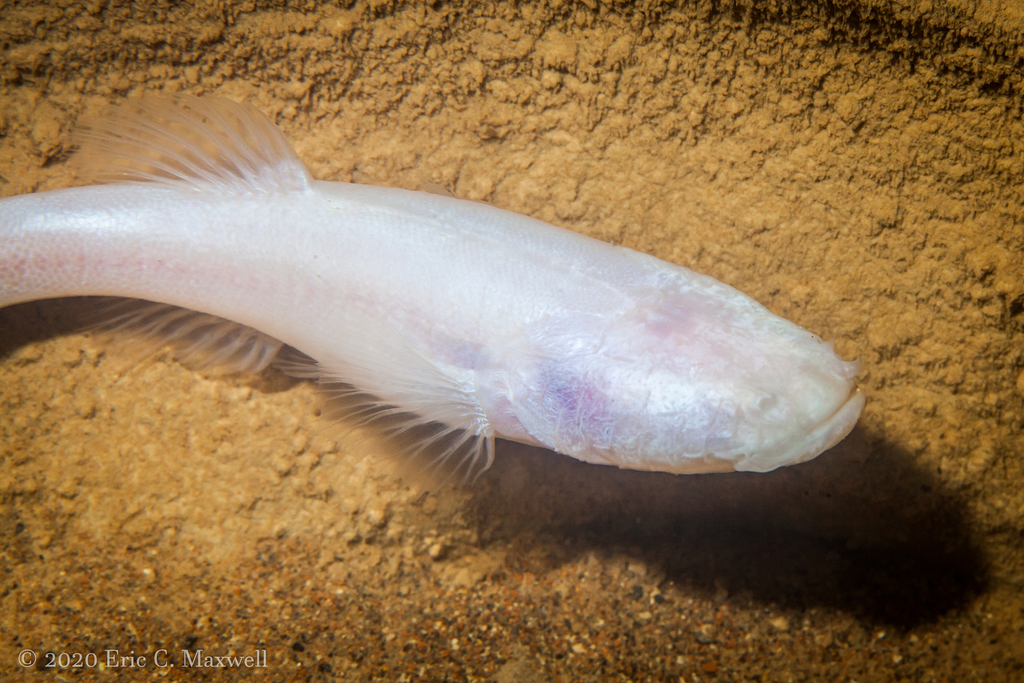
Hoosier Cavefish
Amblyopsis hoosieri
The Hoosier cavefish (Amblyopsis hoosieri) is a subterranean species of blind fish from southern Indiana in the United States. Described in 2014, A. hoosieri was the first new species of amblyopsid cavefish to be discovered in 40 years.
From the article Hoosier cavefish on Wikipedia (CC BY-SA), quoted section by section
Description
Average length is 6–8 centimetres (2.4–3.1 in). The head makes up approximately one quarter of its total length. As typical of cavefish, this species is blind. The lower jaw extends beyond the upper. The body is flattened dorsally, but robust, with short, rounded fins. The anus is located toward the front of the body, directly behind the gills. General coloration is pinkish-white, with red around the gills. The fins are transparent.
Range & habitat
The subterranean A. hoosieri is distributed among 68 caves and 6 springs throughout Indiana, between the Ohio River and the East Fork of the White River. Its range is limited to those caves that were not covered by glaciers during the Pleistocene. The Hoosier cavefish is usually found in pools in slow-flowing cave streams, in water that ranges from more than 2 metres (6.5 ft) deep to as shallow as 10 centimetres (4 in). Other species from the genus have been observed to prefer large, deep pools.
Wikipedia: “Range and habitat”
What it does
Breeding takes place between February and April, when the water levels are highest. Eggs are brooded in the females' gill cavity. After hatching, the females care for the young for 4–5 months. Individuals become sexually mature at 3–4 years of age. The species is suspected to have a lifespan of 12–15 years, but may live as long as 20 years.
Wikipedia: “Reproduction and development”
In human culture
The specific name is derived from the word "Hoosier", the name for a resident of the state of Indiana. The choice of the name was also influenced by the fact that Prosanta Chakrabarty, the senior author of the paper that first described the species, was a fan of the Indiana Hoosiers college basketball team.
Wikipedia: “Etymology”
Where it lives
Recorded sightings
—
geo-referenced records in GBIF, from museums, herbaria and field observers.
Drag the globe to turn it. Dots are where records exist, not a range map; darker means more records.
In the stacks
Searching the stacks…
Every page naming Amblyopsis hoosieri in the Biodiversity Heritage Library →
This page is assembled live from iNaturalist, GBIF, Wikipedia, the Source Library and the Internet Archive. It is not yet part of the hand-edited codex. iNaturalist taxon 511402.