- Animals
- ›Chordates
- ›Vertebrates
- ›Birds
- ›Cranes, Rails, and Allies
- ›Rails, Gallinules, and Coots
- ›Erythromachus
On eBird ↗
Rodrigues Rail
Live sightings near you, the range map, bar charts of when it is seen, and Macaulay Library photos and recordings.
Rodrigues Rail
Erythromachus leguati
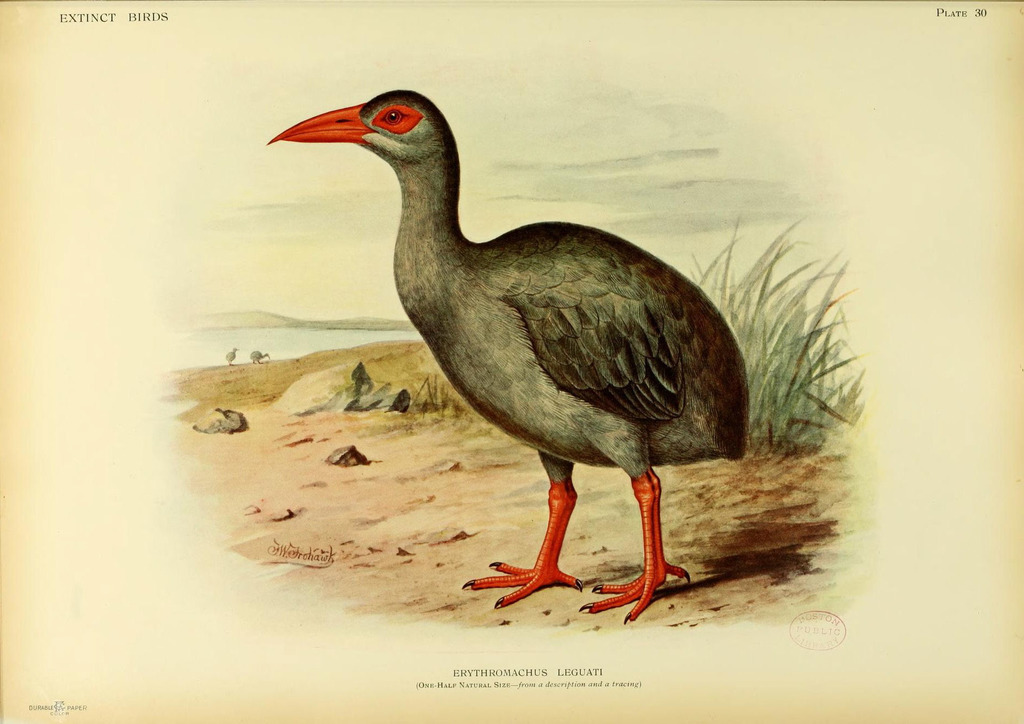
The Rodrigues rail (Erythromachus leguati), also known as Leguat's gelinote or Leguat's rail, is an extinct species of the rail family that was endemic to the Mascarene island of Rodrigues. The bird was first documented from life by two accounts from 1691–93 and 1725–26. Subfossil remains were later discovered and correlated with the old accounts in 1874, and the species was named E. leguati in Leguat's honour. It is generally kept in its own genus, Erythromachus, but has sometimes been assigned to the genus Aphanapteryx along with its close relative the red rail (A. bonasia) of Mauritius; their relationship with other rails is unclear.
The Rodrigues rail was about 35 cm (14 in) long and weighed at least 500 g (18 oz). It was described as having grey plumage, a red beak, red legs, and a naked red patch around the eye. The beak was long and curved downwards. It was flightless and fed on tortoise eggs. It was described as being attracted to red objects, which humans exploited while hunting it. The Rodrigues rail is believed to have become extinct in the mid-18th century mainly because of predation by introduced cats and hunting.
From the article Rodrigues rail on Wikipedia (CC BY-SA), quoted section by section
Description
The Rodrigues rail was about 35 cm (14 in) long, smaller than the red rail, but with proportionally longer wings. It may have weighed at least 500 g (18 oz). Subfossil remains exhibit a large variation in size, which may reflect sexual dimorphism. It had bright grey plumage, perhaps flecked with white. Its beak and legs were red, and it had a red, naked area (or wattle) around its eyes. The cranium of the Rodrigues rail was slightly elongated, convex in every direction, and compressed from top to bottom in side-view. The cranium was medium-sized among Mascarene rails, 38 mm (1.5 in) long and 20 mm (0.79 in) wide. It had a narrow, long frontal region, 6.5 mm (0.26 in) at its least width. The beak was long and curved downwards as in the red rail, but the narial openings were longer. The premaxilla that comprised most of the upper bill was long, shallow in side-view, with a narrow nasal bone, and its total length was almost 60% longer than the cranium. The culmen of the beak was almost straight above the nostril, and the nasal bone was slightly longer than the cranium. The beak was up to 77 mm (3.0 in) long, the lower jaw up to 98 mm (3.9 in) long, and 8 mm (0.31 in) at its greatest depth. The narial (nostril) opening was very long, 66% of the rostrum's length. There were foramina (openings) on the upper bill, which did not extend to the front edge of the narial opening. …
What it does
According to Tafforet's account, the Rodrigues rail fed on the eggs of the now extinct Cylindraspis tortoises, three species of which lived on Rodrigues. As it took advantage of their breeding season, Hume considered it an opportunistic predator, which perhaps also fed on hatchling tortoises. A former tortoise breeding area in the Plaine Corail shows that such sites were concentrated into a small area containing large numbers of eggs; the phalanx bone of a Rodrigues rail has been found among the egg remains. The rails would have fattened themselves seasonally, but at other times of the year, they probably fed on snails and other invertebrates, as well as scavenging sea bird colonies. The Rodrigues rail probably fed on worms, such as Kontikia whartoni and the now extinct Geonemertes rodericana, by probing leaf-litter or rotting wood. Sexual dimorphism may have reflected differences in diet between the sexes. Since Leguat was unable to locate its nests, the Rodrigues rail may have nested outside the easily accessible open forest as was typical in coastal and lowland areas, and rather nested deep in forested valleys or mountainous hills of the interior, according to Hume. Its nests may have been well concealed in vegetation on the ground, as is the case of other flightless rails. …
Wikipedia: “Behaviour and ecology”
Listen
Looking for field recordings…
Where it lives
Recorded sightings
—
geo-referenced records in GBIF, from museums, herbaria and field observers.
Drag the globe to turn it. Dots are where records exist, not a range map; darker means more records.
In the stacks
Searching the stacks…
Every page naming Erythromachus leguati in the Biodiversity Heritage Library →
This page is assembled live from iNaturalist, GBIF, Wikipedia, the Source Library and the Internet Archive. It is not yet part of the hand-edited codex. iNaturalist taxon 511372.