- Animals
- ›Chordates
- ›Vertebrates
- ›Ray-finned Fishes
- ›Spiny-rayed fishes
- ›Wrasses and allies
- ›False scorpionfishes, wrasses, and parrotfishes
- ›Wrasses and Parrotfishes
- ›Rainbow Wrasses and Allies
- ›Coris
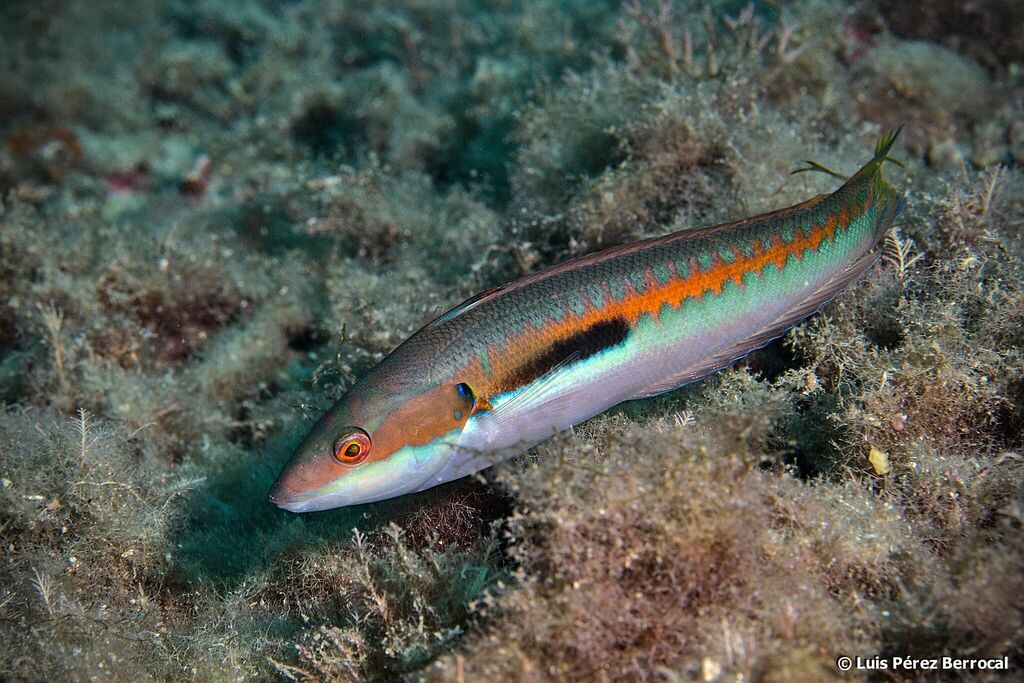
Mediterranean Rainbow Wrasse
Coris julis
Coris julis also known by its common name, the Mediterranean rainbow wrasse, is a Mediterranean and Eastern Atlantic fish. Phylogenetically they belong to the Labridae family, also known as the wrasses. Within their genus, Coris, there are a total of 28 species. As discussed more in the Life History section below, they can present with more than one coloration. This is because they are diandric protogynous hermaphrodites. These fish are born as what scientists term primary males and females and can transition from a female to a secondary male. Primary individuals are described to be less than 18cm in length and all those larger are secondary males.
From the article Mediterranean rainbow wrasse on Wikipedia (CC BY-SA), quoted section by section
Range & habitat
C. julis typically inhabits rock/sandy substrates at the oceans floor and can commonly be found in seagrass beds. They also bury themselves in sand between sunset and sunrise. These habitats are in shallower coastal waters, and their standard depth range has been described as 0–50m with extremes of 0–120m. Geographically, as their name indicates, these fish are found in the Mediterranean Sea with an apparently even distribution. However, it can also be found as far North as Norway and as far South as Senegal. Further south you begin to see the related species Coris atlantica which is less widespread and lives in Western-central Africa. These two species represent the only 2 in the genus Coris found in the Eastern Atlantic. The other 26 are found in the Indo-Pacific. Although based upon the study mentioned under Species Description, C. julis should be split into C. julis and C. menalura.
Wikipedia: “Distribution”
What it does
When mating, the terminal males swim rapidly with their dorsal fins erect in short up and down motions. Both phases of males can mate but secondary males have higher success rates for spawning. After the mating ritual, eggs are fertilized and hatch about two days later. They live as larvae with the zooplankton for about a month then fall to the bottom of the ocean and begin their juvenile stage. They are known to be reproductively active between May and July in the Balearic Islands. This life history strategy of non-year-round reproduction allows C. julis to put resources toward growth the rest of the year without sacrificing reproductive success. It is also during this post spawning season time between August and December that they undergo sex inversion. C. julis is classified as a diandric protogynous hermaphrodite. Diandric species are those with two male categories and protogyny is the sex-inversion from female to male. Sex change is common in the Labridae family, and for C. julis the shift in color occurs at the same time. Spermatongial nets appear along the ovarian wall and spread inward. This makes telling secondary and primary males apart difficult. All stages and sexes are functional, including primary males who are male at first maturation and do not undergo sex inversion.
Wikipedia: “Reproduction, mating, and sex reversal”
In human culture
Behavior and feeding As mentioned above, this species lives in rocky or sandy substrates as well as seagrass beds at typical depths of 0–50 m. They feed on benthic organisms such as mollusks and crustaceans. They forage in groups by day, disappearing before sunset by burying themselves in the sand and reemerging at sunrise. One study even showed that the fish are in a sleeplike state at night, indicated by their lowered reactiveness. C. julis are also documented to be territorial, though only the secondary males exhibit this behavior. Although they are territorial, they do not control the movements of females within their territory or where they spawn. One study showed that secondary males are more likely to be territorial with other males when they can distinguish between long and short-wave colors. This is notable as colors like red and orange don't penetrate far into the water column, but secondary males do display a bright orange stripe.
Wikipedia: “Life history”
Where it lives
Recorded sightings
—
geo-referenced records in GBIF, from museums, herbaria and field observers.
Drag the globe to turn it. Dots are where records exist, not a range map; darker means more records.
In the stacks
Searching the stacks…
Every page naming Coris julis in the Biodiversity Heritage Library →
This page is assembled live from iNaturalist, GBIF, Wikipedia, the Source Library and the Internet Archive. It is not yet part of the hand-edited codex. iNaturalist taxon 50968.