- Plants
- ›Vascular Plants
- ›flowering plants
- ›Dicots
- ›Sunflowers, Bellflowers, Fanflowers, and Allies
- ›Sunflowers, Daisies, Asters, and Allies
- ›Asteroideae
- ›marigolds and allies
- ›Calendula
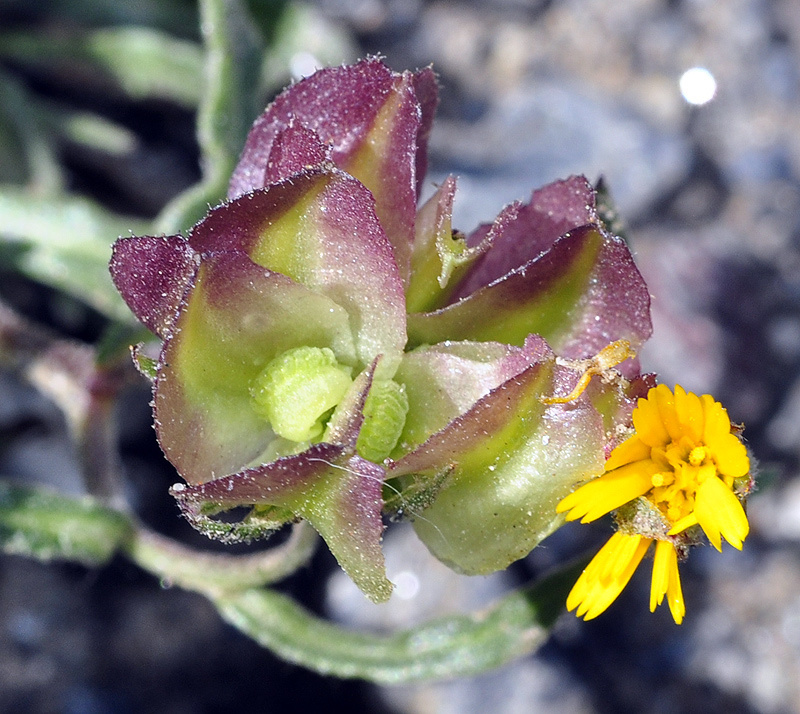
Calendula tripterocarpa
Calendula tripterocarpa is a species of flowering plant in the marigold genus Calendula, family Asteraceae. It is native to Spain, the Canary Islands, North Africa, and the Middle East as far as Iran. It is a therophyte.
From the article Calendula tripterocarpa on Wikipedia (CC BY-SA), quoted section by section
Description
This perennial plant reaches a height between 10 and 20 cm. The leaves are mid green, covered with short, sticky hairs. Flowers are multi petaled, and yellow or orange in colour. The young stems are at first erect, but later they begin to hang and spread on the soil.The most peripheral fruits have flat wings, and are therefore much broader than the fruits of Calendula arvensis. Flowers autumn to spring.
In medicine
Calendula tripterocarpa is a medicinal plant widely used in folk medicine for treatment of minor cuts, burns and skin irritation in Saudi Arabia. A 2018 study showed high phenol and flavonoid content. However, further study has to be accomplished on this plant type to prove its traditional uses and its various biological activities.
== References ==
Wikipedia: “Medicinal usage”
Where it lives
Recorded sightings
—
geo-referenced records in GBIF, from museums, herbaria and field observers.
Drag the globe to turn it. Dots are where records exist, not a range map; darker means more records.
In the stacks
Searching the stacks…
Every page naming Calendula tripterocarpa in the Biodiversity Heritage Library →
This page is assembled live from iNaturalist, GBIF, Wikipedia, the Source Library and the Internet Archive. It is not yet part of the hand-edited codex. iNaturalist taxon 509607.