On eBird ↗
Reed Cormorant
Live sightings near you, the range map, bar charts of when it is seen, and Macaulay Library photos and recordings.
Reed Cormorant
Microcarbo africanus
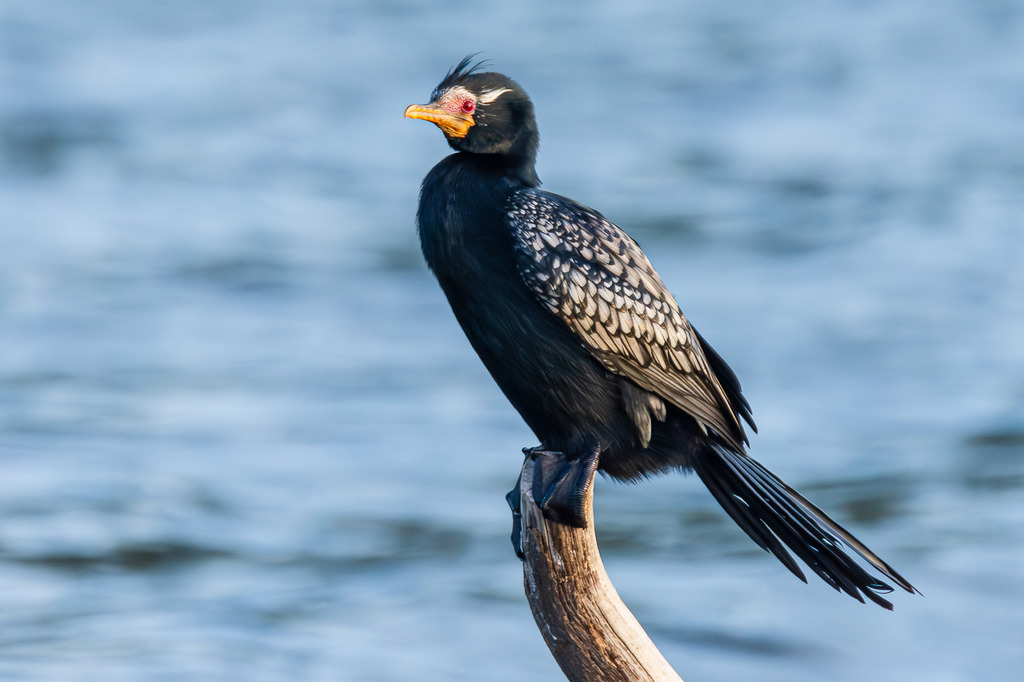
The reed cormorant (Microcarbo africanus), also known as the long-tailed cormorant, is a bird in the cormorant family Phalacrocoracidae. It breeds in much of Africa south of the Sahara, and Madagascar. It is resident but undertakes some seasonal movements.
From the article Reed cormorant on Wikipedia (CC BY-SA), quoted section by section
Description
This is a small cormorant, 50–55 cm (20–22 in) in overall length with a wingspan of 80–90 cm (31–35 in). It is mainly black, glossed green, in the breeding season. The wing coverts are silvery. It has a longish tail, a short head crest and a red or yellow face patch. The bill is yellow. The sexes are similar, but non-breeding adults and juveniles are browner, with a white belly. Some southern races retain the crest all year round.
Range & habitat
This is a common and widespread species, and is not considered to be threatened. It breeds on freshwater wetlands or quiet coasts.
Wikipedia: “Distribution and habitat”
What it does
The reed cormorant can dive to considerable depths, but usually feeds in shallow water. It frequently brings prey to the surface. It takes a wide variety of fish. It prefers small slow-moving fish, and those with long and tapering shapes, such as mormyrids, catfishes, and cichlids. It will less frequently eat soles (which can be important in its diet locally), frogs, aquatic invertebrates, and small birds. Two to four eggs are laid in a nest in a tree or on the ground, normally hidden from view by long grass.
Wikipedia: “Behaviour”
Listen
Looking for field recordings…
Where it lives
Recorded sightings
—
geo-referenced records in GBIF, from museums, herbaria and field observers.
Drag the globe to turn it. Dots are where records exist, not a range map; darker means more records.
In the stacks
Searching the stacks…
Every page naming Microcarbo africanus in the Biodiversity Heritage Library →
This page is assembled live from iNaturalist, GBIF, Wikipedia, the Source Library and the Internet Archive. It is not yet part of the hand-edited codex. iNaturalist taxon 508246.