- Animals
- ›Chordates
- ›Vertebrates
- ›Birds
- ›Pelicans, Herons, Ibises, and Allies
- ›Herons, Egrets, and Bitterns
- ›Typical Herons and Egrets
- ›Gorsachius
On eBird ↗
Malayan Night Heron
Live sightings near you, the range map, bar charts of when it is seen, and Macaulay Library photos and recordings.
Malayan Night Heron
Gorsachius melanolophus
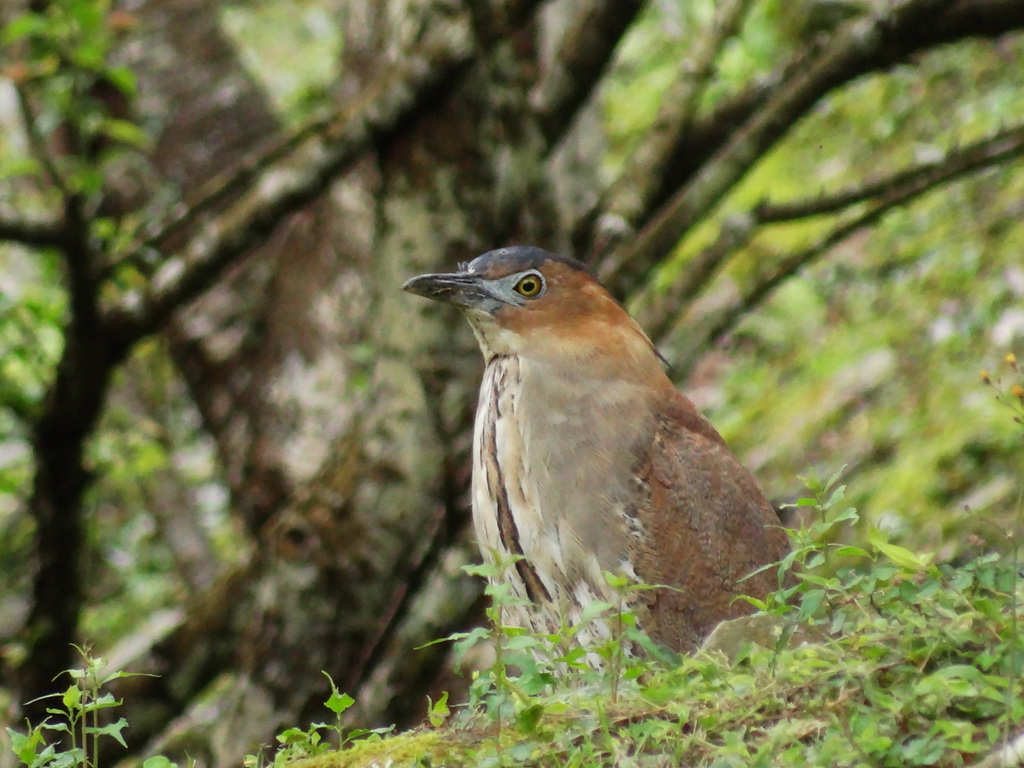
The Malayan night heron (Gorsachius melanolophus), also known as Malaysian night heron and tiger bittern, is a medium-sized heron. It is distributed in southern and eastern Asia.
From the article Malayan night heron on Wikipedia (CC BY-SA), quoted section by section
Description
The Malayan night heron is about 48 cm (19 in) long. The wingspan is about 86 cm (34 in). It is stocky, with a short beak. Its neck and breast are rufous. There are streaks going down the centre of the neck to the breast. The upperparts are chestnut and vermiculated. The flight feathers are blackish. The crown is black, the chin is white, and the eyes are yellow. The beak is black and the legs are greenish. The juvenile is greyish to rufous and is spotted and vermiculated. Males have been reported to have deeper blue lores and a longer crest compared to females during the breeding season. Males develop the dark blue lores 30–60 days prior to pair-bonding, while females had bluish-green lores when they first appeared in the breeding areas. Colours of the lores of both sexes faded as incubation progressed, with colours changing to bluish-green to green to greyish-green. If pairs laid a second clutch, the colouration of their lores were duller than the colouration during the first clutch.
Range & habitat
The Malayan night heron has been found in India, Sri Lanka, Brunei, Nepal, Bangladesh, Myanmar, Cambodia, Laos, Vietnam, Thailand, Malaysia, Singapore, China, Indonesia, the Philippines, Taiwan and Japan. It is a vagrant in Palau and Korea. Its range size is estimated at 1,240,000 km2. One roadkilled bird was discovered on Christmas Island, Australia where it is likely a vagrant. This bird occurs in forests, streams, and marshes. In Japan, population densities of the herons increased as undisturbed forest cover on islands increased.
Wikipedia: “Distribution and habitat”
Listen
Looking for field recordings…
Where it lives
Recorded sightings
—
geo-referenced records in GBIF, from museums, herbaria and field observers.
Drag the globe to turn it. Dots are where records exist, not a range map; darker means more records.
In the stacks
Searching the stacks…
Every page naming Gorsachius melanolophus in the Biodiversity Heritage Library →
This page is assembled live from iNaturalist, GBIF, Wikipedia, the Source Library and the Internet Archive. It is not yet part of the hand-edited codex. iNaturalist taxon 5043.