- Animals
- ›Chordates
- ›Vertebrates
- ›Birds
- ›Pelicans, Herons, Ibises, and Allies
- ›Herons, Egrets, and Bitterns
- ›Boat-billed Herons
- ›Cochlearius
On eBird ↗
Boat-billed Heron
Live sightings near you, the range map, bar charts of when it is seen, and Macaulay Library photos and recordings.
Boat-billed Heron
Cochlearius cochlearius
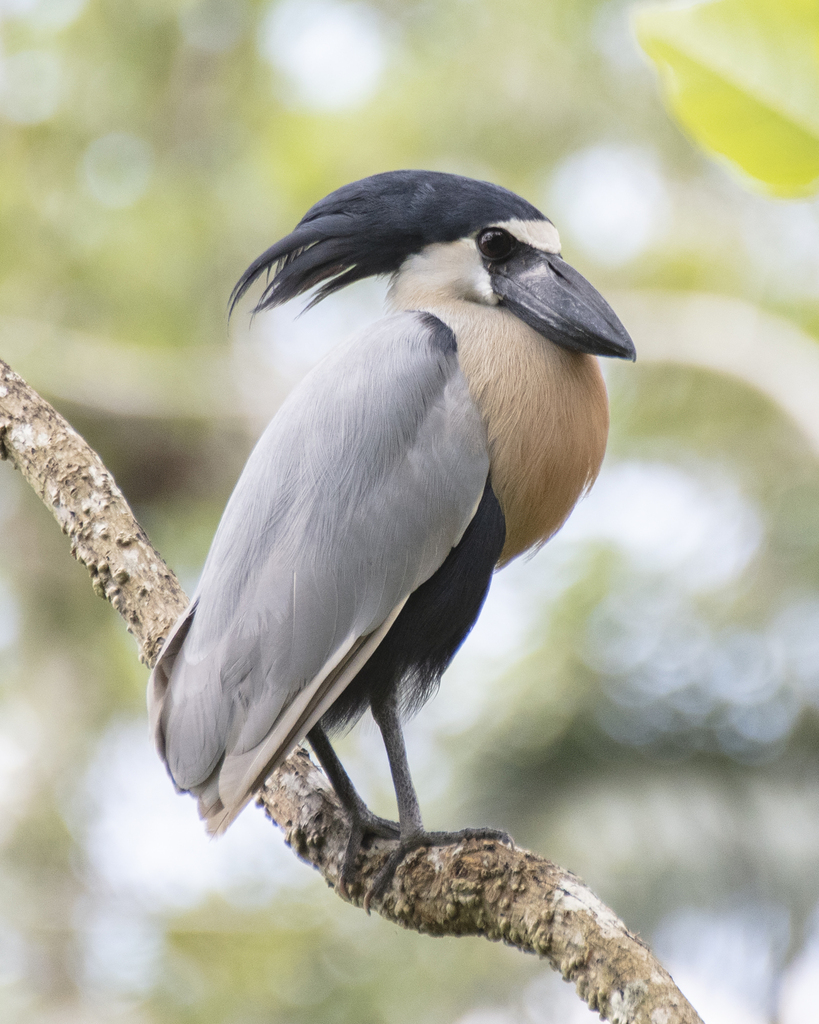
The boat-billed heron (Cochlearius cochlearius), colloquially known as the boatbill, is an atypical member of the heron family. It is the only member of the genus Cochlearius and was formerly placed in a monotypic family, the Cochleariidae. It lives in mangrove swamps from Mexico south to Peru and Brazil. It is a nocturnal bird, and breeds semi-colonially in mangrove trees, laying two to four bluish-white eggs in a twig nest.
From the article Boat-billed heron on Wikipedia (CC BY-SA), quoted section by section
Description
The boat-billed heron grows to about 54 cm (21 in) long. Adults are pale grey to white in color, with chestnut-colored abdomens and black flanks. The massive, broad, scoop-like bill, which gives rise to this species' name, is mainly black. This bird is also adorned with a crest which is thought to be used in mate attraction as it is larger in males. The sexes are similar in appearance, the main differences being that females are slightly smaller, grayer in appearance, and have shorter crests than males. Newly hatched nestlings have green-yellow skin, with their upperparts covered in gray down feathers. Their upper bill is black, and they have green-yellow legs. Juveniles are darker in color than adults and lack a crest.
Range & habitat
Boat-billed herons have a huge native range that reaches from Mexico to Peru, Brazil, and northeastern Argentina. They are nonmigratory birds that tend to live in seasonal lagoons and estuaries, and nest in mangroves.
Wikipedia: “Distribution and habitat”
What it does
Boat-billed herons feed on small mammals, amphibians, annelids, molluscs, insects, crabs, shrimp such as Penaeus and Macrobrachium, and small fish such as Dormitator latifrons, a species of sleeper goby. Other fish preyed upon include mullet, snook, and catfish. They tend to forage in vegetative streams, shallow water, and lagoons. When foraging in streams, they use low-hanging branches and mangrove roots to stand over the water. In ponds, they will walk slowly through the water up to 10 cm (4 in) deep or will forage near the water's edge. In order to capture prey they will lunge at fish or scoop the surface of the water with their bills, which are uniquely shaped for this method of capture. Additionally, they have been observed using two different feeding techniques: standing and slowly stalking prey, or disturbing the water and chasing prey. Boat-billed herons will forage nocturnally and have been seen leaving the roost 30 minutes after sundown to feed. It has been observed that they do not feed when a light source is present such as daylight, moonlight, or artificial light. One study hypothesized that in order to forage for food in the dark and in shallow, muddy water, their bills are sensitive to touch, which helps them feel for their prey.
Wikipedia: “Food and feeding”
Listen
Looking for field recordings…
Where it lives
Recorded sightings
—
geo-referenced records in GBIF, from museums, herbaria and field observers.
Drag the globe to turn it. Dots are where records exist, not a range map; darker means more records.
In the stacks
Searching the stacks…
Every page naming Cochlearius cochlearius in the Biodiversity Heritage Library →
This page is assembled live from iNaturalist, GBIF, Wikipedia, the Source Library and the Internet Archive. It is not yet part of the hand-edited codex. iNaturalist taxon 5036.