- Animals
- ›Chordates
- ›Vertebrates
- ›Birds
- ›Pelicans, Herons, Ibises, and Allies
- ›Herons, Egrets, and Bitterns
- ›Typical Herons and Egrets
- ›Ardeola
On eBird ↗
Chinese Pond-Heron
Live sightings near you, the range map, bar charts of when it is seen, and Macaulay Library photos and recordings.
Chinese Pond-Heron
Ardeola bacchus
The Chinese pond heron (Ardeola bacchus) is an East Asian freshwater bird of the heron family, (Ardeidae).
It is one of six species of birds known as "pond herons" (genus Ardeola). It is parapatric (or nearly so) with the Indian pond heron (A. grayii) to the west and the Javan pond heron (A. speciosa) to the south, and these three are presumed to form a superspecies. As a group they are variously affiliated with the squacco heron (A. ralloides) or the Malagasy pond heron (A. idae). As of mid-2011 there are no published molecular analyses of pond heron interrelationships and osteological data is likewise not analyzed for all relevant comparison taxa.
From the article Chinese pond heron on Wikipedia (CC BY-SA), quoted section by section
Description
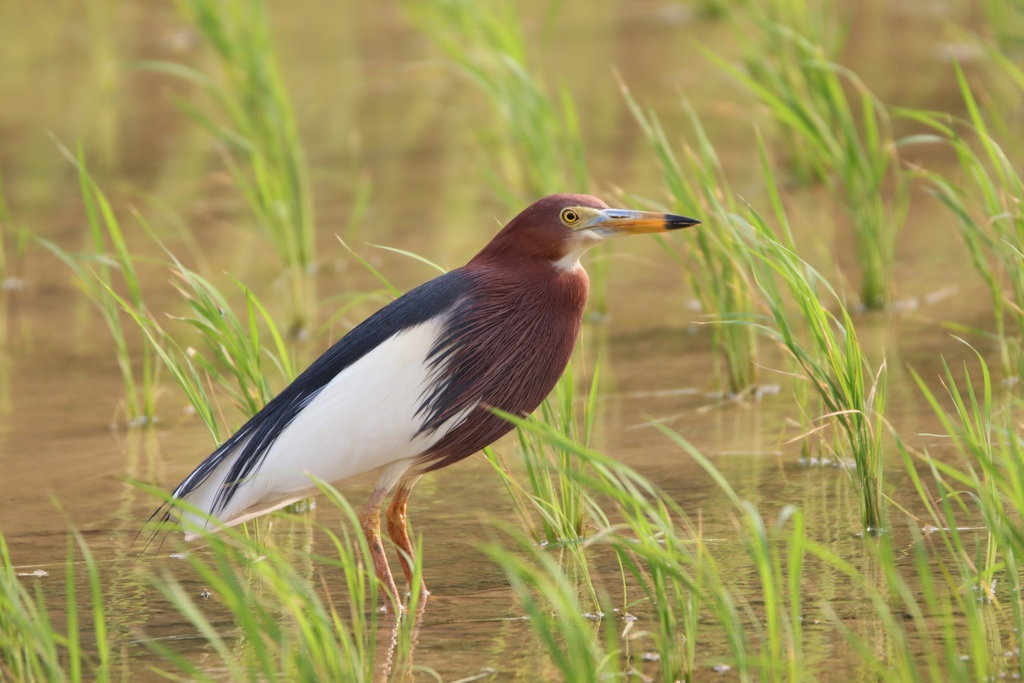
The Chinese pond heron is typically 47 cm (19 in) long with white wings, a yellow bill with a black tip, yellow eyes and legs. Its overall colour is red, blue and white during breeding season, and greyish-brown and flecked with white at other times.
It is found in shallow fresh and salt water wetlands and ponds in China and adjacent temperate and subtropical East Asia. Essentially a lowland bird, its range is delimited by the subarctic regions in the north, and by the mountain ranges in the west and south. The species is prone to some vagrancy. One individual in breeding plumage was seen by the river at Bonzon near Gangaw—just inside the Chin State of Burma—west of the species' usual range, on April 8, 1995. A stray bird stopping over on Saint Paul Island, Alaska on August 4–9, 1997 was the first recorded occurrence of this species in North America. Its food consists of insects, fish, and crustaceans. The Chinese pond heron often nests in mixed-species heronries. It lays a clutch of 3–6 blue-green eggs. It is fairly common and not considered a threatened species by the IUCN.
Wikipedia: “Description and ecology”
Listen
Looking for field recordings…
Where it lives
Recorded sightings
—
geo-referenced records in GBIF, from museums, herbaria and field observers.
Drag the globe to turn it. Dots are where records exist, not a range map; darker means more records.
In the stacks
Searching the stacks…
Every page naming Ardeola bacchus in the Biodiversity Heritage Library →
This page is assembled live from iNaturalist, GBIF, Wikipedia, the Source Library and the Internet Archive. It is not yet part of the hand-edited codex. iNaturalist taxon 4990.