- Animals
- ›Chordates
- ›Vertebrates
- ›Birds
- ›Pelicans, Herons, Ibises, and Allies
- ›Herons, Egrets, and Bitterns
- ›Typical Herons and Egrets
- ›Nycticorax
On eBird ↗
Nankeen Night Heron
Live sightings near you, the range map, bar charts of when it is seen, and Macaulay Library photos and recordings.
Nankeen Night Heron
Nycticorax caledonicus
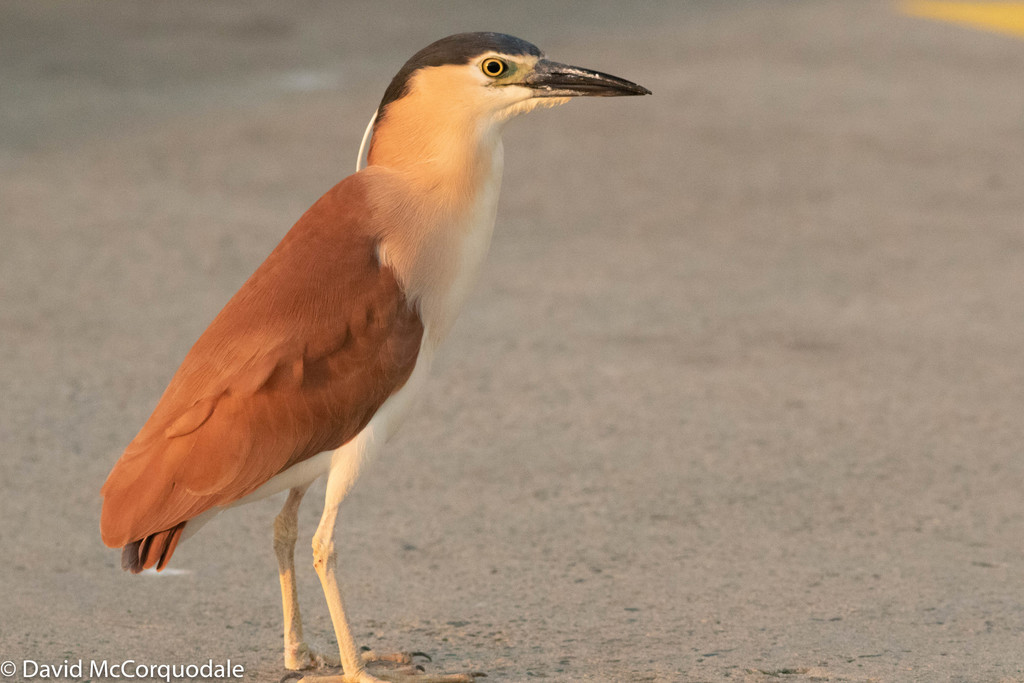
The nankeen night heron (Nycticorax caledonicus) is a heron that belongs to the genus Nycticorax and the family Ardeidae. Due to its distinctive reddish-brown colour, it is also commonly referred to as the rufous night heron. It is primarily nocturnal and is observed in a broad range of habitats, including forests, meadows, shores, reefs, marshes, grasslands, and swamps. The species is 55 to 65 cm (22 to 26 in) in length, with rich cinnamon upperparts and white underparts. The nankeen night heron has a stable population size, and is classified as a species of least concern by the International Union for Conservation of Nature (IUCN).
From the article Nankeen night heron on Wikipedia (CC BY-SA), quoted section by section
Description
The nankeen night heron is a medium-sized heron. The adult male is 55 to 65 cm in length, while the female is slightly smaller, measuring 55 to 60 cm. Its weight varies from 810 g to 1014 g, and the wingspan ranges from 95 to 105 cm. Other than females being smaller in most measurements, the sexes of the nankeen night heron are alike in appearance. The nankeen night heron has a heavy black bill, which is similar in length as its head. The face is white with a cinnamon tint, and the nape and crown of breeding adults is a grey-black. During the breeding season, there are also usually two or three thin, white plumes from the crown in a downward direction to the neck. These are tipped with black when newly grown. The heron has a rich chestnut colour across the upperparts, and the colours are more intense in the breeding season. The underparts of the nankeen night heron are white, and there is a gradual blend of the chestnut colour and the white on its neck and upper breast. The back, tail, and upper wing of the bird are a rich rufous colour. The iris is of a straw yellow and can be tinged with orange during the breeding season, while the legs and feet are a creamy yellow. …
Range & habitat
Nankeen night herons have a broad distribution and are found in Australia, New Zealand, the Philippines, Papua New Guinea, the Solomon Islands, Java, New Caledonia, Palau, and the Caroline Islands, Federated States of Micronesia. They are native to Australia and are widespread in most states of the country except for the west, in which it is rare or absent. Nankeen night herons have six subspecies, which includes the Bonin nankeen night heron (Nycticorax caledonicus crassirostris). This subspecies was endemic to Bonin Islands, Japan, but has been extinct since the late 1800s. The nankeen night heron is resident in a wide range of habitats, which includes grasslands, meadows, forests, lagoons, beaches, reefs, marshes, shores, wetlands, and swamps. It is most commonly found near rivers and streams. The species prefer habitats with emergent vegetation when near permanent water. The nankeen night heron is mainly nocturnal, and thus roosts during the daytime in dense cover of trees, bushes, and reeds. In more exposed situations, they are also known to roost in dead trees. In urban areas, the nankeen night heron favours nesting and roosting in trees such as cypresses and pines. They also reside in urban wetlands, dry fields, gardens, ponds, airports, and parks.
Wikipedia: “Distribution and habitat”
What it does
The nankeen night heron is almost fully nocturnal. They tend to leave roosts shortly after sunset and are most active from dusk to dawn. They are attentive in general, including during roosting, but can be vulnerable to predators when feeding. However, the species remain stable and widespread, and there are no current conservation measures. Adult nankeen night herons in Australia are observed as partially migratory, moving during winter and major events such as flood and rainfall. Populations that regularly migrate in accordance to seasonal shifts usually move north and can go as far as Papua New Guinea, but some can also arrive in New Zealand, as well as Pacific islands such as Christmas Island, Lord Howe Island, and Cocos-Keeling Island. Other populations of the nankeen night heron are classified as sedentary and hardly migrate at all. When facing threats, male nankeen night herons will stand fully erect and make rasping sounds or snap its bill, signalling aggressive intentions. As opponents get close, agonistic behaviours of the male nankeen night heron includes pointing and snapping its bill and waving its wing, while crouching and glaring at its opponent. There are no records of agonistic behaviour in female nankeen night herons.
Breeding. …
Wikipedia: “Behaviour”
Listen
Looking for field recordings…
Where it lives
Recorded sightings
—
geo-referenced records in GBIF, from museums, herbaria and field observers.
Drag the globe to turn it. Dots are where records exist, not a range map; darker means more records.
In the stacks
Searching the stacks…
Every page naming Nycticorax caledonicus in the Biodiversity Heritage Library →
This page is assembled live from iNaturalist, GBIF, Wikipedia, the Source Library and the Internet Archive. It is not yet part of the hand-edited codex. iNaturalist taxon 4988.