- Animals
- ›Chordates
- ›Vertebrates
- ›Ray-finned Fishes
- ›Spiny-rayed fishes
- ›Butterflyfishes, Angelfishes, and Allies
- ›Drums
- ›Aplodinotus
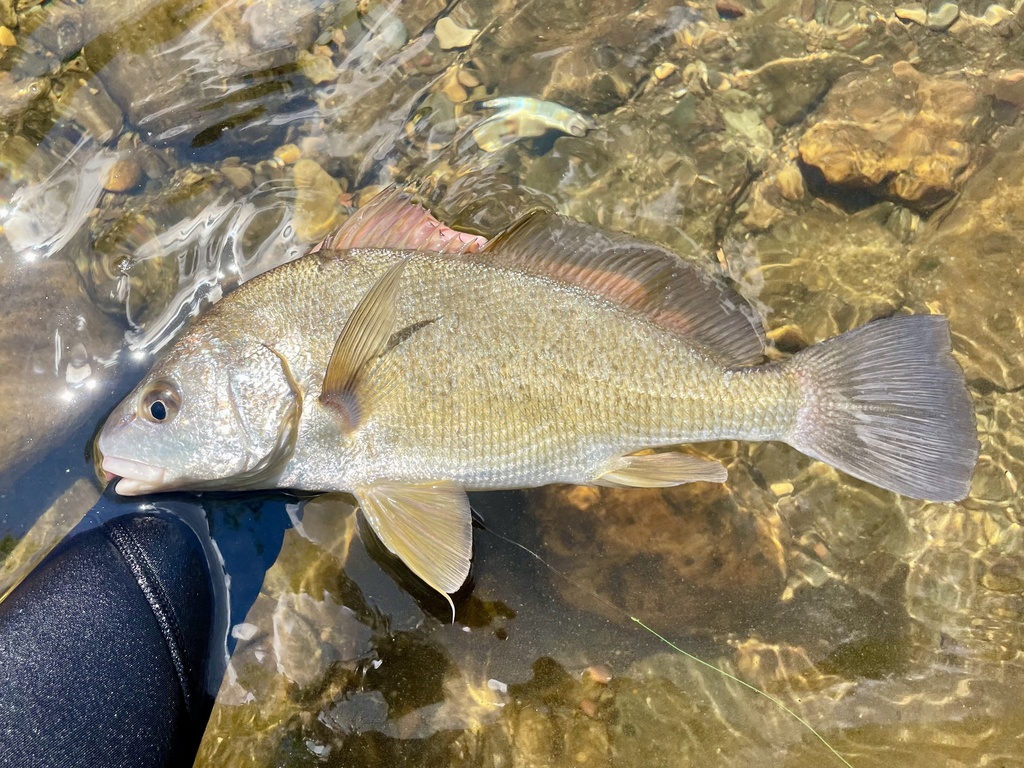
Freshwater Drum
Aplodinotus grunniens
The freshwater drum, Aplodinotus grunniens, is a fish endemic to North and Central America. It is the only species in the genus Aplodinotus, and is a member of the family Sciaenidae. It is the only North American member of the group that inhabits freshwater for its entire life. Its generic name, Aplodinotus, comes from Greek meaning "single back", and the specific epithet, grunniens, comes from a Latin word meaning "grunting". It is given to it because of the grunting noise that mature males make. This noise comes from a special set of muscles within the body cavity that vibrate against the swim bladder. The purpose of the grunting is unknown, but due to it being present in only mature males and during the spawning season, it is assumed to be linked to spawning.
The freshwater drum is also called Russell fish, shepherd's pie, gray bass, Gasper goo, Gaspergou, gou, grunt, grunter, grinder, gooble gobble, and croaker. It is commonly known as sheephead and sunfish in parts of Canada, and the United States.
From the article Freshwater drum on Wikipedia (CC BY-SA), quoted section by section
Description
The drum typically weighs 5–15 lb (2.3–6.8 kg). The world record was caught on Nickajack Lake in Tennessee, and weighed in at 54 lb 8 oz (24.7 kg). The freshwater drum is frequently gray or silvery but may be more bronze or brown colored, common in the Lake Erie population. It is a deep-bodied fish with a divided dorsal fin consisting of 10 spines and approximately 30 rays. The pectoral fins are elongated and pointed, and the lateral line extends into the caudal fin, which has a rounded or pointed margin. The eye of the freshwater drum contains a tapetum lucidum within the retinal pigmented epithelium, as in other sciaenids. In other sciaenids this structure has been found to contain packed lipid spherules which contribute to its reflective properties. Extensive pharyngeal tooth pads are present in upper and lower sets, with cardiform and villiform teeth gradually being replaced by molariform teeth as the fish grows larger.
Range & habitat
Freshwater drum are the only North American member of their family to exclusively inhabit freshwater (freshwater family members in genera Pachypops, Pachyurus, Petilipinnis and Plagioscion are from South America, while Boesemania is Asian). Their great distribution range goes as far north as the Hudson Bay, and reaches as far south as Guatemala. Their longitudinal distribution goes as far east as the eastern Appalachians and stretches as far west into Texas, Kansas, and Oklahoma. Freshwater drum are considered to be one of the most wide-ranging species in North America.
Wikipedia: “Distribution”
What it does
The freshwater drum prefers clear water, but it is tolerant of turbid and murky water. They prefer the bottom to be clean sand and gravel substrates. The diet of the freshwater drum is generally benthic and composed of macroinvertebrates (mainly aquatic insect larvae and bivalve mussels), as well as small fish in certain ecosystems. Freshwater drum show distinct seasonal differences in their diet. In April and May, the drum feeds on dipterans. During these months, dipterans make up about 50 percent of the freshwater drum's diet. In August through November, they tend to eat fish (which are primarily young-of-the-year Gizzard shad). The percentage of fish in their diet at this time ranges from 52 to 94 percent. Other items in the drum's diet are mollusks and crayfish. The freshwater drum competes with several organisms. During its early stages in Lake Erie, it has been shown to compete with yellow perch, the trout-perch, and the emerald shiner. During its adult lifetime, it competes with yellow perch and silver chub in deep water, and competes with black bass in the shoal areas.
Predators on drum include humans and other fish. During its first year, the freshwater drum serves as a forage fish for many species of predatory fish. These include smallmouth bass, walleye, and many other piscivores. After its first year, the primary predators on freshwater drum are humans. …
Wikipedia: “Ecology”
In human culture
During the summer, freshwater drums move into warm, shallow water that is less than 33 ft (10 m) deep. The freshwater drum then spawn during a six to seven-week period from June through July when the water reaches a temperature of about 65 °F (18 °C). During the spawn, females release their eggs into the water column and males release their sperm. Fertilization is random. Males generally reach sexual maturity at four years, whereas females reach maturity at five or six years. Females from six to nine years old have a clutch size of 34,000 to 66,500 eggs and they spawn in open water giving no parental care to their larvae. The eggs then float to the top of the water column and hatch between two and four days. Due to the broadcasting of eggs in open water and lack of parental care, many eggs and larvae fall victim to predation upon hatching, the pro-larvae average 3.2 mm (1⁄8 in) long. The post-larval stage begins about 45 hours after hatching and a length of 4.4 mm (3⁄16 in) is attained.
Females grow at a faster rate than the males and adult characteristics start to form at a length of 15 mm (1 in). Females continue to outgrow the male throughout their lives reaching a length of 12 to 30 in (30 to 76 cm). Usually the freshwater drum weighs 2–10 lb (0.91–4.54 kg), but they can reach well over 36 lb (16 kg). …
Wikipedia: “Life history”
Where it lives
Recorded sightings
—
geo-referenced records in GBIF, from museums, herbaria and field observers.
Drag the globe to turn it. Dots are where records exist, not a range map; darker means more records.
In the stacks
Searching the stacks…
Every page naming Aplodinotus grunniens in the Biodiversity Heritage Library →
This page is assembled live from iNaturalist, GBIF, Wikipedia, the Source Library and the Internet Archive. It is not yet part of the hand-edited codex. iNaturalist taxon 49749.