- Animals
- ›Arthropods
- ›Hexapods
- ›Insects
- ›Winged and Once-winged Insects
- ›Beetles
- ›Water, Rove, Scarab, Long-horned, Leaf, and Snout Beetles
- ›Elateriform Beetles
- ›Click, Firefly, and Soldier Beetles
- ›Fireflies
- ›typical fireflies
- ›Photinini
- ›Photinus
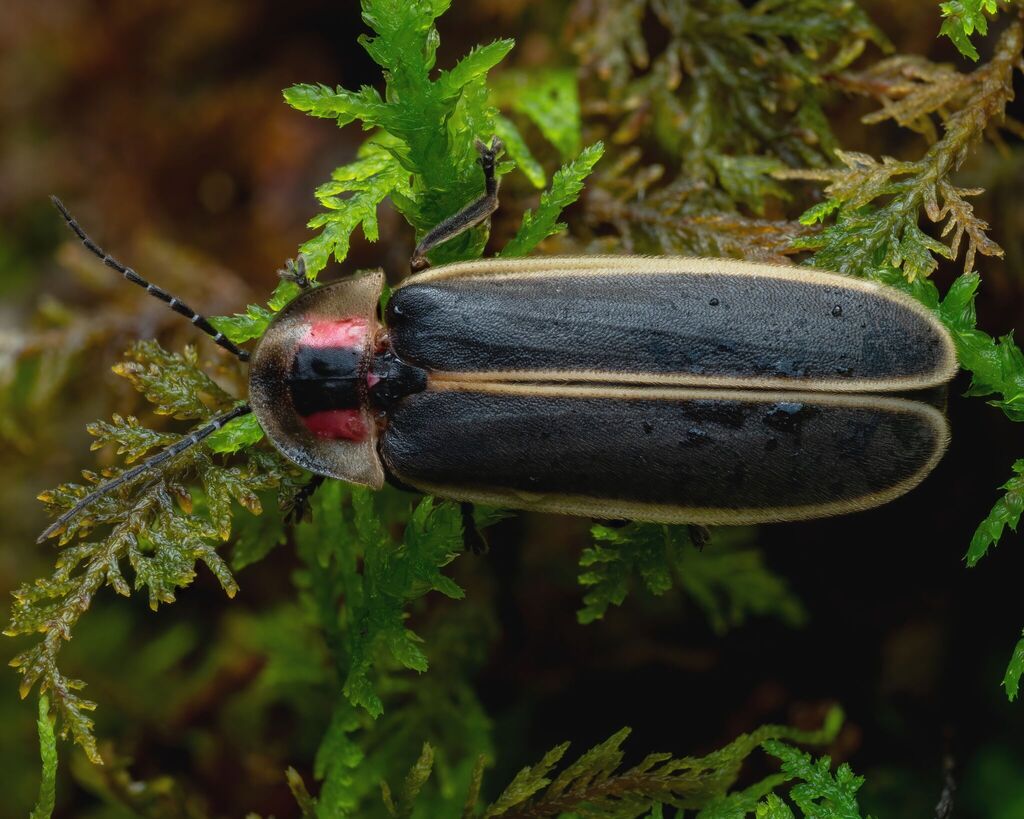
Smokies Synchronous Firefly
Photinus carolinus
Photinus carolinus, commonly known as the Smokies synchronous firefly, is a species of rover firefly whose mating displays of synchronous flashing have fascinated both scientists and tourists. As individual females synchronize with males nearby, waves of alternating bright light and darkness seem to travel across the landscape. Firefly displays typically occur in early June near Elkmont, Tennessee, in the Great Smoky Mountains National Park, near Gatlinburg. The species can be found in isolated pockets of the Appalachian Mountains in the eastern United States.
From the article Photinus carolinus on Wikipedia (CC BY-SA), quoted section by section
Description
P. carolinus is a medium-sized beetle, with adults measuring 11–15 mm (0.4–0.6 in) long. The adults have dark wing covers, or elytra, with light-colored side margins, and a pale yellow head shield, or pronotum, with a dark rectangular mark in the center and very thin black edging on the sides. Males have pale lanterns on segments 6 and 7 of their abdomen, and females have one lantern on segment 6. The rest of the abdomen is uniformly dark.
Range & habitat
In the southern part of its range, P. carolinus is usually found in hardwood forests that are 65 years old or older, in mountain river valleys at elevations from 1,400–6,000 feet (430–1,830 m). In Pennsylvania and New York, the species is found at lower elevations, 1,000–2,000 feet (300–610 m).
Wikipedia: “Habitat”
What it does
Beetles such as P. carolinus go through four life stages: egg, larva, pupa, and adult. Photinus fireflies spend the majority of their lives as larvae, which are bioluminescent and likely live below the soil surface, eating snails, worms, and other soft-bodied invertebrates. Adults appear in early summer, from late May to June.
Wikipedia: “Life cycle”
In human culture
The specific epithet refers to North Carolina, where the species was originally found.
Wikipedia: “Etymology”
Listen
Looking for field recordings…
Where it lives
Recorded sightings
—
geo-referenced records in GBIF, from museums, herbaria and field observers.
Drag the globe to turn it. Dots are where records exist, not a range map; darker means more records.
In the stacks
Searching the stacks…
Every page naming Photinus carolinus in the Biodiversity Heritage Library →
This page is assembled live from iNaturalist, GBIF, Wikipedia, the Source Library and the Internet Archive. It is not yet part of the hand-edited codex. iNaturalist taxon 497008.