- Animals
- ›Chordates
- ›Vertebrates
- ›Birds
- ›Pelicans, Herons, Ibises, and Allies
- ›Herons, Egrets, and Bitterns
- ›Typical Herons and Egrets
- ›Ardea
On eBird ↗
Goliath Heron
Live sightings near you, the range map, bar charts of when it is seen, and Macaulay Library photos and recordings.
Goliath Heron
Ardea goliath
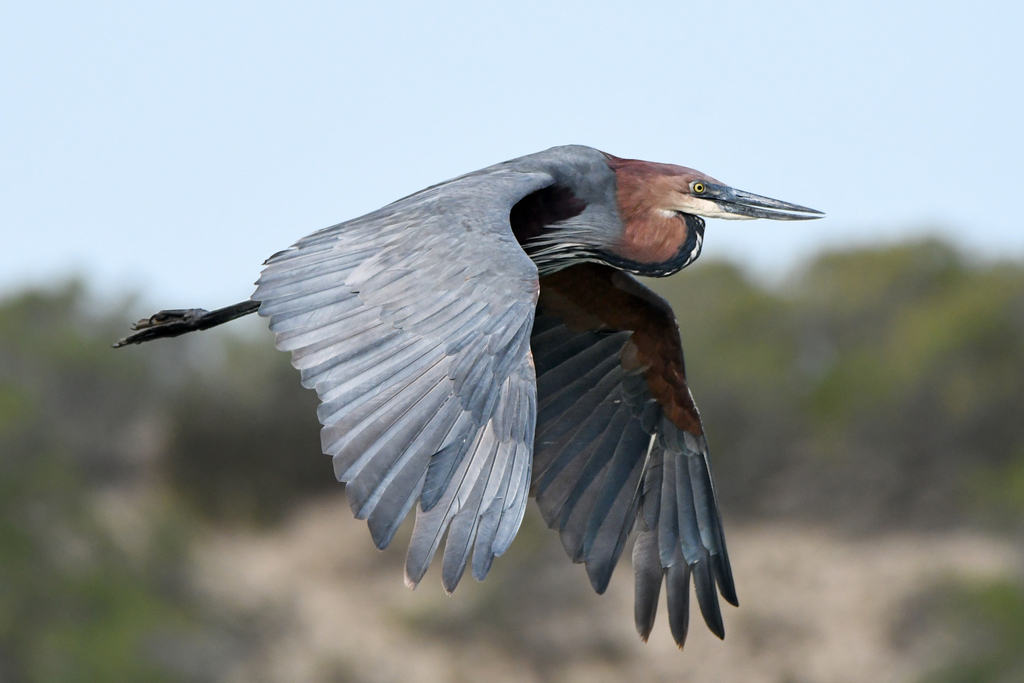
The Goliath heron (Ardea goliath), also known as the giant heron, is a very large wading bird in the heron family, Ardeidae. It is primarily found in sub-Saharan Africa, with smaller, declining numbers in Southwest and South Asia. Asian records are now very rare, but it is still known as an occasional vagrant.
From the article Goliath heron on Wikipedia (CC BY-SA), quoted section by section
Description
It is the world's largest living heron, though the extinct Bennu heron may have been larger. The height of the goliath heron is 120–152 cm (3 ft 11 in – 5 ft 0 in), the wingspan is 185–230 cm (6 ft 1 in – 7 ft 7 in), and the weight is 4–5 kg (8.8–11.0 lb). The tarsus measures from 21.2 to 25.5 cm (8.3 to 10.0 in) and the wing chord averages around 60.7 cm (23.9 in) in length. The culmen measures from 18 to 20 cm (7.1 to 7.9 in), while the bill from the gape measures around 24 cm (9.4 in). In flight it has a slow and rather ponderous look and, unlike some other herons, its legs are not held horizontally. Males and females look similar, with an overall covering of slate-grey and chestnut feathers. The head and its bushy crest, face, back, and sides of the neck are chestnut. The chin, throat, fore neck, and upper breast are white, with black streaks across the fore neck and upper breast. The lower breast and belly are buff with black streaks. The back and upper wings are slate-grey, with a chestnut shoulder patch at the bend of the wings when they are closed. The under wing is pale chestnut. The upper mandible is black and the lores and orbital areas are yellow with a greenish tinge. The eyes are yellow while the legs and feet are black. Juveniles look similar to adults, but are paler. …
Range & habitat
The Goliath heron is very aquatic, even by heron standards, rarely venturing far from a water source and preferring to fly along waterways rather than move over land. Important habitats can include lakes, swamps, mangrove wetlands, reefs with cool water, sometimes river deltas. It typically is found in shallows, though can be observed near deep water over dense water vegetation. Goliath herons can even be found in small watering holes. They range in elevation from sea level to 2,100 m (6,900 ft). They tend to prefer pristine wetlands, and generally avoid areas where human disturbance is a regular occurrence.
Wikipedia: “Habitat”
What it does
Goliath herons are solitary foragers and are highly territorial towards other herons entering their feeding territories. On occasions, two may be seen together but these are most likely to be a breeding pair or immatures. A diurnal and often rather inactive feeder, this heron often hunts by standing in the shallows, intently watching the water at its feet. This is a typical feeding method among large Ardea herons and it can forage in deeper waters than most due to its larger size. It may also perch on heavy floating vegetation, to prevent water from rippling around them. As prey appears, the heron rapidly spears it with open mandibles, often spearing both mandibles through the fish's body, and then swallows it whole. It is possible that the bill is used in a lure-like fashion occasionally, attracting fish to the static, large object submerged in the water. The handling period is long, with herons often placing their struggling prey on floating vegetation while preparing to swallow it. Due to its generally slow movements and handling time, the goliath is frequently vulnerable to kleptoparasitism. In Africa, African fish eagles frequently pirate food caught by goliath herons, and other large birds such as saddle-billed storks and pelicans may also steal their prey. The prey consists almost entirely of fish. …
Wikipedia: “Diet and behaviour”
Listen
Looking for field recordings…
Where it lives
Recorded sightings
—
geo-referenced records in GBIF, from museums, herbaria and field observers.
Drag the globe to turn it. Dots are where records exist, not a range map; darker means more records.
In the stacks
Searching the stacks…
Every page naming Ardea goliath in the Biodiversity Heritage Library →
This page is assembled live from iNaturalist, GBIF, Wikipedia, the Source Library and the Internet Archive. It is not yet part of the hand-edited codex. iNaturalist taxon 4969.