On eBird ↗
Double-spurred Spurfowl
Live sightings near you, the range map, bar charts of when it is seen, and Macaulay Library photos and recordings.
Double-spurred Spurfowl
Pternistis bicalcaratus
The double-spurred spurfowl (Pternistis bicalcaratus) is a gamebird in the pheasant family Phasianidae of the order Galliformes, gallinaceous birds. Like most spurfowls, it is restricted to Africa. It is a resident breeder in tropical West Africa, but there is a small and declining isolated population in Morocco.
From the article Double-spurred spurfowl on Wikipedia (CC BY-SA), quoted section by section
Description
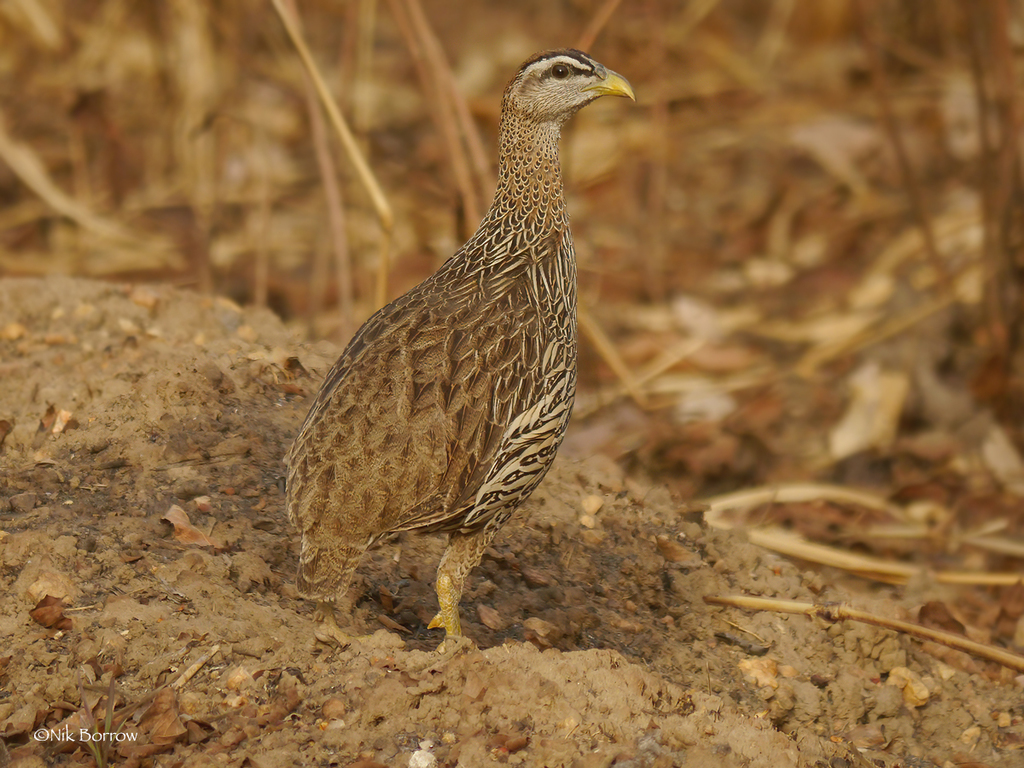
The double-spurred spurfowl is 30–34 cm (12–13 in) in length. The male is mainly brown, sparingly streaked and spotted darker and cream above, chest and flank feathers are dark brown edged and centrally spotted cream. The face is pale cream finely flecked with dark brown, and the head features a chestnut crown and white supercilium. It has a chestnut neck collar, white cheek patches and brown wings. The male usually has two spurs on each leg, the upper one being blunt. The legs are dull green. The female is similar in appearance, but usually lacks spurs and is slightly smaller and less robustly built. Males weigh around 507 g (17.9 oz) and females around 381 g (13.4 oz). Young birds are almost indistinguishable from adult females after the post juvenile moult at several weeks old, males take several months to develop any spurs. Breeding is unlikely until the birds are in their second year.
Range & habitat
This bird is found in open habitats with trees. It nests in a lined ground scrape laying 5 to 7 eggs. The double-spurred spurfowl takes a wide variety of plant and insect food. This is a very unobtrusive species, best seen in spring when the male sings a mechanical krak-krak-krak from a mound. It has a pheasant's explosive flight, but prefers to creep away unseen.
Wikipedia: “Distribution and habitat”
Listen
Looking for field recordings…
Where it lives
Recorded sightings
—
geo-referenced records in GBIF, from museums, herbaria and field observers.
Drag the globe to turn it. Dots are where records exist, not a range map; darker means more records.
In the stacks
Searching the stacks…
Every page naming Pternistis bicalcaratus in the Biodiversity Heritage Library →
This page is assembled live from iNaturalist, GBIF, Wikipedia, the Source Library and the Internet Archive. It is not yet part of the hand-edited codex. iNaturalist taxon 495940.