On eBird ↗
Eurasian Thick-knee
Live sightings near you, the range map, bar charts of when it is seen, and Macaulay Library photos and recordings.
Eurasian Stone-curlew
Burhinus oedicnemus
The Eurasian stone-curlew, Eurasian thick-knee, or simply stone-curlew (Burhinus oedicnemus), is a northern species of the Burhinidae (stone-curlew) bird family.
From the article Eurasian stone-curlew on Wikipedia (CC BY-SA), quoted section by section
Description
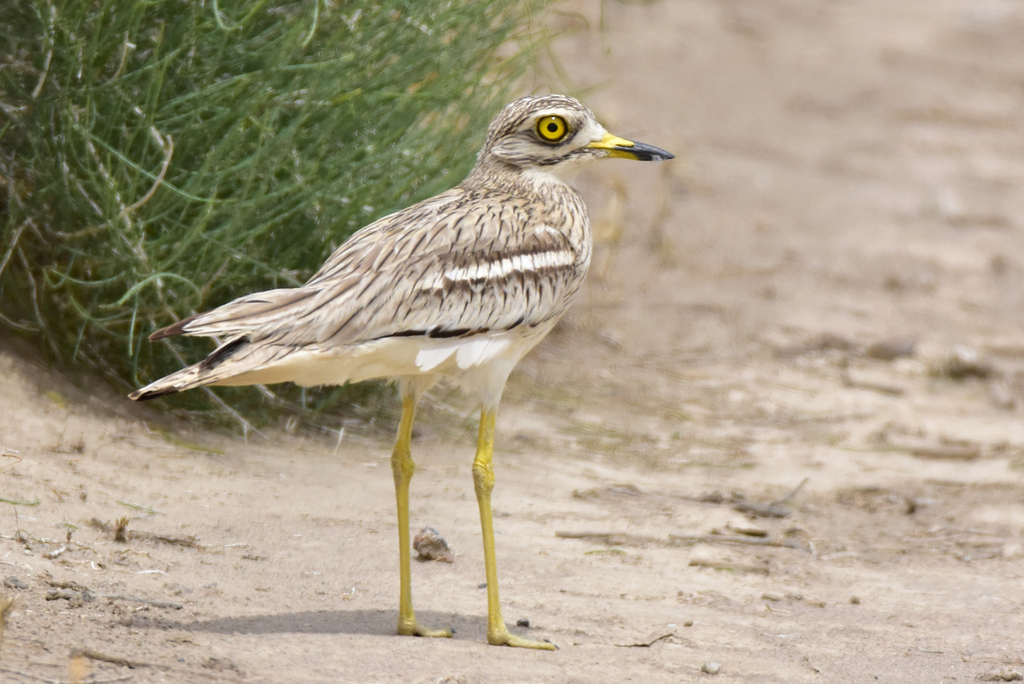
The Eurasian stone-curlew is a fairly large wader, though mid-sized by the standards of its family. Length ranges from 38 to 46 cm (15 to 18 in), wingspan from 76 to 88 cm (30 to 35 in) and weight from 290 to 535 g (10.2 to 18.9 oz). with a strong yellow and black beak, large yellow eyes (which give it a "reptilian", or "goggle-eyed" appearance), and cryptic plumage. The bird is striking in flight, with black and white wing markings.
Range & habitat
The Eurasian stone-curlew occurs throughout Europe, north Africa and southwestern Asia. It is a summer migrant in the more temperate European and Asian parts of its range, wintering in Africa. Despite being classed as a wader, this species prefers dry open habitats with some bare ground.
Wikipedia: “Distribution and habitat”
What it does
The Eurasian stone-curlew is largely nocturnal, particularly when singing its loud wailing songs, which are reminiscent of that of curlews. Food consists of insects and other small invertebrates, and occasionally small reptiles, frogs and rodents.
Breeding. Eurasian stone-curlews probably first breed when they are three years old. The eggs are laid at two day intervals in a scrape on open ground. The clutch normally consists of 2 eggs which are on average 54 mm × 38 mm (2.1 in × 1.5 in). The eggs are pale buff and are variably spotted, streaked or blotched with brown or purple grey. Both sexes incubate the eggs beginning after the last egg is laid. The eggs hatch after 24–26 days. The precocial young leave the nest soon after hatching and are then cared for by both parents for 36–42 days. Normally only a single brood is raised each year but a replacement clutch is laid after the loss of eggs or the loss of small young. The maximum recorded age recorded from ring-recovery data within the British Isles is 22 years and 4 months for a bird ringed as a nestling in Suffolk in 1990 and caught again in Suffolk in 2012.
Wikipedia: “Behaviour and ecology”
Listen
Looking for field recordings…
Where it lives
Recorded sightings
—
geo-referenced records in GBIF, from museums, herbaria and field observers.
Drag the globe to turn it. Dots are where records exist, not a range map; darker means more records.
In the stacks
Searching the stacks…
Every page naming Burhinus oedicnemus in the Biodiversity Heritage Library →
This page is assembled live from iNaturalist, GBIF, Wikipedia, the Source Library and the Internet Archive. It is not yet part of the hand-edited codex. iNaturalist taxon 4923.