- Animals
- ›Arthropods
- ›Hexapods
- ›Insects
- ›Winged and Once-winged Insects
- ›Butterflies and Moths
- ›Curved-horn Moths
- ›Casebearing Moths
- ›Coleophorinae
- ›Coleophora
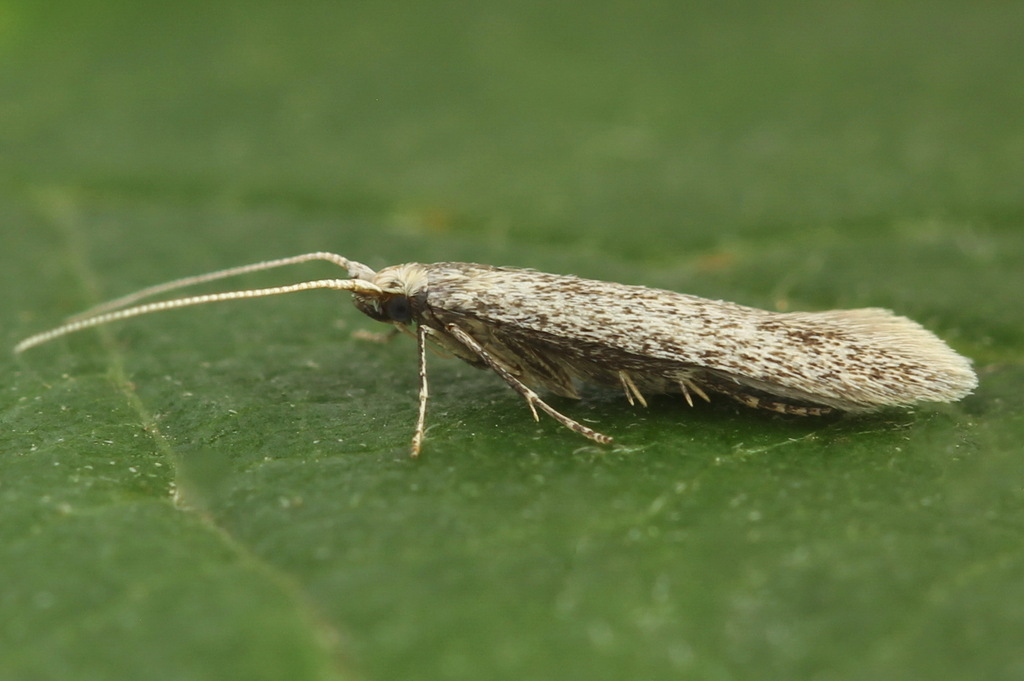
black-stigma case-bearer
Coleophora hemerobiella
The fruit tree case moth (Coleophora hemerobiella) is a moth of the Coleophoridae family. It is found in western Europe, except Ireland and the Iberian Peninsula.
From the article Coleophora hemerobiella on Wikipedia (CC BY-SA), quoted section by section
Description
The wingspan is about 14 mm. Adults have whitish forewings speckled with dark grey and usually an obvious blackish spot at around three-quarters. They are on wing in July in western Europe. The larvae feed on Amelanchier, Chaenomeles, Cotoneaster affinis, Cotoneaster integerrimus, Crataegus laevigata, Cydonia oblonga, Malus domestica, Malus baccata, Malus domestica, Malus floribunda, Malus fusca, Malus asiatica, Malus sylvestris, Mespilus germanica, Prunus avium, Prunus cerasifera, Prunus cerasus, Prunus domestica, Prunus spinosa, Pyrus communis, Sorbus aria, Sorbus aucuparia, Sorbus intermedia, Spiraea japonica and Spiraea × vanhouttei. Full-grown cases can be found from the end of May to early June.
Listen
Looking for field recordings…
Where it lives
Recorded sightings
—
geo-referenced records in GBIF, from museums, herbaria and field observers.
Drag the globe to turn it. Dots are where records exist, not a range map; darker means more records.
In the stacks
Searching the stacks…
Every page naming Coleophora hemerobiella in the Biodiversity Heritage Library →
This page is assembled live from iNaturalist, GBIF, Wikipedia, the Source Library and the Internet Archive. It is not yet part of the hand-edited codex. iNaturalist taxon 492248.