- Plants
- ›Vascular Plants
- ›flowering plants
- ›Dicots
- ›Legumes, Milkworts, and Allies
- ›Legumes
- ›Faboideae
- ›Trifolieae
- ›Medicago
- ›Medicago
- ›Medicago
- ›Medicago sativa
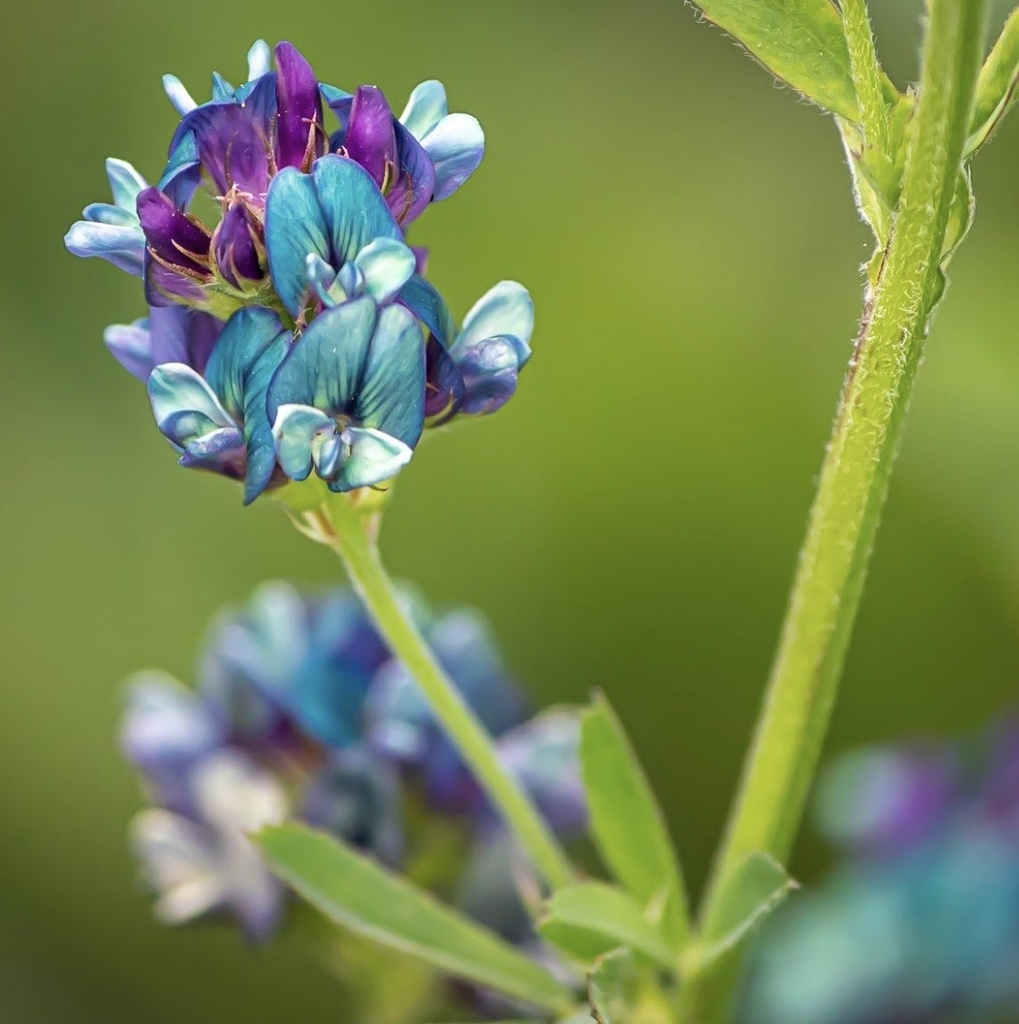
Sand Lucerne
Medicago × varia
Alfalfa (/ælˈfælfə/), also called lucerne and called Medicago sativa in binomial nomenclature, is a perennial flowering plant in the legume family Fabaceae. It is cultivated as an important forage crop in many countries around the world. It is used for grazing, hay, and silage, as well as a green manure and cover crop. The name alfalfa is used in North America. The name lucerne is the more commonly used name in the United Kingdom, South Africa,...
From the article Alfalfa on Wikipedia (CC BY-SA), quoted section by section
Description
Alfalfa is a perennial forage legume which normally lives four to eight years but can live more than 20 years, depending on variety and climate. The plant grows to a height of up to 1 metre (3+1⁄2 feet). Its root system typically grows to a depth of 2–3 m (7–10 ft) depending on subsoil constraints but sometimes grows to a depth of more than 15 m (49 ft) to reach groundwater. The leaves are typically trifoliolate. The plant has clusters of 5–20 florets, which are usually purple but can be blue, yellow, or cream. The small seeds are yellowish. The species has an autotetraploid genome with tetrasomic inheritance.
What it does
Alfalfa is considered an insectary plant and may help other crops such as cotton because it harbours predatory and parasitic insects that would protect the other crop if the two were interplanted. Harvesting the alfalfa by mowing the entire crop area destroys the insect population; this can be avoided by mowing in strips so that part of the growth remains. Alfalfa develops extensive taproots that can extend around 6 feet per year in loose soil. This allows the plant to access soil moisture that is not accessible to plants with shallow root systems, making it more resistant to droughts and soil erosion. This depth of root system, and perenniality of crowns that store carbohydrates as an energy reserve, makes it very resilient. Alfalfa exhibits autotoxicity, which means it is difficult for alfalfa seed to grow in existing stands of alfalfa. Therefore, alfalfa fields are recommended to be rotated with other species (for example, corn or wheat) before reseeding. The exact mechanism of autotoxicity is unclear, with medicarpins and phenols both seeming to play a role. The level of autotoxicity in soil depends on soil type (clay soils maintain autotoxicity for longer), cultivar and age of the previous crop. A soil assay can be used to measure autotoxicity. Resistance to autotoxicity also varies by cultivar, a tolerant one being 'WL 656HQ'.
Pests and diseases. …
Wikipedia: “Ecology”
At the table
Raw alfalfa seed sprouts are 93% water, 2% carbohydrates, 1% fat, and 4% protein. In a reference amount of 100 g (3.5 oz), raw sprouts supply 23 calories and a rich content of vitamin K (25% of the Daily Value, table).
Sprouts. Sprouting alfalfa seeds is the process of germinating seeds at the immature stage for use as a garnish on various food preparations, such as salads. Although sprouts may be grown in soil, they are more commonly germinated in a soilless medium using drums, trays or racks.
Wikipedia: “Nutrition”
Toxicity
Raw alfalfa seeds and sprouts are a source of the amino acid canavanine. Much of the canavanine is converted into other amino acids during germination, so sprouts contain much less canavanine than unsprouted seeds. Canavanine competes with arginine, resulting in the synthesis of dysfunctional proteins. Raw unsprouted alfalfa has toxic effects in primates, including humans, which can result in lupus-like symptoms and other immunological diseases in susceptible individuals. Stopping consumption of alfalfa seeds can reverse the effects.
Wikipedia: “Toxicity of canavanine”
How it is grown
Alfalfa is widely grown throughout the world as forage for cattle. It is most often harvested as hay but can also be made into silage, grazed, or fed as greenchop. Alfalfa usually has the highest feeding value of all common hay crops. It is used less frequently as pasture. When grown on soils where it is well-adapted, alfalfa is often the highest-yielding forage plant, but its primary benefit is the combination of high yield per hectare and high nutritional quality. Its primary use is as feed for high-producing dairy cows because of its high protein content and highly digestible fiber, and secondarily for beef cattle, horses, sheep, and goats. Alfalfa hay is a widely used protein and fiber source for meat rabbits. In poultry diets, dehydrated alfalfa and alfalfa leaf concentrates are used for pigmenting eggs and meat because of their high content in carotenoids, which are efficient for colouring egg yolk and body lipids. Humans also eat alfalfa sprouts in salads and sandwiches. Dehydrated alfalfa leaf is commercially available as a dietary supplement in several forms, such as tablets, powders and tea. Fresh alfalfa can cause bloating in livestock, so care must be taken with livestock grazing on alfalfa. Alfalfa engages in symbiotic nitrogen fixation with nitrogen-fixing bacteria called rhizobia, including Sinorhizobium meliloti. …
Wikipedia: “Modern cultivation”
In human culture
According to Merriam-Webster, English use of alfalfa dates to 1791 and derives from the identical cognate in Spanish, whose origin is al-faṣfaṣa, of an Arabic dialect. Etymology Online suggests that alfalfa derives from the same Spanish cognate (c. 1845), from the Spanish predecessor alfalfez; according to "Iberian sources" the word's root was al-fisfisa, claimed to mean "fresh fodder". Linguist Calvert Watkins suggested that the Arabic word might derive from an Old Iranian compound meaning "horse food". Lucerne, or lucern, as a synonym for alfalfa was borrowed from French, first appearing in written English in 1652. The French word was itself a borrowing from the Occitan luzerno, meaning "glowworm", likely a reference to the bright yellow seeds of some strains of alfalfa.
Wikipedia: “Etymology”
Where it lives
Recorded sightings
—
geo-referenced records in GBIF, from museums, herbaria and field observers.
Drag the globe to turn it. Dots are where records exist, not a range map; darker means more records.
In the stacks
Searching the stacks…
Every page naming Medicago × varia in the Biodiversity Heritage Library →
This page is assembled live from iNaturalist, GBIF, Wikipedia, the Source Library and the Internet Archive. It is not yet part of the hand-edited codex. iNaturalist taxon 491202.