On eBird ↗
Horned Coot
Live sightings near you, the range map, bar charts of when it is seen, and Macaulay Library photos and recordings.
Horned Coot
Fulica cornuta
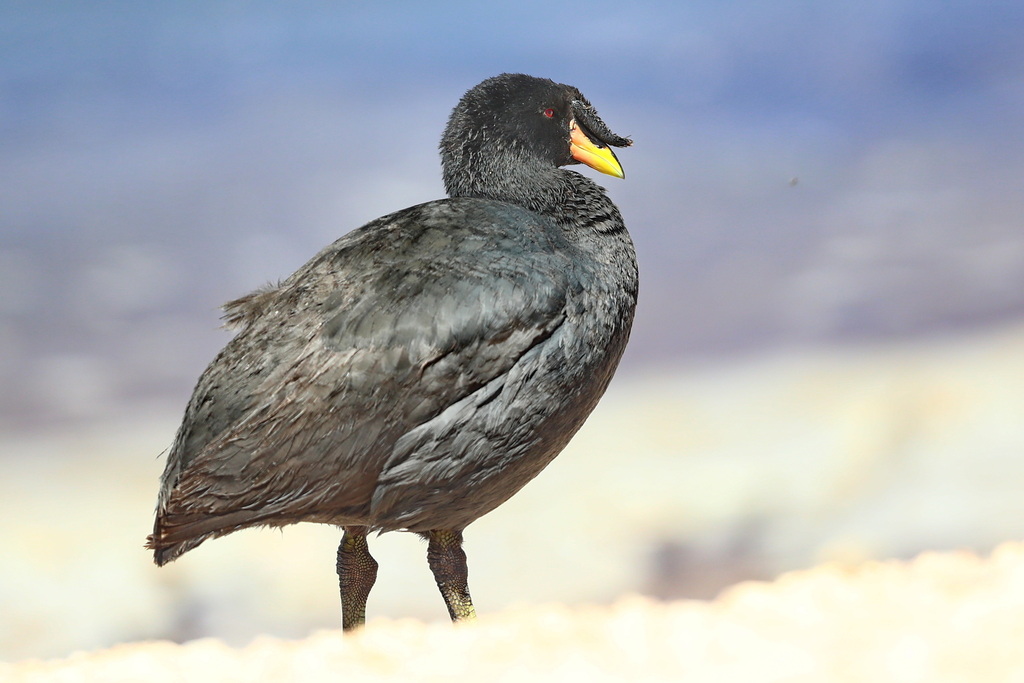
The horned coot (Fulica cornuta) is a species of bird found in the Andes of South America. It was described by Bonaparte in 1853 based on a specimen collected in Bolivia. For a long time it was known only from the type specimen.
From the article Horned coot on Wikipedia (CC BY-SA), quoted section by section
Description
Horned coot males average a little larger than the female. With a total length of 46–62 cm (18–24 in) and a reported body mass from 1.6–2.29 kg (3.5–5.0 lb), it averages slightly smaller than the related giant coot as the second largest coot and the third largest extant species of rail. While most coots have a horny shield on the forehead, the horned coot has three wattles in both sexes. The central wattle is large and may possibly be erectile. The three wattles terminate in tufts of filoplumes. At the base of the beak and below the wattle is a fleshy caruncle which is whitish. The bill is olive yellow, brightening to dull orange towards the base. Unlike the giant coot, the legs of the horned coot are dull greenish.
Range & habitat
The coot occurs in the altiplano of north-western Argentina, south-western Bolivia, and north-eastern Chile. A single vagrant has been recorded in southern Peru. It is almost entirely restricted to lakes at altitudes of 3000–5200 m.a.s.l., but has occasionally been recorded at lower altitudes.
Wikipedia: “Distribution and habitat”
Listen
Looking for field recordings…
Where it lives
Recorded sightings
—
geo-referenced records in GBIF, from museums, herbaria and field observers.
Drag the globe to turn it. Dots are where records exist, not a range map; darker means more records.
In the stacks
Searching the stacks…
Every page naming Fulica cornuta in the Biodiversity Heritage Library →
This page is assembled live from iNaturalist, GBIF, Wikipedia, the Source Library and the Internet Archive. It is not yet part of the hand-edited codex. iNaturalist taxon 490.