- Plants
- ›Vascular Plants
- ›flowering plants
- ›Dicots
- ›Legumes, Milkworts, and Allies
- ›Legumes
- ›Faboideae
- ›brooms, lupines, and allies
- ›Lupinus
- ›Scabrispermae
- ›Lupinus pilosus
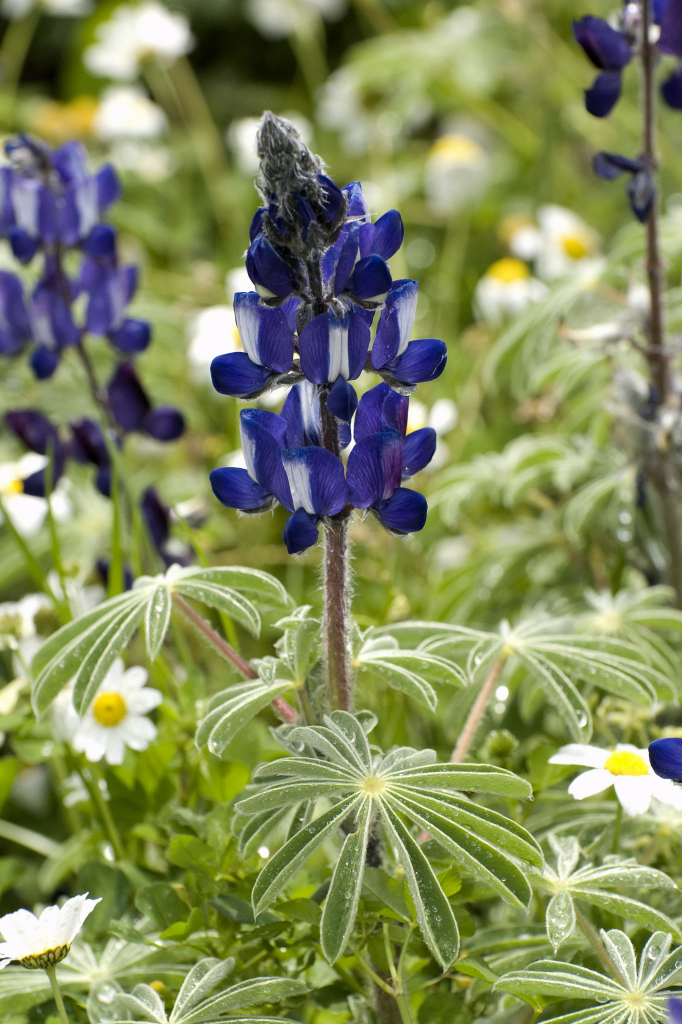
Blue Lupine
Lupinus pilosus
Lupinus pilosus, commonly known as blue lupine, (Hebrew: תורמוס ההרים, Arabic: ترمس برّي) is a species of flowering plant from the order of Lamiales which is endemic to Israel where it is found in Mediterranean scrubland. It has a 30–70 centimetres (12–28 in) long stem and 3–8 centimetres (1.2–3.1 in) long legume. The species blooms from February to May. The species have white coloured flowers which are 1–1.5 centimetres (0.39–0.59 in) long and pods the diameter of which is...
From the article Lupinus pilosus on Wikipedia (CC BY-SA), quoted section by section
Description
The stem is 30–70 centimetres (12–28 in) long. Blooming from February to May, the species has white-coloured flowers which are 1–1.5 cm (3⁄8–5⁄8 in) long and pods 3–8 cm (1–3 in) in diameter. The legume is 3–8 cm long. In Israeli farms, the Lupinus pilosus has blue flowers with a white vertical spot in the middle.
At the table
Around the South Tyrolean village of Altrei (Anterivo), L. pilosus was historically grown. The seeds were roasted and mixed with malt grains and infused in boiling water to produce a coffee-like but caffeine-free hot beverage, Altreier kaffee ("Altrei coffee"). Since 2006, a local initiative has been reestablishing L. pilosus cultivation in the Altrei region to revive this culinary specialty. In the geographical region of Palestine, the plant is numbered among the few wild edible plants, but the seeds still require leaching in boiling water several times (with replacement of the water) for the seeds to become palatable. The seeds are then roasted in a skillet with a dash of water, salted, and eaten. The prepared seeds may be pulverized and mixed with wheat or sorghum flour for bread.
Wikipedia: “Culinary uses”
Where it lives
Recorded sightings
—
geo-referenced records in GBIF, from museums, herbaria and field observers.
Drag the globe to turn it. Dots are where records exist, not a range map; darker means more records.
In the stacks
Searching the stacks…
Every page naming Lupinus pilosus in the Biodiversity Heritage Library →
This page is assembled live from iNaturalist, GBIF, Wikipedia, the Source Library and the Internet Archive. It is not yet part of the hand-edited codex. iNaturalist taxon 489458.