On eBird ↗
Black-bellied Plover
Live sightings near you, the range map, bar charts of when it is seen, and Macaulay Library photos and recordings.
Black-bellied Plover
Pluvialis squatarola
The grey plover (Pluvialis squatarola), known as the black-bellied plover in North America, is a medium-sized plover breeding in Arctic regions. It is a long-distance migrant, with a nearly worldwide coastal distribution when not breeding. The genus name is Latin and means relating to rain, from pluvia, "rain". It was believed that golden plovers flocked when rain was imminent. The species name squatarola is a Latinised version of Sgatarola, a Venetian name for some kind of...
From the article Grey plover on Wikipedia (CC BY-SA), quoted section by section
Description
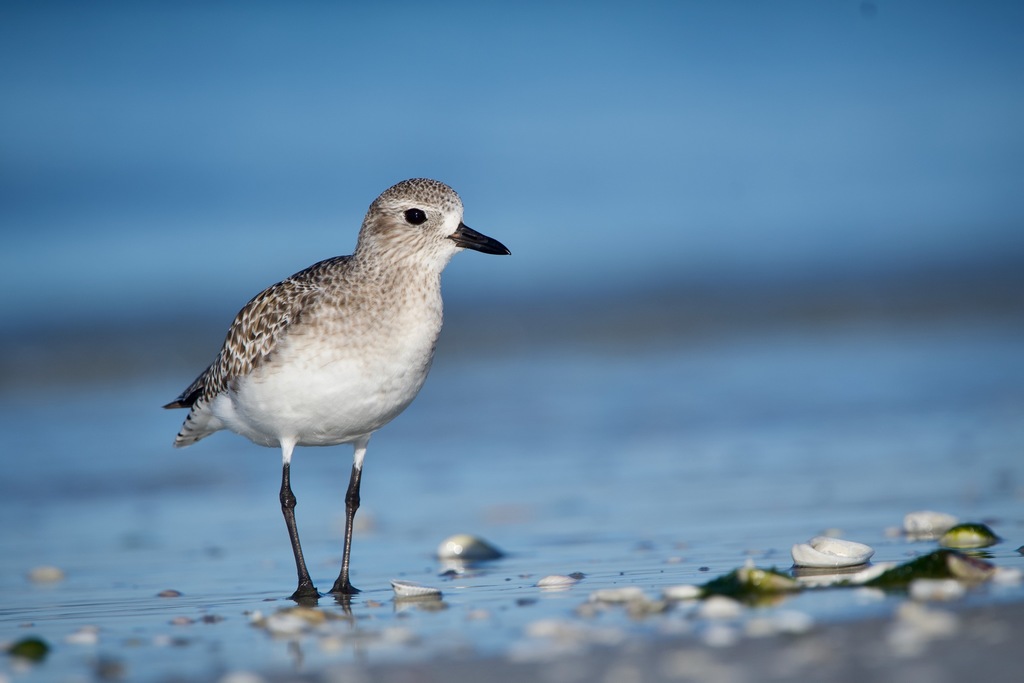
The grey plover is 27–30 cm (11–12 in) long with a wingspan of 71–83 cm (28–33 in) and a weight of 190–280 g (6.7–9.9 oz) (up to 345 g (12.2 oz) in preparation for migration). In spring and summer (late April or May to August), adults are spotted black and white on the back and wings. The face and neck are black with a white border; they have a black breast and belly and a white rump. The tail is white with black barring. The bill and legs are black. They moult to winter plumage in mid August to early September and retain this until April; this being a fairly plain grey above, with a grey-speckled breast and white belly. The juvenile and first-winter plumages, held by young birds from fledging until about one year old, are similar to the adult winter plumage but with the back feathers blacker with creamy white edging. In all plumages, the inner flanks and axillary feathers at the base of the underwing are black, a feature which readily distinguishes it from the other three Pluvialis species in flight. On the ground, it can also be told from the other Pluvialis species by its larger (24–34 mm, 0.94–1.34 in), heavier bill.
What it does
They forage for food on beaches and tidal flats, usually by sight. The food consists of small molluscs, polychaete worms, crustaceans, and insects. It is less gregarious than the other Pluvialis species, not forming dense feeding flocks, instead feeding widely dispersed over beaches, with birds well spaced apart. They will however form dense flocks on high tide roosts.
Wikipedia: “Food and feeding”
Listen
Looking for field recordings…
Where it lives
Recorded sightings
—
geo-referenced records in GBIF, from museums, herbaria and field observers.
Drag the globe to turn it. Dots are where records exist, not a range map; darker means more records.
In the stacks
Searching the stacks…
Every page naming Pluvialis squatarola in the Biodiversity Heritage Library →
This page is assembled live from iNaturalist, GBIF, Wikipedia, the Source Library and the Internet Archive. It is not yet part of the hand-edited codex. iNaturalist taxon 4892.