On eBird ↗
American Avocet
Live sightings near you, the range map, bar charts of when it is seen, and Macaulay Library photos and recordings.
American Avocet
Recurvirostra americana
The American avocet (Recurvirostra americana) is a large wader in the avocet and stilt family, Recurvirostridae, found in North America. It spends much of its time foraging in shallow water or on mud flats, often sweeping its bill from side to side in water as it seeks crustacean and insect prey.
From the article American avocet on Wikipedia (CC BY-SA), quoted section by section
Description
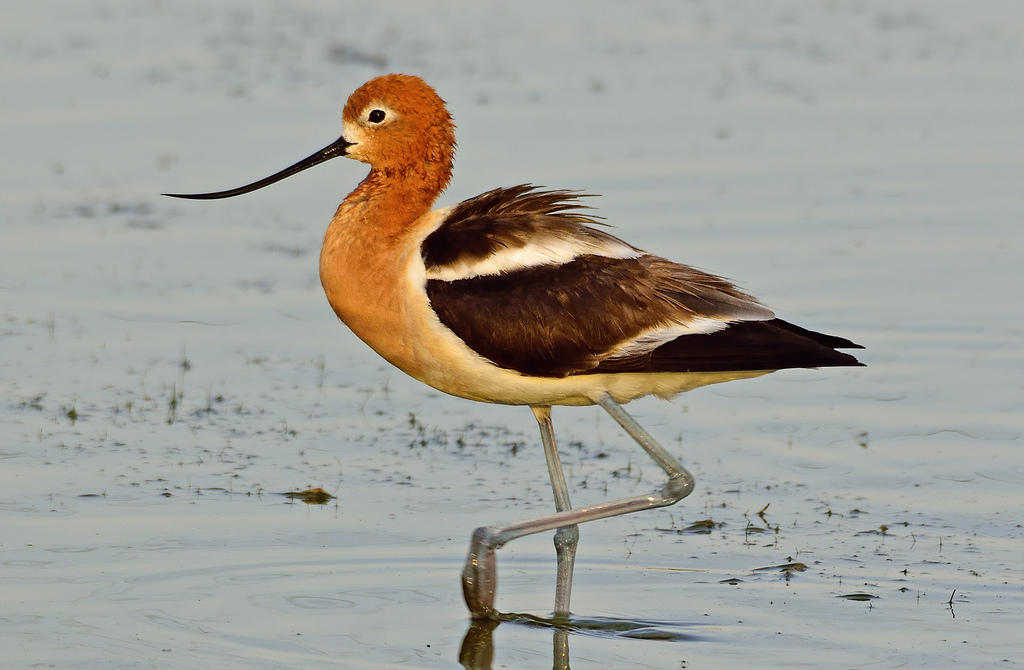
The American avocet measures 40–51 cm (16–20 in) in length, has a wingspan of 68–76 cm (27–30 in) and weighs 275–420 g (9.7–14.8 oz) The bill is black, pointed, and curved slightly upwards towards the tip. It is long, surpassing twice the length of the avocet's small, rounded head. Like many waders, the avocet has long, slender legs and slightly webbed feet. The legs are a pastel grey-blue, giving it its colloquial name, blue shanks. The plumage is black and white on the back, with white on the underbelly. During the breeding season, the plumage is brassy orange on the head and neck, continuing somewhat down to the breast. After the breeding season, these bright feathers are swapped out for white and grey ones. The avocet preens its feathers, commonly considered to be a comfort movement. The call has been described as both a shrill and melodic alarm bweet, which rises in inflection over time. Avocets use three distinct calls: common call, excited call, and broken wing call. The common call is a loud repeated wheep. The excited call has a similar wheep sound, but it speeds up rather than having an even rhythm. Lastly, the broken wing call is noticeably different from the other two calls. It is a distressed screech sound and is alarming rather than melodic.
Range & habitat
American avocets were previously found across most of the United States until extirpated from the East Coast. The breeding habitat consists of marshes, beaches, prairie ponds, and shallow lakes in the mid-west, as far north as southern Canada. These breeding grounds are largely in areas just east of the rocky mountains including parts of Alberta, Saskatchewan, Montana, Idaho, Washington, Utah, North and South Dakota, Nebraska, Colorado, and even down to parts of New Mexico, Oklahoma and Texas. Their migration route lands them in almost every state in the western United States. The avocet's wintering grounds are mainly coastal. Along the Atlantic Ocean, they are found in North and South Carolina, Georgia and Florida. There are also wintering grounds along the Gulf of Mexico in Florida, Texas, and Mexico, and along the Pacific Ocean in California and Mexico. There are resident populations in the Mexican States of Zacatecas, San Luis Potosí, Guanajuato, Hidalgo, Mexico City and Puebla, and in Central California. Flocks ranging from 50 to 300 avocets migrate together to their breeding sites together during peak season, which is typically in the spring, peaking around April or May.
Wikipedia: “Distribution and habitat”
What it does
Each pair defends their own territory against predators and other avocets. Nests are built in areas that predators would struggle to gain access to. Predators that do try to approach the colony find themselves surrounded by several adult avocets. While incubating however, the avocets tend only to their nest and defense is considered a lower priority, unless the eggs are in immediate danger, in which case the avocets may take more aggressive measures, calling loudly and flying at the threat. Most efforts are solely distractionary; these include both aerial and terrestrial tactics in groups. Avocets may pretend to incubate where there is no nest, repeating at various spots in the vicinity. Uniquely, Avocets simulate the Doppler effect with their calls when diving at predators, imitating greater speeds to heighten intimidation.
Wikipedia: “Anti-predator behavior”
At the table
The American avocet tends to prefer habitats with fine sediments for foraging. In the winter, it feeds extensively on brine shrimp. Usually, this entails the avocet pecking while walking or wading on the shore, but it can also swim to expand foraging area. During the breeding season, avocets continue to eat brine shrimp but switch mainly to consuming brine flies. Brine flies and brine fly larvae are so abundant in avocet breeding grounds that they often blacken the surface of any exposed mud. Brine flies sustain the avocet during its breeding season. The avocet employs both visual and tactile methods of feeding. The primary visual feeding method is pecking at flies. However the avocet will also feed by plunging (wherein the head and neck of the bird are submerged), snatching (wherein the bird catches a flying insect), and bill pursuit (wherein the bird repeatedly opens and closes its bill while moving its head along the surface of the water). Methods of tactile feeding include filtering, scraping, and scythe feeding.
Wikipedia: “Food and feeding”
In human culture
In his famous The Birds of America, John James Audubon describes a day of stalking and spying on the avocet. He judiciously noted their foraging, nesting, defensive, and flight behaviors.
Wikipedia: “In culture”
Listen
Looking for field recordings…
Where it lives
Recorded sightings
—
geo-referenced records in GBIF, from museums, herbaria and field observers.
Drag the globe to turn it. Dots are where records exist, not a range map; darker means more records.
In the stacks
Searching the stacks…
Every page naming Recurvirostra americana in the Biodiversity Heritage Library →
This page is assembled live from iNaturalist, GBIF, Wikipedia, the Source Library and the Internet Archive. It is not yet part of the hand-edited codex. iNaturalist taxon 4885.