On eBird ↗
Red-gartered Coot
Live sightings near you, the range map, bar charts of when it is seen, and Macaulay Library photos and recordings.
Red-gartered Coot
Fulica armillata
The red-gartered coot (Fulica armillata) is a species of bird in the family Rallidae. On average, it grows to 45 cm (18 in) in length, which exceeds that of most coots. It is found in Argentina, southern Brazil, Chile, Paraguay and Uruguay, and is a vagrant to Bolivia and the Malvinas Islands. Its natural habitats are swamps and freshwater lakes.
From the article Red-gartered coot on Wikipedia (CC BY-SA), quoted section by section
Description
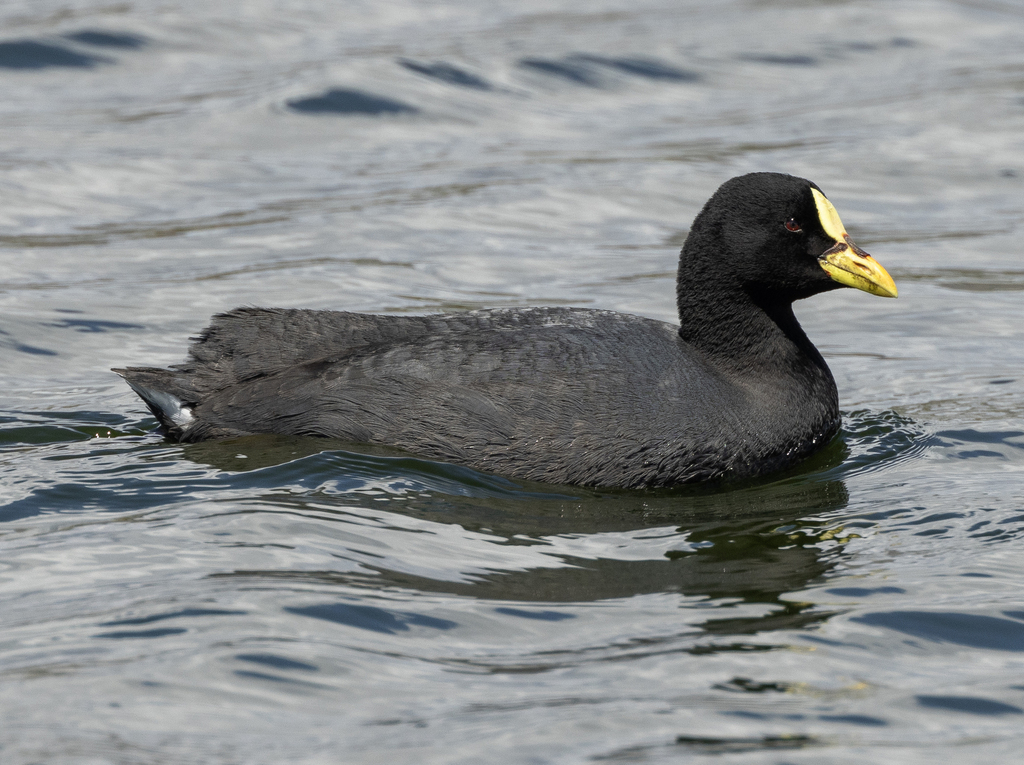
The red-gartered coot is 43 to 51 cm (17 to 20 in) long. The sexes are alike. Adults have a yellow bill and frontal shield with a patch of red between them. (The bill is sometimes reddish.) Their legs are orange-yellow to yellow with a pale red "garter" above the ankle. Their plumage is slaty gray that is blacker on the head and neck. Their undertail coverts are white. Immature birds have a paler bill than adults and olive legs and feet. Juveniles are drab gray-brown with dusky mottling on a white head and neck.
Range & habitat
The red-gartered coot is found from central and southern Chile, Paraguay, and southeastern Brazil south through Argentina to Tierra del Fuego. It has reached the Falkland Islands as a vagrant, and sight records in Bolivia lead the South American Classification Committee of the American Ornithological Society to classify it as hypothetical in that country. Fossils of this species are known from the Laguna de Tagua Tagua formation of Chile. The red-gartered coot inhabits large ponds, lakes, rivers, and marshes, and in winter sheltered marine bays. It is generally a bird of the lowlands but occurs up to about 1,200 m (3,900 ft) in Patagonia, to 1,000 m (3,300 ft) in the southern Andes, and as high as 2,100 m (6,900 ft) in northwestern Argentina.
Wikipedia: “Distribution and habitat”
What it does
The red-gartered coot feeds primarily on aquatic plants, mostly by diving in open water but also upends like a duck in shallower water. It also grazes on land near water.
Wikipedia: “Feeding”
Listen
Looking for field recordings…
Where it lives
Recorded sightings
—
geo-referenced records in GBIF, from museums, herbaria and field observers.
Drag the globe to turn it. Dots are where records exist, not a range map; darker means more records.
In the stacks
Searching the stacks…
Every page naming Fulica armillata in the Biodiversity Heritage Library →
This page is assembled live from iNaturalist, GBIF, Wikipedia, the Source Library and the Internet Archive. It is not yet part of the hand-edited codex. iNaturalist taxon 488.