On eBird ↗
Masked Lapwing
Live sightings near you, the range map, bar charts of when it is seen, and Macaulay Library photos and recordings.
Masked Lapwing
Vanellus miles
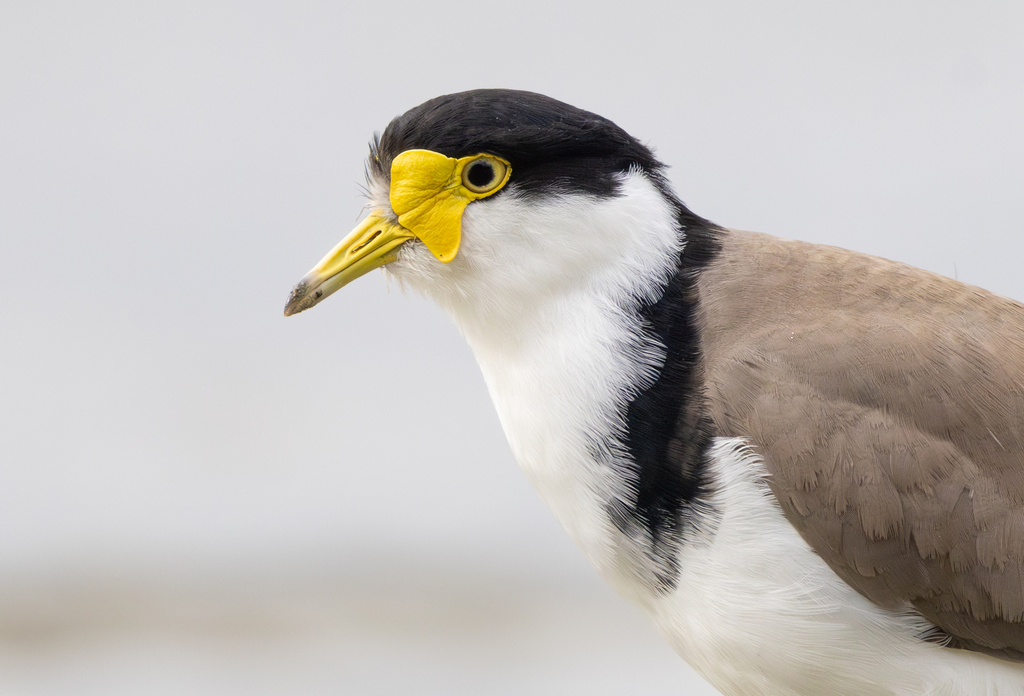
The masked lapwing (Vanellus miles) is a large, common and conspicuous bird native to Australia (particularly the northern and eastern parts of the continent), New Zealand and New Guinea. It spends most of its time on the ground searching for food such as insects and worms and has several distinctive calls. It is common in Australian fields, open land and where there is lots of water, and is known for its defensive swooping behaviour during the nesting season.
Despite the species being also known as the masked plover and often called the spur-winged plover or just plover in its native range, lapwings are classified to their own subfamily, Vanellinae, and not to the closely related plover subfamily, Charadriinae. There are two subspecies, the nominate subspecies and the southern V. m. novaehollandiae. The latter has distinctive black markings on the shoulder and side of the chest, and is sometimes recognised as a separate species, the black-shouldered lapwing (Vanellus novaehollandiae).
From the article Masked lapwing on Wikipedia (CC BY-SA), quoted section by section
Description
The masked lapwing is the largest representative of the family Charadriidae. It measures from 30 to 37 cm (12 to 15 in) in length and has a wingspan of 75–85 cm (30–33 in), and has a conspicuous yellow spur on the carpal joint of each wing. The nominate subspecies (V. m. miles) weighs 191–300 g (6.7–10.6 oz), while the southern race (V. m. novaehollandiae) is larger and weighs 296–412 g (10.4–14.5 oz). The subspecies from northern Australia and New Guinea (V. m. miles) has an all-white neck and large yellow wattles, with the male having a distinctive mask and larger wattles. The subspecies found in the southern and eastern states of Australia and in New Zealand (V. m. novaehollandiae), and often locally called the spur-winged plover, has a black neck-stripe and smaller wattles. (Note that the northern-hemisphere spur-winged plover is a different bird.) The birds have a wide range of calls which can be heard at any time of the day or night: the warning call, a loud defending call, courtship calls, calls to its young, and others. Since the bird lives on the ground, it is always alert and, even though it rests, it never sleeps properly.
Range & habitat
Masked lapwings are most common around the edges of wetlands and in other moist, open environments, but are adaptable and can often be found in surprisingly arid areas. They can also be found on beaches and coastlines. Vanellus miles novaehollandiae spread naturally to Southland, New Zealand, in the 1930s and has now spread throughout New Zealand, where it is recognised as a self-introduced native and known as the spur-winged plover.
Wikipedia: “Distribution and habitat”
What it does
Masked lapwings are shy and harmless in summer and autumn but are best known for their bold nesting habits, being quite prepared to make a nest on almost any stretch of open ground, including suburban parks and gardens, school ovals, and even supermarket carparks and flat rooftops. They can be particularly dangerous at airports where their reluctance to move from their nesting area, even for large aircraft, has resulted in several bird strikes. Breeding usually happens after winter solstice (June 21), but sometimes before. The nesting pair defends their territory against all intruders by calling loudly, spreading their wings, and then swooping fast and low, striking at interlopers, if necessary, with their feet, and attacking animals on the ground with the conspicuous yellow spur on the carpal joint of the wing. The bird may also use diversion tactics against potential predators, such as fiercely protecting a non-existent nest, or a distraction display of hopping on a single leg, to attract attention to itself and away from its real nest, or from its chicks after they have commenced foraging. There is a widely-believed myth that the spur can inject venom, however this is false. The myth may have been based on fear of the masked lapwing's territorial behaviour. …
Wikipedia: “Behaviour”
Listen
Looking for field recordings…
Where it lives
Recorded sightings
—
geo-referenced records in GBIF, from museums, herbaria and field observers.
Drag the globe to turn it. Dots are where records exist, not a range map; darker means more records.
In the stacks
Searching the stacks…
Every page naming Vanellus miles in the Biodiversity Heritage Library →
This page is assembled live from iNaturalist, GBIF, Wikipedia, the Source Library and the Internet Archive. It is not yet part of the hand-edited codex. iNaturalist taxon 4872.