On eBird ↗
Long-toed Lapwing
Live sightings near you, the range map, bar charts of when it is seen, and Macaulay Library photos and recordings.
Long-toed Lapwing
Vanellus crassirostris
The long-toed lapwing (Vanellus crassirostris), also known as the long-toed plover, is a species of wading bird in the lapwing subfamily, within the family Charadriidae. It is mainly sedentary and found across central and eastern Africa, from Chad and South Sudan in the north to Mozambique in the southeast of its range. It is one of 13 species of ground-nesting lapwings found in Africa.
From the article Long-toed lapwing on Wikipedia (CC BY-SA), quoted section by section
Description
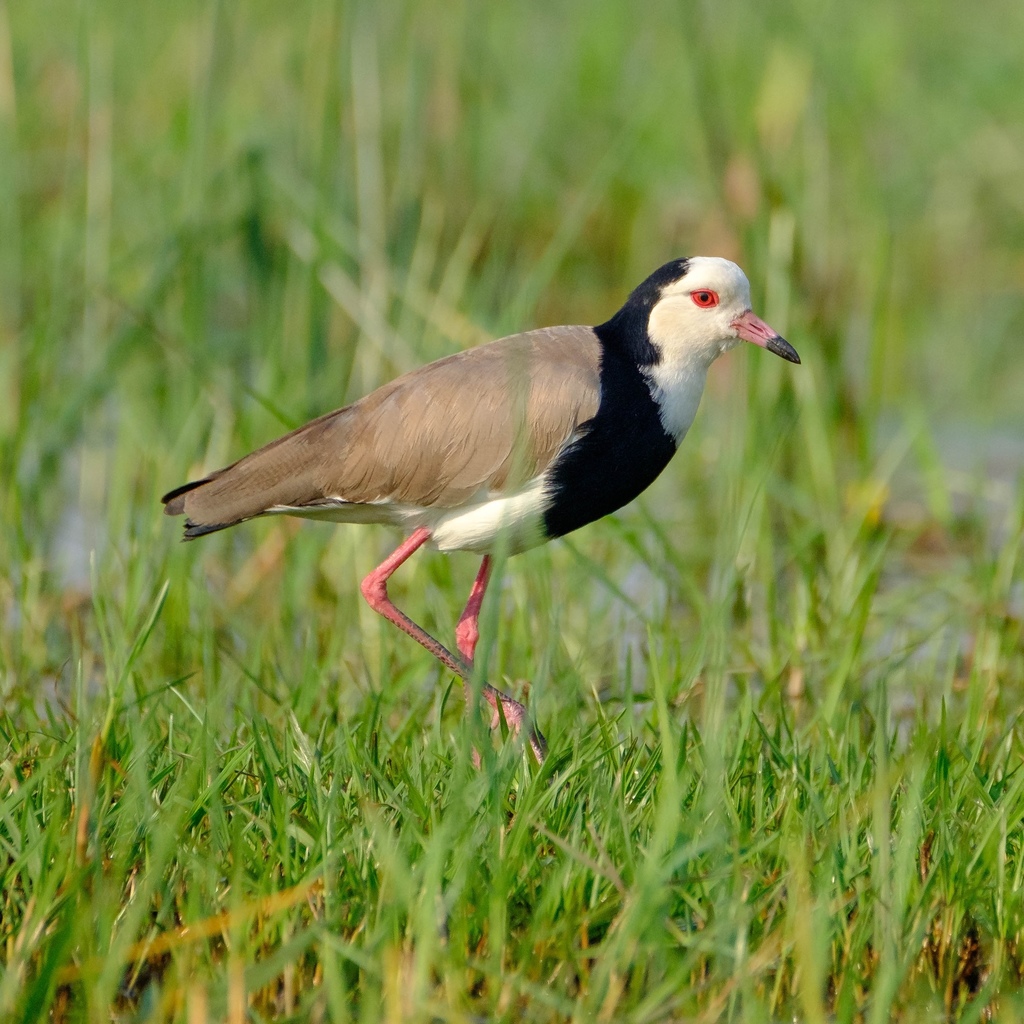
The long-toed lapwing measures 31 cm (12 in) in length with a body mass of 162–225 g (5.7–7.9 oz). It is a brown, black, and white lapwing with long red legs, long toes, and a red bill with a black tip. It has short wing spurs and rounded wings; in flight it shows extensive white in the wing feathers, as well as legs and feet extending beyond the end of the tail. It is sexually monomorphic and has no seasonal variation in plumage. Juveniles have a browner breast than adults and buff tips to feathers. Juvenile primary feathers are retained after the post-juvenile moult.
Similar species. White-crowned lapwing is the only other lapwing with extensive white plumage in the wings, showing white on the primary and secondary flight feathers, but this pattern is distinct from long-toed lapwing which has black colouration on the primary flight feathers (and for V. c. crassirostris, black on the secondary feathers as well).
Range & habitat
The long-toed lapwing is found across central and eastern Africa, from South Sudan in the north to Botswana, Mozambique, and northeast South Africa in the south of its range, as well as outlying populations in Chad and western Angola. The long-toed lapwing prefers habitats of lakes, pools, marshes, floodplains, and swamps. It finds its food of aquatic invertebrates on floating vegetation. It uses pool edges in the dry season, and in the wet season can often be found in flooded rice fields and wet grasslands. Birds are sedentary as long as water remains. Nesting and foraging areas are generally the same. It has been recorded up to an elevation of 1,300 m (4,300 ft) in Zambia. The long-toed lapwing has similar habitat preferences to the African Jacana, both using floating weeds and fringing vegetation around water. This direct association often leads lapwings to show aggressive behaviour towards jacanas, primarily as swooping attacks towards a jacana without making direct contact; one study found jacanas were attacked by adult lapwings once every 12 minutes.
Wikipedia: “Distribution and habitat”
What it does
The long-toed lapwing is unusual among lapwings as it feeds with behaviour like jacanas, foraging for aquatic insects, larvae, beetles, ants, dragonfly nymphs, and snails on the surface of floating aquatic vegetation, spreading out its weight through the support of its long toes. There has been documentation of some individuals using one foot to stir water, likely to bring prey to the water's surface, similar to the behaviour of blacksmith lapwing and spur-winged lapwing. It regularly forages alone; however, in the dry season birds may gather in family groups or larger groups of 10 to 20, with one record of a group of approximately 80 reported from Malawi. Foraging lapwings may follow spur-winged geese as the geese uproot dead vegetation and disturb aquatic invertebrates. Long-toed lapwings also attack non-predator bird species in their territories, such as African jacana, blacksmith lapwing, and squacco heron, all with which the lapwings share foraging habitat.
Wikipedia: “Diet and foraging”
Listen
Looking for field recordings…
Where it lives
Recorded sightings
—
geo-referenced records in GBIF, from museums, herbaria and field observers.
Drag the globe to turn it. Dots are where records exist, not a range map; darker means more records.
In the stacks
Searching the stacks…
Every page naming Vanellus crassirostris in the Biodiversity Heritage Library →
This page is assembled live from iNaturalist, GBIF, Wikipedia, the Source Library and the Internet Archive. It is not yet part of the hand-edited codex. iNaturalist taxon 4862.