- Animals
- ›Arthropods
- ›Hexapods
- ›Insects
- ›Winged and Once-winged Insects
- ›Butterflies and Moths
- ›Plume Moths and Allies
- ›Plume Moths
- ›Pterophorinae
- ›Oxyptilini
- ›Capperia
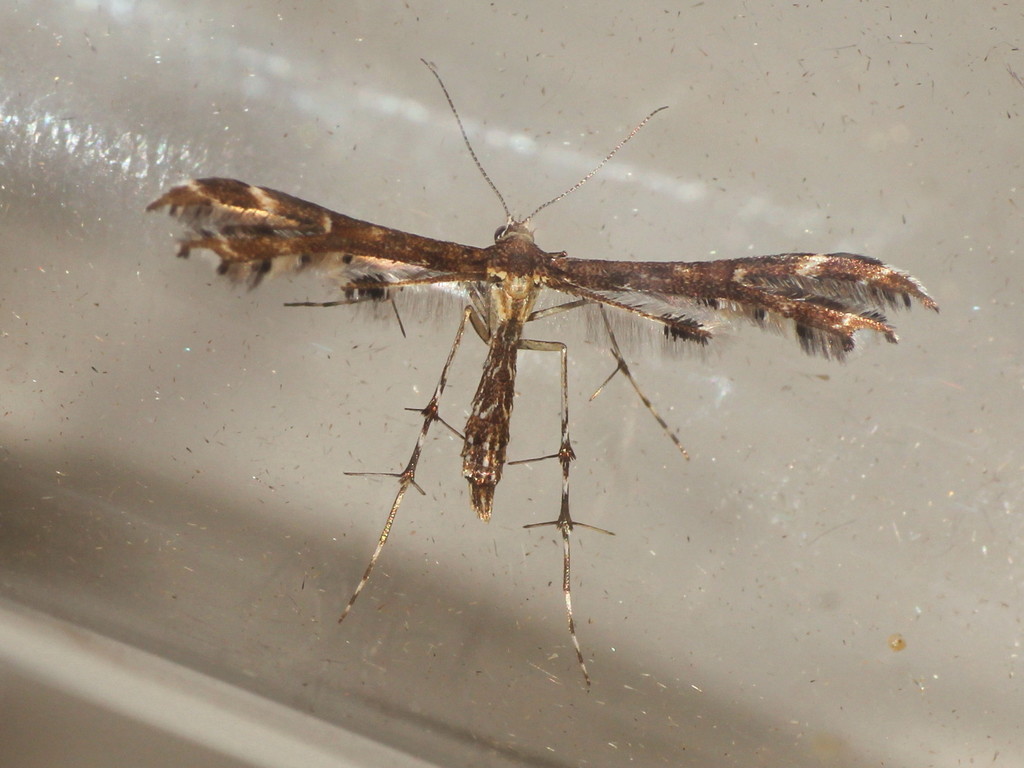
Wood Sage Plume Moth
Capperia britanniodactylus
Capperia britanniodactylus is a moth of the family Pterophoridae. It is found in western Europe, from Ireland and Spain to Norway, Germany and Italy. It has also been recorded from Romania and Bulgaria.
From the article Capperia britanniodactylus on Wikipedia (CC BY-SA), quoted section by section
Description
The wingspan is 18–21 mm. Adults are on wing from May to August. The forewings are dark reddish-fuscous, with a few white scales and indistinct whitish spots at 1/3 of disc and at the base of the first segment. There are two well-marked white bars on the segments. The cilia are mixed with black scales, banded with whitish. The hindwings are dark fuscous, the third segment with two subapical black scale-teeth in the upper cilia and suboblong subapical and small apical scale-teeth in the dorsal cilia, separated by whitish spots. The larva is pale greyish-green with darker green dorsal and subdorsal lines and brown spots and numerous whitish hairs.
The larvae feed on the stem of wood sage (Teucrium scorodonia), just below some leaves which soon wither. The larvae then continue living underneath the withered leaves with pupation taking place on the stem under the withered part, or under a leaf, or on adjacent foliage.
Range & habitat
The wood sage plume is found in western Europe, from Ireland and Spain to Norway, Germany and Italy. It has also been recorded from Romania and Bulgaria.
Wikipedia: “Distribution”
Listen
Looking for field recordings…
Where it lives
Recorded sightings
—
geo-referenced records in GBIF, from museums, herbaria and field observers.
Drag the globe to turn it. Dots are where records exist, not a range map; darker means more records.
In the stacks
Searching the stacks…
Every page naming Capperia britanniodactylus in the Biodiversity Heritage Library →
This page is assembled live from iNaturalist, GBIF, Wikipedia, the Source Library and the Internet Archive. It is not yet part of the hand-edited codex. iNaturalist taxon 483679.