- Animals
- ›Arthropods
- ›Hexapods
- ›Insects
- ›Winged and Once-winged Insects
- ›Butterflies and Moths
- ›Owlet Moths and Allies
- ›Cutworm Moths and Allies
- ›Cutworms and Dart Moths
- ›Xylenini
- ›Xylenina
- ›Lithophane
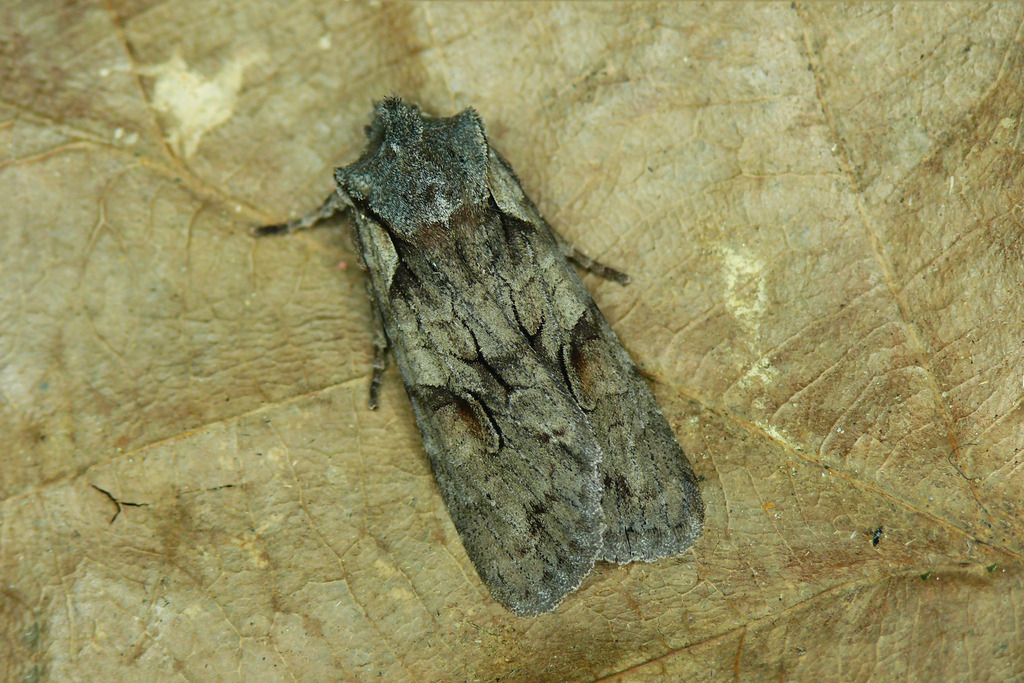
Conformist
Lithophane furcifera
Lithophane furcifera, the conformist, is a moth of the family Noctuidae. The species was first described by Johann Siegfried Hufnagel in 1766. It is found from central Europe, east to the Black Sea region, the Caucasus and western Siberia. In the mountains, it is found up to elevations of 1,800 meters.
From the article Lithophane furcifera on Wikipedia (CC BY-SA), quoted section by section
Description
L. furcifera Hubn. (= bifurca Esp., conformis Hbn.) (30 i). Forewing purplish grey irrorated with olive; a thick black streak from base below cell, upcurved and forked, edged above by a white line; another from claviform to outer line; lines black, edged with pale grey, fairly distinct; claviform and orbicular pale blue grey edged with black; reniform inwardly bearing a fulvous crescent, its lower edge curved and black; a dark median shade and a narrow one before submarginal line; hindwing brownish fuscous, darker towards termen, sometimes showing a large cellspot and dark outer line; ab. rufescens Spul. has the forewing more or less flushed with reddish; nearly all of these, however, seem to be females, while the males remain dark purple grey without the red tinge; — ab. suffusa Tutt from the West of England is violet black; ab. variegata Spuler corresponding to the zinckenii form of lamda is much more variegated, the dark markings being relieved by silvery grey. — Larva red brown or earth brown marbled with black dots and streaks; the lines pale yellow; a dorsal series of diamond shaped marks and subdorsal series of oblique black streaks; another form of the larva is said to be green marked with yellow. The wingspan is 42–48 mm.
Wikipedia: “Description in Seitz”
Listen
Looking for field recordings…
Where it lives
Recorded sightings
—
geo-referenced records in GBIF, from museums, herbaria and field observers.
Drag the globe to turn it. Dots are where records exist, not a range map; darker means more records.
In the stacks
Searching the stacks…
Every page naming Lithophane furcifera in the Biodiversity Heritage Library →
This page is assembled live from iNaturalist, GBIF, Wikipedia, the Source Library and the Internet Archive. It is not yet part of the hand-edited codex. iNaturalist taxon 483466.