 NL·0771
Herbarium of the Nature Library
- Name
- Aurelia aurita
- Family
- Ulmaridae
- Native to
- North-east Atlantic and adjacent seas; very similar moon jellies worldwide are now recognised as separate, cryptic Aurelia species
- Habitat
- Coastal waters, Harbours, Estuaries
Moon jellyfish
Aurelia aurita
Also calledOhrenqualle (German) · Méduse aurélie (French) · Medusa luna (Spanish) · Mizukurage (Japanese)
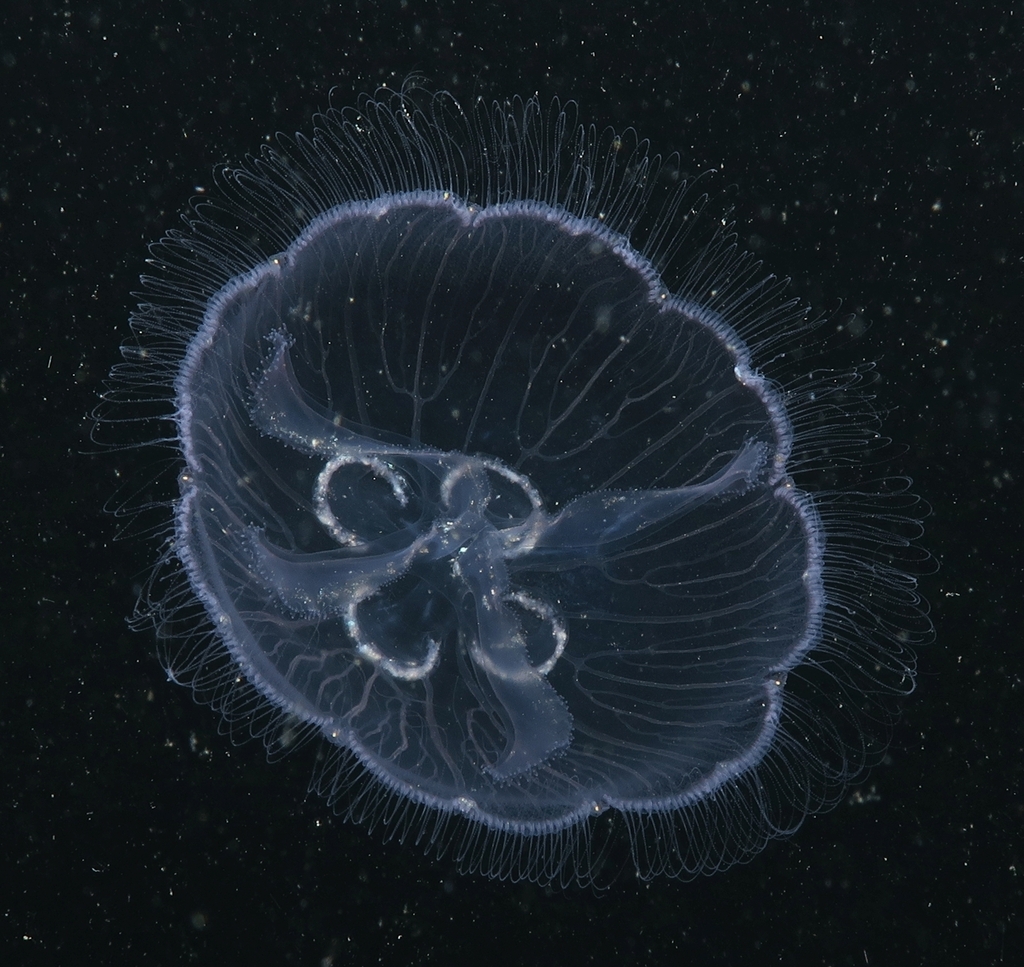
A translucent, saucer-shaped jellyfish marked with four pale rings, the most familiar jellyfish of European coasts and public aquariums. Its life cycle alternates between a tiny polyp on the sea floor and the drifting medusa.
Aurelia aurita is a species of true jellyfish in the family Ulmaridae and the type species of its genus, Aurelia. Before the 2020s, the species was considered cosmopolitan, but the taxon has since been split into at least 28 species. The species now identified as A. aurita is only found in the north Atlantic and in Argentina and is not dangerous to humans. Wikipedia
What it can do
- iPolyps bud off stacks of baby jellyfish (strobilation) when water temperature changes
- iiBlooms can contain millions of individuals and block power-station cooling intakes
- iiiMild sting from short marginal tentacles
In the field
Field marks
- aClear, flat, saucer-shaped bell
- bFour horseshoe-shaped rings (gonads), pale violet, pink or white
- cShort fringe of fine tentacles around the edge
- dFour frilly oral arms under the bell
- Not to be confused with
- Compass jellyfish (Chrysaora hysoscella) has brown V-shaped markings radiating from the centre. Lion's mane (Cyanea capillata) is reddish-brown with a mass of long tentacles. Blue jellyfish (Cyanea lamarckii) is bluish with long tentacles.
- Where to see it
- Harbours and bays around Britain, the North Sea and the Baltic in summer; public aquariums worldwide.
- When
- Medusae mainly May–Sep in European waters
Life & habits
- Diet
- Plankton, fish eggs and larvae, caught in mucus on the bell and wiped to the mouth by oral arms
- Habitat
- Coastal waters, bays and harbours, often in sheltered, nutrient-rich water
- Size
- Bell usually 25–40 cm across
- Lifespan
- Medusae usually a few months to a year; polyps can persist for years
Medusae drift and gently pulse near the surface; polyps attach to hard surfaces underneath piers and boats.
Where it lives
Recorded sightings
—
geo-referenced records in GBIF, from museums, herbaria and field observers.
Native range
North-east Atlantic and adjacent seas; very similar moon jellies worldwide are now recognised as separate, cryptic Aurelia species
Drag the globe to turn it. Dots are where records exist, not a range map; darker means more records.
In the old herbals & bestiaries
Woodcuts and engravings matched from the Source Library’s scanned books by name. Plates marked “relative” show a close kin rather than this exact species. Click a plate to read the page it came from, with translation.

Vlyssis Aldrovandi Philosophi Ac Medici Bononiensis Historiam Naturalem in Gymnasio ibidem olim profitentis De Reliquis Animalibus exanguibus, utpote De Mollibus, De Crustaceis, De Testaceis & De Zoophytis Libri Quatuor Post mortem eius editi
Aldrovandi, Ulisse · 1623 · p.195

Books on Marine Fishes
Guillaume Rondelet · 1554 · p.551

Books on Marine Fishes
Guillaume Rondelet · 1554 · p.552

History of Animals, Book II: On Oviparous Quadrupeds
Conrad Gessner · 1586 · p.566
In the stacks
Searching the stacks…
Every page naming Aurelia aurita in the Biodiversity Heritage Library →
Marginalia
Moon jellyfish polyps were flown into orbit aboard Space Shuttle Columbia in 1991 to study how gravity-sensing organs develop in microgravity.
Curiosity
Jellyfish raised in space had trouble swimming normally once back on Earth, apparently because their gravity sensors developed differently.
Kinship


Photographs: iNaturalist contributors under the licences shown. Records: GBIF.org. Historical plates: Source Library (CC BY-SA 4.0; originals public domain). Summary text: Nature Library editors and Wikipedia (CC BY-SA). Medicinal and edibility notes are historical and educational, not advice. iNaturalist taxon 48328.