- Plants
- ›Vascular Plants
- ›conifers
- ›conifers
- ›pine family
- ›pines, spruces, larches, and allies
- ›Pseudotsuga
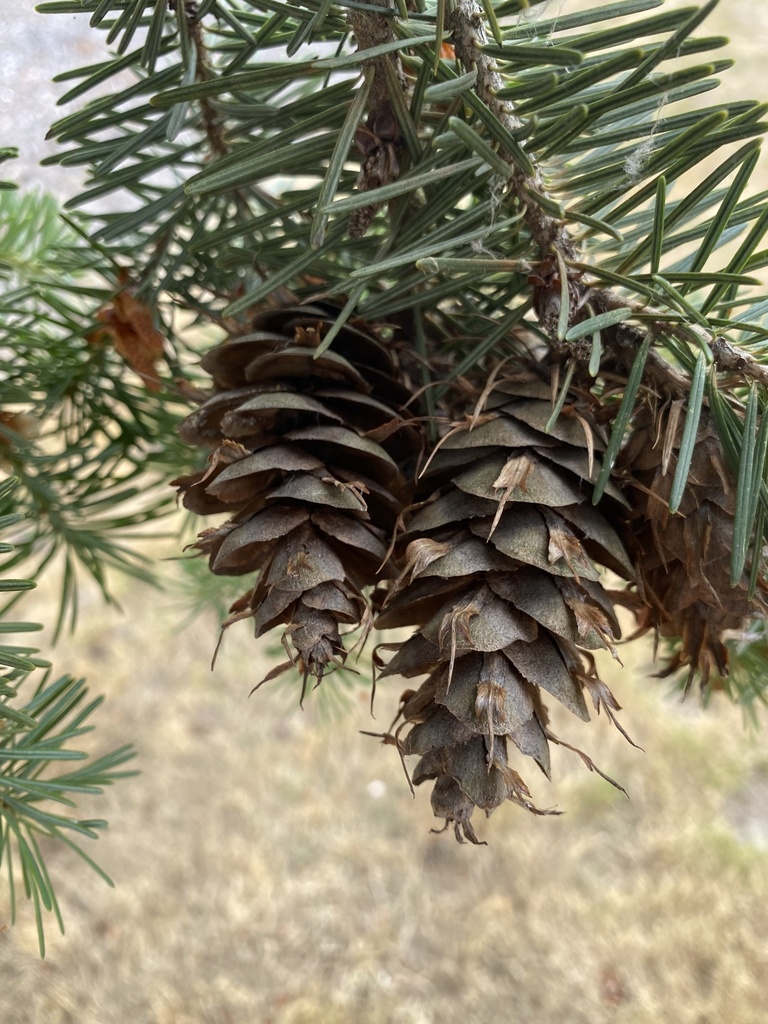
Douglas-fir
Pseudotsuga menziesii
The Douglas fir (Pseudotsuga menziesii) is a conifer species in the pine family, Pinaceae. It is the tallest tree in the family. It is native to western North America and is also known as Douglas-fir, Douglas spruce, Oregon pine, and Columbian pine. There are three varieties: coast Douglas-fir (P. menziesii var. menziesii), Rocky Mountain Douglas-fir (P. menziesii var. glauca) and Mexican Douglas-fir (P. menziesii var. lindleyana).
Despite its common names, it is not a true fir (genus Abies), spruce (genus Picea), or pine (genus Pinus). It is also not a hemlock (genus Tsuga); the genus name Pseudotsuga means "false hemlock".
From the article Douglas fir on Wikipedia (CC BY-SA), quoted section by section
Description
Douglas-firs are medium-sized to extremely large trees, 20–100 metres (70–330 feet) tall (although only coast Douglas-firs reach heights near 100 m) and commonly reach 2.4 m (8 ft) in diameter, although trees with diameters of almost 5 m (16 ft) exist. The largest coast Douglas-firs regularly live over 500 years, with the oldest specimens living for over 1,300 years. Rocky Mountain Douglas-firs, found further to the east, are less long-lived, usually not exceeding 400 years in age. There are records of former coast Douglas-firs exceeding 120 m (390 ft) in height, which if alive today would make it the tallest tree species on Earth. Particular historical specimens with heights exceeding 120 m (400 ft) include the Lynn Valley Tree and the Nooksack Giant. The leaves are flat, soft, linear needles 1.5–4 cm (1⁄2–1+1⁄2 in) long, generally resembling those of the firs, occurring singly rather than in fascicles; they completely encircle the branches, which can be useful in recognizing the species. As the trees grow taller in denser forest, they lose their lower branches, such that the foliage may start as high as 34 m (110 ft) off the ground. Douglas-firs in environments with more light may have branches much closer to the ground. The bark on young trees is thin, smooth, and gray, and contains numerous resin blisters. …
Range & habitat
Pseudotsuga menziesii var. menziesii, the coast Douglas-fir, grows in the coastal regions from west-central British Columbia southward to Central California. In Oregon and Washington, its range is continuous from the eastern edge of the Cascades west to the Pacific Coast Ranges and Pacific Ocean. In California, it is found in the Klamath and California Coast Ranges as far south as the Santa Lucia Range, with a small stand as far south as the Purisima Hills in Santa Barbara County. One of the last remaining old growth stands of conifers is in the Mattole Watershed, and is under threat of logging. In the Sierra Nevada, it ranges as far south as the Yosemite region. It occurs from sea level along the coast to elevations of 1,500 m (4,900 ft) or higher, and inland in some cases up to 2,100 m (6,900 ft). Another variety exists further inland, Pseudotsuga menziesii var. glauca, the Rocky Mountain Douglas-fir or interior Douglas-fir. Interior Douglas-fir intergrades with coast Douglas-fir in the Cascades of northern Washington and southern British Columbia, and from there ranges northward to central British Columbia and southeastward to the Mexican border, becoming increasingly disjunct as latitude decreases and altitude increases. Mexican Douglas-fir (P. lindleyana), which ranges as far south as Oaxaca, is often considered a variety of P. …
Wikipedia: “Distribution”
At the table
Many different Native American groups use the bark, resin, and needles to make herbal treatments for various diseases. Historically, Native Hawaiians built waʻa kaulua (double-hulled canoes) from coast Douglas-fir logs that had drifted ashore. The wood and bark have historically been favored as firewood, especially from the coastal variety. Additionally, Douglas-fir has long been used as a building material by both Native American groups and settlers. The species is extensively used in forestry management as a plantation tree for softwood timber. Douglas-fir is one of the world's best timber-producing species and yields more timber than any other species in North America, making the forestlands of western Oregon, Washington, and British Columbia the most productive on the continent. In 2011, Douglas-fir represented 34.2% of US lumber exports, to a total of 1.053 billion board feet (2,484,803,3 cubic meters). Douglas-fir timber is used for timber frame construction and timber trusses using traditional joinery, veneer, and flooring due to its strength, hardness and durability. As of 2024, the only wooden ships still currently in use by the U.S. …
Wikipedia: “Uses”
Where it lives
Recorded sightings
—
geo-referenced records in GBIF, from museums, herbaria and field observers.
Drag the globe to turn it. Dots are where records exist, not a range map; darker means more records.
In the stacks
Searching the stacks…
Every page naming Pseudotsuga menziesii in the Biodiversity Heritage Library →
This page is assembled live from iNaturalist, GBIF, Wikipedia, the Source Library and the Internet Archive. It is not yet part of the hand-edited codex. iNaturalist taxon 48256.