On eBird ↗
Mongolian Gull
Live sightings near you, the range map, bar charts of when it is seen, and Macaulay Library photos and recordings.
Mongolian Gull
Larus mongolicus
The Vega gull, East Siberian gull, or East Siberian herring gull (Larus vegae) is a large gull of the herring gull/lesser black-backed gull complex which breeds in North-east Asia. Its classification is still controversial and uncertain. It is variously treated as a separate species, as a subspecies of American herring gull (L. smithsonianus) or included with both the American herring gull and European herring gull in L. argentatus. The Mongolian gull, Larus mongolicus, has previously been...
From the article Mongolian gull on Wikipedia (CC BY-SA), quoted section by section
Description
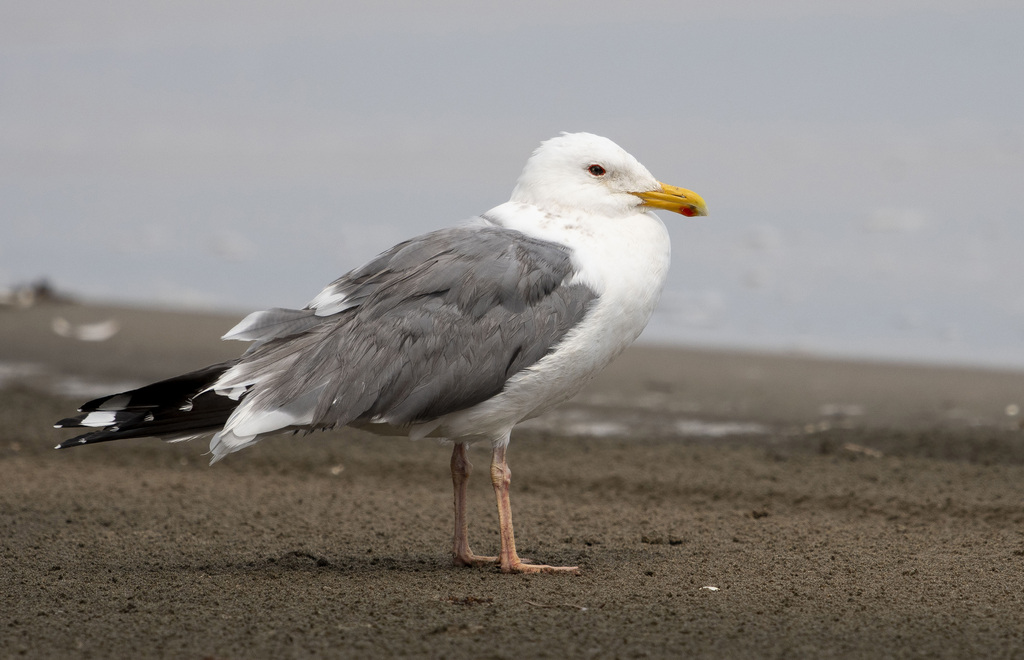
Mongolian gull is closely similar to its relatives Caspian gull and Vega gull, and also to the European herring gull (Larus argentatus), with identification needing careful examination of the wing pattern and moult, and in young birds, the wing and tail patterns. In weight, at 1.15–1.58 kg for males and 0.85–1.1 kg for females, it is somewhat heavier than Caspian gull but about the same as Vega gull and the nominate subspecies of European herring gull. The mantle and wings are mid grey with black primary tips, distinctly darker grey than European herring gull and slightly darker than Caspian gull, but about the same as Vega gull. There is some variation within the species, with darker grey towards the west of the range in NW Mongolia, and paler in birds from Lake Baikal; these last can be almost as pale as European herring gull of the subspecies L. a. argenteus. The legs are pink in most individuals, but in some, tinged yellow to even bright yellow; the eyes are dull yellowish, sometimes brownish; the bill is stout, as in European herring gull and Vega gull, stouter than in Caspian gull.
Range & habitat
The Mongolian gull breeds primarily on large inland lakes, either fresh or saline, from the Altai Republic to Lake Baikal in central southern Russia, in northern Mongolia, and at Lake Khanka in northeast China; there is also a small population breeding on islands in the Yellow Sea west of South Korea, within the normal wintering area. In winter it migrates southeast to the coasts of Japan, the Korean Peninsula, eastern and southern China, Taiwan, and northern Vietnam. Reports from the Indian Ocean are considered unlikely, with sightings claimed from India, Pakistan and the Persian Gulf being unreliable; there are no ringing recoveries from that region, only from the Pacific coasts of Asia.
== References ==
Wikipedia: “Distribution and habitat”
Listen
Looking for field recordings…
Where it lives
Recorded sightings
—
geo-referenced records in GBIF, from museums, herbaria and field observers.
Drag the globe to turn it. Dots are where records exist, not a range map; darker means more records.
In the stacks
Searching the stacks…
Every page naming Larus mongolicus in the Biodiversity Heritage Library →
This page is assembled live from iNaturalist, GBIF, Wikipedia, the Source Library and the Internet Archive. It is not yet part of the hand-edited codex. iNaturalist taxon 480198.